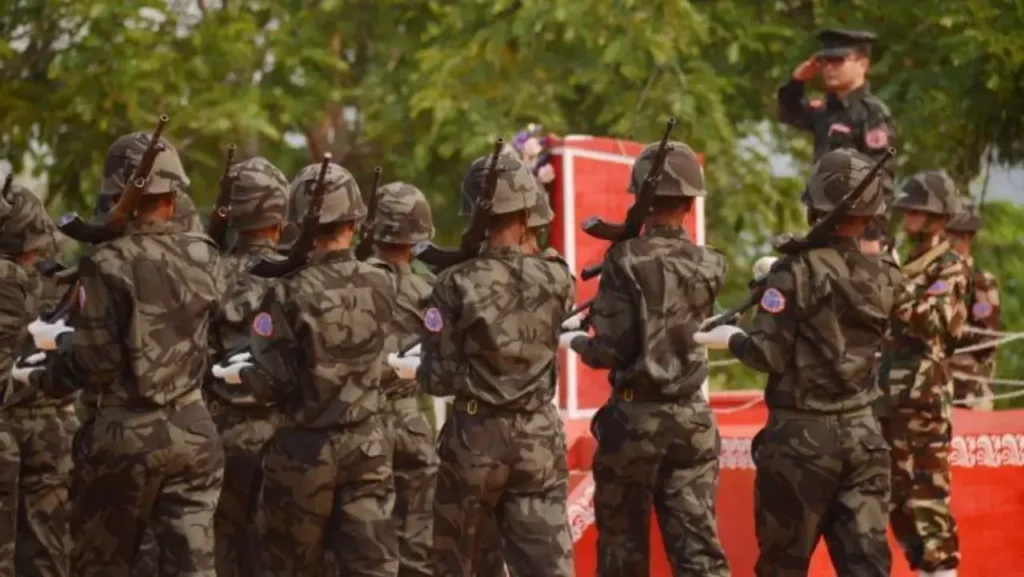
In a sharp escalation of rhetoric and regional concern, the Arakan Army (AA) has issued a stern warning to Bangladesh’s Interim Government, led by Nobel laureate Muhammad Yunus, over what it described as a growing nexus between extremist militants and corrupt elements within the Bangladesh Armed Forces and Border Guard Bangladesh (BGB). The AA cautioned that rising internal support for militant groups could jeopardize not only Bangladesh’s domestic stability but also threaten peace along the Myanmar–Bangladesh frontier and the wider ASEAN region.
The warning came in the wake of an October 11 attack in Maungdaw Township, near the Myanmar–Bangladesh border, when around ten armed members of extremist groups—the Arakan Rohingya Salvation Army (ARSA) and the Rohingya Solidarity Organization (RSO)—ambushed three local residents. The assault underscored the growing security challenges in an already volatile frontier long plagued by insurgent activity and cross-border trafficking.
According to a statement released by the AA, investigations following the incident revealed a disturbing trail of corruption and complicity within sections of the Bangladesh Border Guard (BGB). A social media post by Radio NUG cited the AA as claiming that weapons, ammunition, and other military supplies seized from ARSA and RSO militants had been traced back to “corrupt Bangladeshi officers.” These officers allegedly sold or provided military-grade equipment to militant organisations that propagate extremist ideologies and collaborate with the Myanmar junta’s military commission in orchestrating cross-border violence.
The AA’s statement described how these illicit dealings have evolved into what it called a “mutually beneficial arrangement” between the militant groups and the Myanmar Military Commission, facilitated by “rogue BGB and army officers.” These officials were accused not only of supplying weapons but also of providing logistical and operational support to the militants—ranging from medical treatment for injured fighters to food, rations, and protective cover during armed operations. Some, the AA claimed, have even shared radar-based intelligence and participated in aerial reconnaissance, thereby strengthening the militants’ capacity for coordinated attacks along the border.
The AA emphasized that this was not the first time it had raised the alarm. It had earlier submitted evidence-based reports to the Bangladesh Interim Government on September 27, urging a full investigation and accountability for those complicit in aiding extremist outfits. However, it warned that continued inaction could irreparably damage bilateral trust, destabilise border security, and embolden extremist factions—posing grave risks to Bangladesh’s national security and to the fragile peace across Southeast Asia.
Importantly, the AA stressed that its statement was a “constructive and preventive appeal,” not an act of hostility, aimed at prompting corrective measures before the situation worsens.
Civilian casualties deepen the crisis in Maungdaw
Barely a day after the warning, tragedy struck again. The Arakan Army has claimed that extremist militants from ARSA and RSO launched an ambush on October 11 that killed one civilian and seriously injured two others in Maungdaw Township, located near the Bangladesh–Arakan border.
According to the AA, the attack occurred around noon on October 11, when ten armed assailants attacked three local motorcycle delivery workers transporting essential goods near the Leip Yakhwe junction, north of Maungdaw. The victims—identified as 22-year-old Ko Nyein Chan, 23-year-old Ko Thaung Zin, and 33-year-old Ko Naing Lin—were unarmed civilians eking out their livelihoods by ferrying daily consumer goods between Nan Thar Taung and Kyain Chaung. Nyein Chan died on the spot, while the other two sustained severe injuries but managed to escape. AA personnel later rescued the survivors and provided emergency medical care.
The AA highlighted that it now controls and secures most of the earlier Myanmar junta held military outposts in Buthidaung, Maungdaw, and other border regions of Arakan State. The AA in a statement has reiterated that it is “working to ensure public safety, healthcare, education, and inter-ethnic harmony under the leadership of the Arakan National Council.” The group also reaffirmed its resolve to liberate the remaining three towns still under junta control through combined military and political strategies.
Meanwhile, the AA disclosed that both ARSA and RSO have established fortified bases along the Bangladesh–Arakan border and even within Bangladeshi territory, from where they conduct cross-border raids, ambushes, and attacks targeting civilians and AA security positions. These operations, the AA noted, serve the strategic interests of Myanmar’s military junta, which benefits from instability along the frontier—often aided indirectly by complicit elements within Bangladesh’s security establishment.
A fragile border turning into a faultline
The recent developments underscore the growing fragility of the Bangladesh–Myanmar border, particularly along the Naf River, which demarcates the two countries and has become both a humanitarian corridor and a militant gateway. Over the years, the Bangladeshi side of the river—especially around Cox’s Bazar and Teknaf—has hosted sprawling Rohingya refugee camps, initially established as safe havens but now increasingly infiltrated by militant operatives and criminal syndicates.
The proliferation of weapons, extortion networks, and human trafficking rings has turned the frontier into one of the most volatile borders in South and Southeast Asia. The AA’s claim that elements within the Bangladesh Armed Forces and BGB are colluding with armed Rohingya outfits adds a dangerous new dimension to an already combustible situation. If verified, such internal fractures could undermine Bangladesh’s credibility and expose the entire Naf River corridor to escalating cycles of violence.
Diplomatic observers note that the Bangladesh Interim Government appears to have granted the Bangladesh Army and security forces an unusually free hand in managing border operations. While this may be intended to project strength during a politically uncertain transition, it risks deepening militarisation and creating conditions for renewed cross-border confrontations inside Myanmar’s Rakhine State.
The Myanmar junta, reeling under growing resistance from the Three Brotherhood Alliance (of which the AA is a member), could seek to exploit these tensions to justify increased militarisation in Rakhine, further displacing civilians and prolonging instability.
Ultimately, the Maungdaw and Buthidaung sector and the Naf River basin are fast becoming the epicentre of a new, complex conflict—one that fuses elements of state corruption, ethnic insurgency, and cross-border militancy. Unless both Dhaka and Naypyitaw exercise restraint and cooperate under regional frameworks, the frontier could descend into a prolonged shadow war—undermining not only border security but the fragile balance of peace across the Bay of Bengal and the wider ASEAN region.