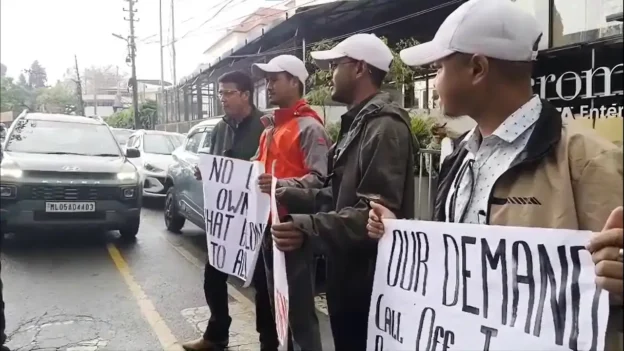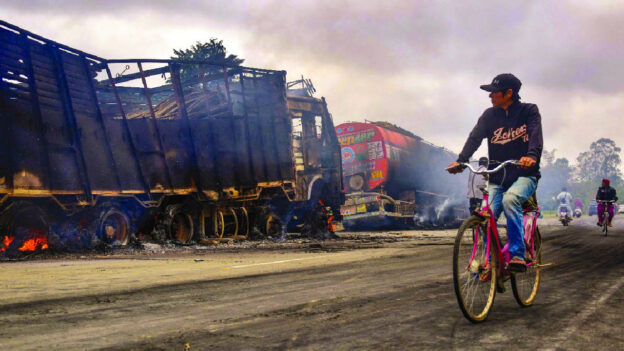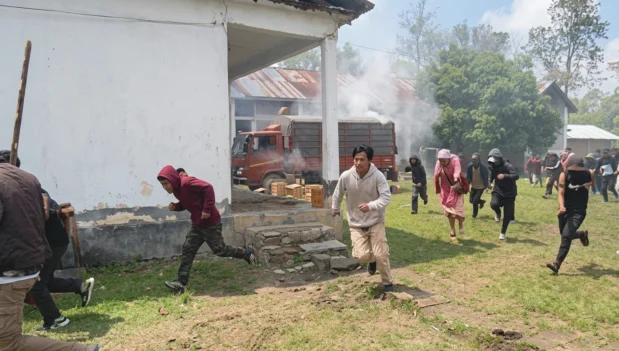

The hills of Meghalaya have long held secrets beneath their green folds — deposits of uranium that the Indian state considers strategic, but which the local communities regard as a curse rather than a blessing. This uneasy relationship between the lure of development and the defence of tribal land rights has once again burst into public view, after the Ministry of Environment, Forest and Climate Change (MoEFCC) issued an Office Memorandum (OM) proposing to exempt uranium and other atomic mineral mining projects from mandatory public hearings.
For many in Meghalaya, the directive reopened old wounds. The issue of uranium mining is not new to the state; it has been simmering for decades. In the 1980s, the Atomic Minerals Directorate (AMD) first discovered significant uranium reserves in the South West Khasi Hills, particularly in Domiasiat, Mawthabah, and surrounding villages. The announcement set off a wave of anxiety and resistance. Communities, whose connection to the land runs deep, feared the loss of traditional ownership, environmental degradation, and the invisible menace of radiation.
Through the 1990s and early 2000s, exploratory drilling was carried out by the Uranium Corporation of India Limited (UCIL). However, repeated protests by villagers, traditional leaders, and student groups — most notably the Khasi Students’ Union (KSU) — brought the project to a standstill. The late Kong Spelity Lyngdoh Langrin of Domiasiat, known as the matriarch of the anti-uranium movement, became a symbol of this resistance when she famously refused to sell her land to UCIL.
Decades later, that same village of Domiasiat is once again the site of renewed mobilisation. In October this year, local organisations gathered there to observe “Anti-Uranium Day.” They lit candles in memory of Kong Spelity and reiterated their pledge that uranium mining would never be allowed in Hynniewtrep land. The visit was both symbolic and strategic — a reminder that the opposition remains strong, rooted in the belief that the land and its people cannot be separated.
Chief Minister Conrad K. Sangma, for his part, has maintained a consistent position against uranium mining. He has assured the people that the state government is not in favour of reopening the issue, especially given widespread fears of health hazards and environmental damage.
Responding to the MoEFCC memorandum, Sangma stated that his government would study its legal implications carefully before taking a stand, and that Meghalaya would not accept any directive that compromises the rights and safety of its citizens. He also dismissed allegations of illegal uranium extraction in parts of the Garo Hills, challenging anyone with evidence to bring it forward so that the government could act swiftly.
The Khasi Hills Autonomous District Council (KHADC), empowered under the Sixth Schedule of the Constitution to protect tribal land and governance, has also taken a firm stand. Under the leadership of Chief Executive Member Winston Tony Lyngdoh, the Council recently passed a resolution opposing the OM. The CEM argued that bypassing public consultations would weaken democratic oversight and directly violate the spirit of the Sixth Schedule, which guarantees community participation in decisions affecting tribal land. The Council has vowed to examine the legal options available to ensure that the rights of indigenous people are not compromised.
The heart of the controversy lies in the question of consent. For the people of Meghalaya, especially those in uranium-rich areas, consent is not merely procedural — it is existential. Land is both heritage and identity. Any attempt to extract minerals without transparent consultation is seen not as development, but as dispossession. Environmentalists have also pointed out that uranium mining carries long-term risks: radioactive contamination, water pollution, and irreversible ecological damage in an already fragile landscape.
Supporters of uranium extraction, mostly at the national level, argue that the resource is vital for India’s nuclear energy ambitions and that responsible mining could bring economic benefits to the region. Yet, such arguments have rarely resonated in Meghalaya, where concerns of displacement and unaddressed fears remain vivid.
Today, the debate has evolved into something larger than a mining dispute. It reflects the enduring struggle between national policy and local autonomy, between developmental ambition and environmental stewardship.
As Domiasiat’s villagers gather once again under the soft light of oil lamps to mark their resistance, their message remains clear — development must not come at the cost of their land, health, and way of life. For them, uranium may hold immense value to the state, but to the people of Meghalaya, the real treasure lies above the ground — in the forests, rivers, and the freedom to decide their own future.