Nearly five years after Myanmar’s military seized power on a cold morning in February 2021, the country remains trapped in a grinding civil war with no horizon of resolution. Yet, amid this national upheaval, the junta is preparing to stage what may be the most elaborate political performance since the coup: a three-phase general election beginning on 28 December and stretching into January. The choreography is unmistakable. Rather than a genuine democratic exercise, the polls are designed to project something far more strategic—that the military is firmly in control and capable of administering a nationwide political process even as large parts of the country slip from its grasp.
What stands out is not the question of who will win—few inside or outside Myanmar expect meaningful competition—but what the election is intended to achieve. The junta seeks to recast itself as the steward of an orderly transition, fragment its opponents, and reassert its position as the indispensable centre of political gravity. In this sense, the election is not a contest at all; it is an attempt to shape the terms of Myanmar’s political future.
Far from the triumphant liberation narrative circulating in some resistance circles, Myanmar’s trajectory is more complicated. The military, despite suffering unprecedented battlefield losses, has not collapsed. It is recalibrating, digging in, and preparing for a prolonged confrontation. Meanwhile, anti-regime forces—from People’s Defence Forces (PDFs) aligned with the National Unity Government (NUG) to powerful ethnic armed organisations (EAOs)—have expanded their influence across substantial territory but remain constrained by internal contradictions and diverging priorities.
This longform analysis examines the junta’s strategy, the shifting battlefield landscape, fractures within the resistance, and the political implications of the upcoming election. It argues that Myanmar is not merely experiencing a crisis of governance but a profound re-engineering of political power—one that pits a patient, methodical military leadership against an opposition struggling to translate battlefield victories into political coherence.
The junta’s long game – outlasting, reframing, consolidating
As Myanmar enters the final weeks before the planned election, the junta’s strategy has become increasingly clear: it intends to survive not by defeating the resistance outright, but by outlasting it. This strategy rests on time-tested military instincts—attrition, narrative control, selective coercion, and calibrated political concessions. What appears on the surface to be an embattled regime is, in reality, a leadership executing a long and calculated game.
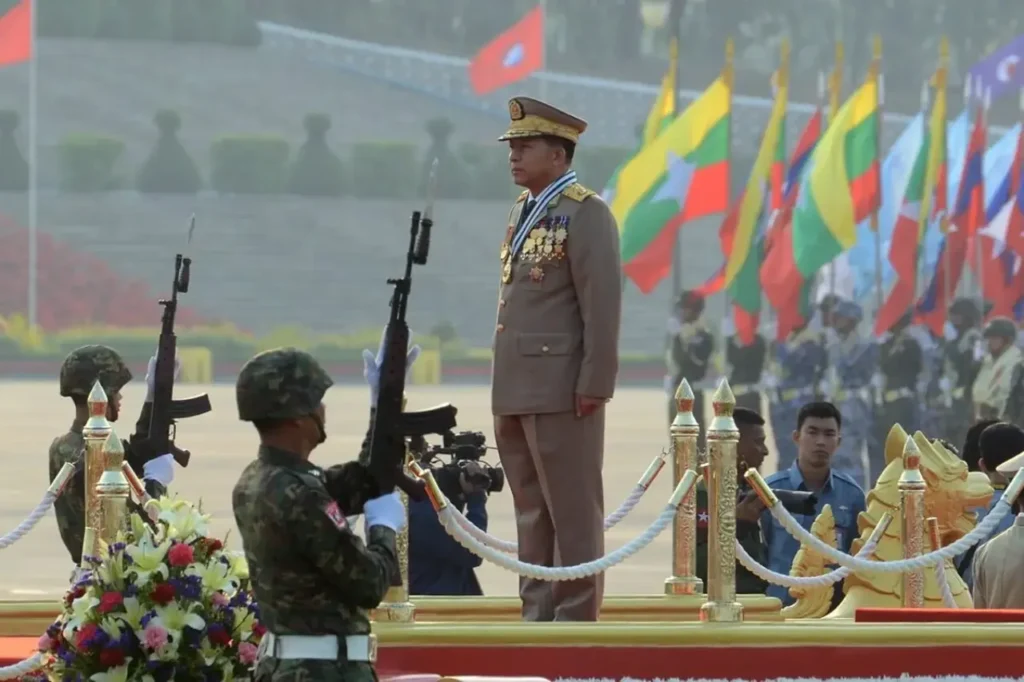
Senior General Min Aung Hlaing and the State Administration Council (SAC) have consistently projected calm, even as the battlefield situation deteriorates in multiple regions. Their narrative frames the conflict not as a crisis of legitimacy but as the by-product of “terrorist threats” that require a firm and stabilising hand. By repeatedly invoking the 2008 Constitution—which grants the military sweeping political privileges—Min Aung Hlaing presents himself as committed to a path toward controlled federalism. This narrative is carefully calibrated: domestically, it reassures the military’s support base; internationally, it signals the promise of a gradual, managed transition.
Central to this effort is the 2023 Political Parties Registration Law, a pivotal instrument that restructured Myanmar’s political landscape. The law requires political parties to re-register under onerous conditions, maintain large membership numbers, and commit to contesting elections in multiple regions—requirements impossible for opposition parties operating in exile or underground. The law effectively deregistered the National League for Democracy (NLD), dissolved dozens of smaller parties, and cleared the field for the USDP and a constellation of military-aligned entities. It is the scaffolding upon which the junta aims to construct a façade of pluralism while maintaining total political control.
Internationally, reactions to the junta’s electoral choreography have been mixed. ASEAN has ruled out sending observers to Myanmar’s year-end elections, with Secretary-General Kao Kim Hourn stressing that the bloc will not provide official monitoring. Yet he simultaneously noted that individual member states remain free to deploy observers on a bilateral basis—an ambivalent position reflecting ASEAN’s long-standing divisions on Myanmar. The junta had extended invitations to the regional grouping, eager to lend its electoral exercise a sheen of legitimacy, but ASEAN’s institutional refusal underscores deep regional skepticism.
Thailand’s response has been particularly telling. Thai Foreign Minister Sihasak Phuangketkeow declared that the electoral process cannot be considered transparent while thousands of political prisoners remain unjustly detained, explicitly calling for the immediate release of Aung San Suu Kyi—a position that resonated deeply with Myanmar’s pro-democracy movement. Yet in the same breath, Sihasak suggested that even an imperfect election could serve as a stepping stone toward reform, citing the flawed 2010 election that nonetheless ushered in limited political opening. His remark—“Maybe an imperfect election can also be a good opportunity to return the country to stability and democracy”—highlighted Thailand’s familiar double stance: critical in principle, accommodating in practice.
Meanwhile, the junta has actively sought support from other international partners. Russia and Belarus have agreed to send observers to Myanmar’s elections, following high-level meetings between their election officials and Myanmar’s Union Election Commission. During Min Aung Hlaing’s visits to both countries earlier this year, he invited Belarusian leader Alexander Lukashenko to dispatch observers—an invitation promptly accepted. Russia’s willingness to engage further underscores the growing military and diplomatic ties between the two authoritarian governments.
China, too, has extended conditional support. In October, Chinese Special Envoy Deng Xijun held talks with Min Aung Hlaing in Naypyitaw, expressing support for holding elections and discussing the deployment of Myanmar’s Electronic Voting Machine system. China emphasized the importance of ensuring that the vote appears “free and fair,” and Myanmar extended invitations for Chinese election observers. While Beijing’s backing reflects self-interest—primarily border stability and protection of economic corridors—it gives the junta valuable diplomatic breathing room.
The election itself thus becomes a carefully staged performance. Whether or not it is believed is less important than the impression it creates: that the junta remains the centre of political gravity. The military’s aim is not to convince the world that its election is legitimate, but to demonstrate that no other actor is capable of organising one.
The shifting battlefield
Across Myanmar’s fractured geography, the military faces one of the most serious armed challenges in its history. Since late 2023, EAOs and PDFs have captured strategic bases, overrun border towns, and stretched the Tatmadaw’s manpower thin. Yet these advances, while significant, do not form a coherent front. Rather, they reveal the deeply localised and uneven nature of Myanmar’s conflict.
In the north, the Kachin Independence Army (KIA) and the Ta’ang National Liberation Army (TNLA) continue to pressure military positions along major transport corridors. Their cooperation with the Myanmar National Democratic Alliance Army (MNDAA) under the “Brotherhood Alliance” has inflicted notable defeats on the Tatmadaw, particularly in northern Shan State. These offensives, however, are guided by each group’s longstanding territorial and political objectives—not by a coordinated national strategy.
The western front is dominated by the Arakan Army (AA), whose rapid territorial expansion has significantly eroded the junta’s control across Rakhine State. The AA now administers large swathes of rural territory, establishing courts, policing structures, and tax systems. Its ambitions are unmistakably nationalist: the creation of a form of Rakhine self-rule. While the AA does cooperate with PDFs and occasionally with the NUG, such alliances are driven by tactical necessity rather than ideological convergence.
In the southeast, the Karen National Union (KNU) remains divided between reformist and conservative factions. While some brigades have aligned strongly with the resistance, others maintain fragile arrangements with the military or pursue local agendas focused on resources and territorial influence. The result is a mosaic of overlapping zones of control, where lines between ally and adversary blur depending on geography and circumstance.
Amid this shifting landscape, the junta has seized on opportunities to project control. One incident in particular has become emblematic of the volatile environment surrounding the election: the detention of Wai Lin Htet, a 37-year-old candidate from the Shan and Nationalities Democratic Party. According to state media, he was seized by three members of a local resistance group in Magway’s Pakokku Township. While resistance actors have not confirmed this account, the episode underscores the explosive context in which the election is unfolding—and the degree to which the junta seeks to portray its opponents as threats to stability.
The battlefield, in short, is dynamic but decentralised. No actor—neither the junta nor the resistance—can claim unified control across multiple fronts. This fragmentation is precisely what allows the military to survive despite mounting pressure.
The fractured resistance- unity elusive, coordination uneven
The resistance landscape in Myanmar is as diverse as it is volatile. What unites its components—EAOs, PDFs, civil society networks, and the NUG—is a shared opposition to military rule. But the forces that divide them are often stronger.
The National Unity Government (NUG) occupies a complex position. It is the most globally recognised representative of the resistance and provides a political umbrella for many PDFs. Yet it has limited command-and-control authority. Many PDFs respond primarily to local leadership or ethnic authorities rather than the NUG’s central directives. While some align ideologically with the NUG’s vision of a federal democratic union, others see the NUG as distant, symbolic, or insufficiently responsive to local conditions.
Relations between the NUG and major EAOs are similarly fraught. Groups such as the AA, KIA, and TNLA have their own political blueprints. Their cooperation with the NUG is tactical and episodic; their priorities—territory, autonomy, ethnic self-rule—precede the coup by decades. The resistance’s ideal of a unified federal future is compelling but not concretely articulated in ways that address the deep-rooted concerns of Myanmar’s ethnic nationalities.
These tensions are particularly visible among Chin resistance groups, where disputes over leadership, recognition, and coordination have weakened the overall anti-junta movement in the region. Similar divisions exist in Karen resistance networks, where conflicts between political leaders and frontline fighters complicate efforts to articulate shared objectives.
These fractures reveal a core dilemma: the resistance is not a unified liberation movement but a coalition of convenience. Its strength lies in local legitimacy and territorial control; its weakness lies in the absence of a shared political horizon.
Elections as strategy
The upcoming election is often dismissed as a hollow exercise, given the ongoing conflict, the absence of genuine competition, and the systematic disenfranchisement of the NLD. Yet from the junta’s perspective, the election is strategically indispensable.
The Political Parties Registration Law ensures that only military-approved or acquiescent parties can legally participate. By setting high membership thresholds and requiring contestation across multiple regions, the law effectively eliminates any serious challenger. It transforms the election into a mechanism of political engineering.
International perception matters. While Western governments have rejected the legitimacy of the poll, the junta is focused on the region—and the region is not unified. ASEAN declined to send an observer mission, but left the door open for bilateral observation. Thailand has criticised the detention of political prisoners while simultaneously suggesting that even an imperfect poll could be a step toward stability. Russia and Belarus have embraced the process and will send observers, while China has endorsed the idea of elections in principle and discussed the technicalities of voting machines.
These endorsements—some tacit, some explicit—give the junta precisely what it wants: the ability to argue that its electoral roadmap is internationally engaged, even if controversial.
At the domestic level, the junta hopes to tap into war fatigue. By promising a return to politics—however stage-managed—it seeks to present itself as the only actor capable of administering a national process. Whether civilians believe this narrative is secondary; the junta only needs them to believe that there are no viable alternatives.
Yet the election’s credibility is already in question. Resistance groups have vowed to disrupt the process, while the UN human rights office has warned that the vote will be held in an environment “rife with threats and violence,” with political participation actively suppressed. The junta’s determination to push ahead nonetheless demonstrates how central the election is to its long-term strategy.
The civilian burden – fatigue, fragmentation, and survival
Beyond strategy lies a much harsher reality: Myanmar’s civilians are paying the highest price. Over two million people have been displaced since the coup, entire towns destroyed, and livelihoods decimated. Access to healthcare, education, and trade has collapsed in many regions, leaving communities trapped in cycles of dependency and insecurity.
War fatigue is widespread. Civilians are often forced to navigate complex terrains of loyalty and coercion. In some areas, they align with PDFs or EAOs out of conviction; in others, they must pay taxes to competing authorities, comply with local militia demands, or flee multiple times due to shifting control.
The junta’s election narrative seeks to exploit this exhaustion. It promotes the poll as the first step toward stability—and relies on the possibility that some citizens will view participation not as endorsement but as resignation.
For many, daily survival eclipses political contestation. This reality shapes the battlefield and political dynamics alike.
The future of the resistance
Despite its fragmentation, the resistance remains formidable. EAOs control more territory today than at any point in decades. PDFs have grown more sophisticated, both militarily and administratively. The military’s capabilities are stretched thin, its morale weakened, its administrative reach heavily eroded.
Yet the resistance faces a strategic dilemma: how to transform fragmented military gains into a cohesive political future. Without a shared vision for federalism, unified command structures, or coordinated governance mechanisms, gains risk solidifying into autonomous enclaves rather than a unified post-junta political order.
The NUG must evolve from a symbolic government-in-exile into a functional node of coordination—one capable of building trust with ethnic groups, decentralising decision-making, and addressing long-standing grievances. Whether it can do so fast enough remains an open question.
A conflict without resolution, a politics without consensus
Myanmar stands at a critical juncture. The military’s election—engineered through the 2023 Political Parties Registration Law and bolstered by selective international participation—will not resolve the crisis. It will instead reshape the political terrain within which the conflict continues.
The junta’s long game is clear: outlast the resistance, fragment its alliances, and present itself as the inevitable centre of governance. The resistance, though resilient, remains divided. Its victories are significant but not yet decisive.
Over the coming year, Myanmar’s future will hinge not only on military confrontations but on political imagination—the ability of anti-junta actors to articulate a shared vision amid deep fractures, and the junta’s capacity to sustain a façade of order amid ongoing chaos.
If Myanmar is to move toward a post-military future, the work of building political cohesion will need to begin now. Otherwise, the country risks trading one form of instability for another, with the military continuing to shape its destiny through a carefully managed, tightly controlled version of democracy designed to perpetuate its rule.