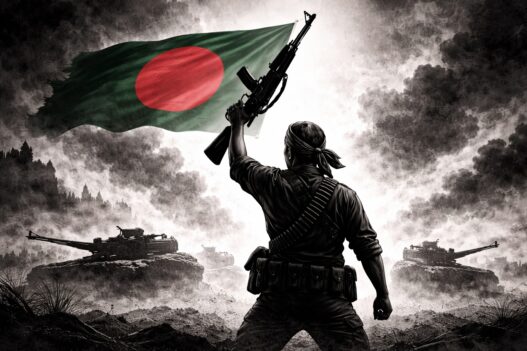
December 16 marks Bangladesh’s Independence Day—the culmination of a nine-month Liberation War in 1971 that reshaped South Asia’s political map. Yet, fifty-four years after emerging from one of the twentieth century’s most decisive struggles for self-determination, Bangladesh finds itself embroiled in a different kind of conflict: a battle over memory, meaning, and moral ownership of 1971.
This struggle is no longer confined to academic debate. In the aftermath of the ouster of Sheikh Hasina’s Awami League government, the history of the Liberation War has become a central arena of contemporary politics, selectively mobilised to legitimise present-day ambitions. At the heart of this contest lies a deeply troubling attempt—led primarily by Jamaat-e-Islami Bangladesh—to equate the 2024 mass movement with the 1971 Liberation War. Such claims raise urgent questions about political intent, ideological rehabilitation, and the future of Bangladesh’s national consensus.
Jamaat-e-Islami and the politics of historical revisionism
At the centre of this controversy stands Jamaat-e-Islami, a party that opposed Bangladesh’s independence in 1971 and collaborated with the Pakistani military regime during the genocide in East Pakistan. Today, Jamaat is attempting to reshape both the past and the present by reframing the meaning of liberation itself.
1971: A war of national liberation, not a matter of interpretation
The Liberation War of 1971 was neither a symbolic protest nor a routine regime-change movement. It was a war of national survival. Decades of political exclusion, economic exploitation, and cultural repression by West Pakistan culminated in genocide after the Pakistani military launched Operation Searchlight on March 25, 1971.
Under the leadership of Sheikh Mujibur Rahman, the Bengali nationalist movement transformed from a democratic mandate into armed resistance. His historic March 7 speech articulated the political blueprint for independence, while his subsequent declaration of independence—and imprisonment—provided the struggle with legitimacy and moral clarity. In his absence, the Mujibnagar Government functioned as the lawful provisional authority, coordinating diplomacy, resistance, and military strategy.
The war was fought on multiple fronts. On the ground, the Mukti Bahini, alongside defecting soldiers of the East Bengal Regiment, formed the backbone of resistance across strategic locations. Coordination with India’s armed forces under the Mitra Bahini command later strengthened the campaign. Internationally, Cold War geopolitics shaped the conflict, with India’s military support and the Soviet Union’s diplomatic backing proving decisive—yet supportive, not substitutive. The surrender of Pakistani forces on December 16, 1971, was unequivocally Bangladesh’s victory, secured through the sacrifice of nearly three million lives.
To deny this history is not reinterpretation—it is negation.
Jamaat’s historical burden and its post-2024 strategy
Jamaat-e-Islami’s discomfort with 1971 is structural, not incidental. During the Liberation War, its leaders—most notably Golam Azam—openly collaborated with Pakistan’s military regime and its auxiliary forces, including Razakar, Al-Badr, and Al-Shams. These groups were directly involved in genocide, the killing of intellectuals, mass repression, looting, arson, and the targeting of Hindu minorities. These facts are well documented in court proceedings, eyewitness accounts, and international scholarship.
In the post-2024 political landscape, Jamaat perceives an opportunity to dilute this historical culpability. Public frustration with the Awami League’s monopolisation of the Liberation War narrative has enabled Jamaat to attempt a dual manoeuvre: first, to delegitimise the established history of 1971 by branding it as exaggerated or “Indian-centric”; and second, to recast the 2024 student-led mass movement as a parallel—or even a corrective—to 1971, implying that the original Liberation War was flawed or incomplete.
This strategy is both morally and historically indefensible.
Why 2024 cannot be a “New 1971”
The 2024 movement was a significant democratic uprising, initiated by students protesting quota policies, authoritarian governance, electoral manipulation in the 2014, 2018, and 2024 elections, and political repression. Its importance is undeniable. Yet equating it with 1971, as freedom fighters and historians consistently argue, collapses two fundamentally different historical moments.
The contrast is stark. 1971 was a war against a colonial-military state that denied Bengalis nationhood and unleashed systematic genocide, forcing millions into exile. 2024 was a domestic political movement within an already independent Bangladesh, operating within constitutional and civic frameworks.
Simply put, 1971 created the Bangladeshi state; 2024 sought to reform it. Conflating the two erases the meaning of independence and allows forces that once opposed Bangladesh’s creation to present themselves as champions of freedom—without accountability.
Selective scholarship and strategic amnesia
Jamaat leaders, including Amir Hamza, have recently cited historian Badruddin Umar to claim that “90 percent of Liberation War history is false.” This is a deliberate misuse of scholarship.
Umar critiques the post-independence appropriation of the Liberation War for political purposes and the betrayal of its democratic promises. He does not deny the genocide, the war itself, or Jamaat’s collaboration. Weaponising his work to rehabilitate Jamaat’s historical image is intellectual dishonesty.
Claims that Jamaat was “against India, not against Bangladesh’s independence,” or calls to “forget the past and create a new history,” do not constitute reconciliation. They amount to amnesia without accountability. History shows that nations heal not by erasing truth but by confronting it—Germany did not forget Nazism, nor did South Africa reconcile by denying apartheid. Bangladesh cannot erase 1971 without paying a long-term moral and political price.
The complicity of silence
Jamaat’s revisionist narrative has gained ground not only through its own platforms but also through broader political discourse. Opposition parties, including the BNP, have rightly criticised the Awami League for politicising the Liberation War since coming to power in 2008. Yet, in doing so, some inadvertently create space for historical relativism—where 1971 becomes a flexible political instrument rather than a shared moral foundation.
There is a crucial distinction between rejecting partisan monopolisation of history and tolerating systematic distortion. Critiquing political misuse does not require questioning the legitimacy of the war, its victory, or the identity of collaborators.
The 1971 power handover controversy: Aurora, Niazi, and Osmani
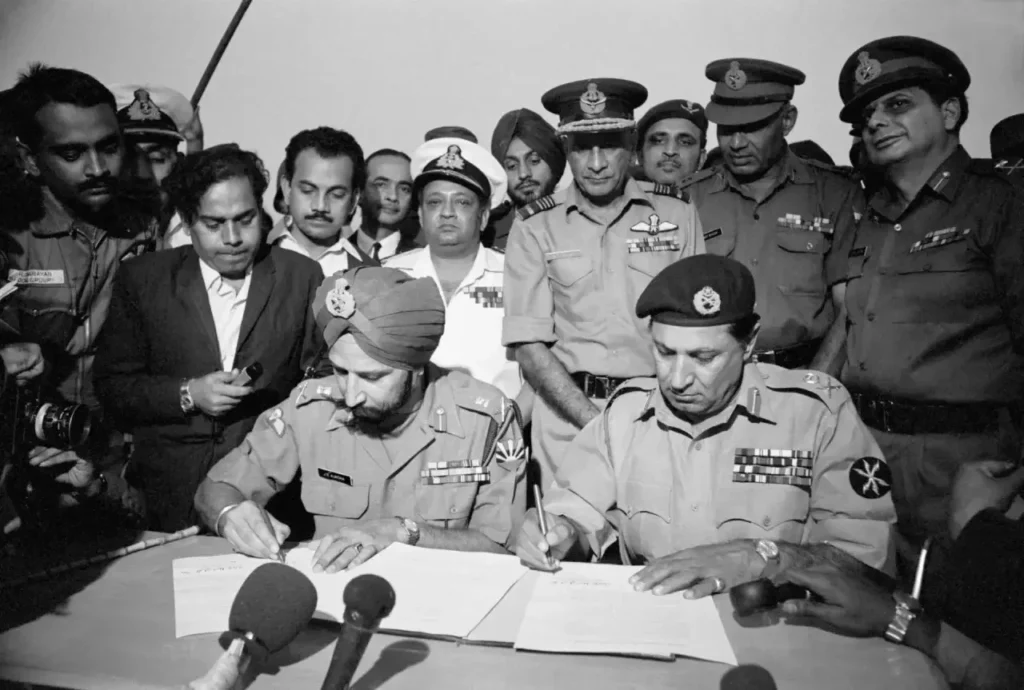
One lesser-known yet critical episode of 1971 concerns the transfer of authority during Pakistan’s military defeat. This controversy involved three key figures: Lt. Gen. J.F.R. Aurora of the Indian Army, Lt. Gen. A.A.K. Niazi of Pakistan, and Gen. M.A.G. Osmani of Bangladesh.
General Aurora, commander of India’s Eastern Command, played a decisive role in orchestrating the surrender. His insistence on a formal, structured process aimed to preserve international legitimacy and minimise chaos. General Niazi, despite being militarily encircled, resisted an immediate handover, seeking to retain control over personnel and assets. According to historians, he refused to surrender directly to the Mukti Bahini and instead handed over authority to Aurora.
General Osmani, commander-in-chief of the Bangladesh Forces, was the legitimate representative of Bangladeshi authority but was not physically present at the surrender ceremony.
Local historians emphasise that claims suggesting power was formally transferred directly to Bangladesh—and not India—are politically fabricated narratives promoted decades later, often by groups like Jamaat-e-Islami to distort history under the guise of safeguarding sovereignty.
Strategic interests behind the surrender
The handover reflected competing interests: Indian strategists sought an orderly surrender; Pakistani commanders aimed to protect institutional honour; and the Mujibnagar Government, led by Tajuddin Ahmad, pressed for full recognition of Bangladesh’s sovereignty.
The carefully choreographed surrender on December 16, 1971, ultimately marked the birth of a new nation—not an Indian protectorate.
Why anti-India rhetoric persists
Criticism of India by certain Bangladeshi politicians stems from multiple factors: historical sensitivities, unresolved border and water-sharing disputes, domestic political mobilisation, and anxieties over India’s economic and cultural influence. While such rhetoric can yield short-term political gains, it often obscures the pragmatic reality that cooperation benefits trade, energy, and infrastructure.
Can Bangladesh “change” its neighbour?
Bangladesh cannot replace or fundamentally alter India’s regional position. However, it can influence India through diplomacy, economic interdependence, and strategic partnerships with other regional actors. Overly aggressive posturing risks economic retaliation and the erosion of goodwill.
Bangladesh’s history of 1971 is not negotiable. While political actors may debate governance failures and post-independence betrayals, the Liberation War itself—and the identities of its perpetrators and collaborators—remain moral facts. Rewriting that history for short-term political rehabilitation risks undermining the very foundations of the Bangladeshi state.