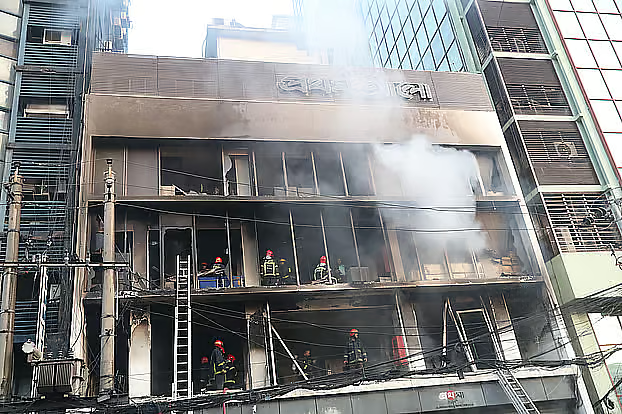
“Enough is enough.” That, increasingly, is how Bangladesh’s journalists appear to be speaking—in one voice and without ambiguity. The arson attacks on The Daily Star and Prothom Alo have triggered not merely outrage but a rare moment of collective reckoning, as the country’s media community warns that Bangladesh’s political transition has entered a far more dangerous phase—one where journalism itself faces physical annihilation.
Under the interim government led by Dr Muhammad Yunus, journalists, editors, cultural figures, human rights activists and political leaders poured onto the streets of Dhaka this week in an unusually unified protest. The demonstrations followed the coordinated vandalism, looting and arson carried out on December 18 against the country’s most influential English- and Bengali-language newspapers. What disturbed many was not only the violence itself, but the confidence with which it was executed.
For the protesters, this was not an isolated act of mob fury but a watershed moment. Years of intimidation, pressure and legal harassment against the press, they argued, have now escalated into something far more lethal: a willingness to silence journalism through fear, fire and brute force. The attacks marked a shift from coercion to attempted eradication.
For India and the wider region, the scenes in Dhaka underscore a growing concern that democratic backsliding in Bangladesh is accelerating at a moment of political transition—raising uncomfortable questions about stability in a country long viewed as a relatively resilient neighbour in South Asia’s volatile political landscape.
A rare moment of media solidarity
Bangladesh’s media sector has historically been fragmented—divided along political loyalties, linguistic identities and ideological leanings. Competition between outlets has often been fierce, sometimes acrimonious. Against this backdrop, the sight of rival editors and journalists standing shoulder to shoulder was itself deeply symbolic.
Participants repeatedly stressed that the protest was no longer about professional rivalry or editorial disagreements. It was about collective survival. The burning of two flagship newspapers, they argued, represented an attack on the entire profession, regardless of political alignment.
“This is not an everyday protest,” a veteran journalist said at the gathering. “This is the media realising that the red line has been crossed.” His words echoed a sentiment shared widely across the crowd—that something fundamental had changed.
The timing of the protest added to its gravity. Barely months after the fall of the Sheikh Hasina–led Awami League government and the installation of an interim administration, many had hoped for democratic renewal and institutional reset. Instead, the arson attacks have cast a long and unsettling shadow over those expectations.
Editors warn of a breakdown in protection
The sense of alarm was sharpened by the testimony of editors who directly witnessed the attacks. Addressing the gathering, Mahfuz Anam, editor and publisher of The Daily Star, delivered a warning that captured the prevailing mood.
“These attacks are no longer only about freedom of expression,” he said. “It has become a question of whether journalists can survive.” His remarks underscored a shift from abstract rights to immediate physical safety.
Anam recounted how journalists and staff were trapped inside the Daily Star building as flames and thick smoke engulfed the top floor. According to him, the attackers operated in large numbers and with apparent confidence—suggesting planning and intent rather than spontaneous rage.
Matiur Rahman, editor and publisher of Prothom Alo, echoed these concerns, warning that the attacks reflected a deepening intolerance of dissent and an emboldened culture of impunity. “When mobs can burn down leading newspapers without fear,” he said, “it sends a message that critical voices are no longer protected by the state.”
Both editors stressed that the violence was directed not merely at two institutions, but at the public’s right to information and the constitutional foundations of democratic life in Bangladesh.
From newsrooms to the public sphere
Speakers at the protest warned that the implications of the attacks extend far beyond Dhaka’s media houses. Editors from newspapers and online portals pointed out that if globally recognised outlets in the heart of the capital could be targeted so openly, journalists in district towns and rural areas would face even greater danger.
“This fear will not stop at newsrooms,” one senior editor warned. “It will spread to writers, academics, lawyers and anyone who speaks critically for the betterment of the country.” The statement reflected a broader anxiety that violence against the press often acts as a gateway to wider repression.
Several speakers noted that attacks on journalism historically serve as early indicators of democratic decline. Once mobs are normalised as tools of silencing, the boundaries of acceptable violence expand rapidly.
For many in attendance, the arson attacks symbolised not only an assault on media freedom, but a warning that the public sphere itself—debate, dissent and accountability—was under threat.
A broader assault on culture and pluralism
Cultural activists at the protest linked the newspaper attacks to recent assaults on institutions such as Chhayanaut and Udichi—organisations deeply associated with Bangladesh’s secular, progressive and pluralist traditions. Viewed together, they argued, these incidents point to a coherent and troubling pattern.
“When journalism and culture are attacked together,” one cultural organiser observed, “it signals hostility to diversity and debate itself.” The attacks were seen not as isolated acts, but as part of a broader ideological push.
For Bangladesh, whose national identity was forged through a liberation struggle rooted in language, culture and freedom of expression, such assaults strike at the symbolic heart of the state. The targeting of cultural institutions alongside media houses raised fears of an attempt to reshape the country’s ideological foundations.
Speakers warned that once pluralism is delegitimised, intolerance becomes normalised—and violence easier to justify.
Role of digital incitement
Another recurring concern was the role of social media in amplifying hatred and mobilising violence. Journalists and analysts pointed to online posts that allegedly celebrated the arson attacks or openly called for further assaults on reporters and media houses.
They warned that the failure to curb digital incitement has increasingly blurred the line between online rhetoric and physical violence—a phenomenon seen across South Asia. Several speakers urged authorities to treat online calls for violence as integral to the crime itself.
“Fire begins online before it reaches the streets,” one media analyst said. “Ignoring that ecosystem is no longer an option.” The remark captured the urgency of addressing digital radicalisation as a law-and-order issue, not merely a speech concern.
Elections and democratic credibility
The protests carried an unmistakable political undertone, situating the attacks within the context of Bangladesh’s expected national elections in 2026. Civil society leaders argued that a free and safe press is indispensable for credible elections, particularly during a transitional phase.
“Silencing journalists through fear distorts the entire electoral environment,” one opposition figure said. “Without independent reporting, voters are left in the dark.” The warning resonated strongly among participants.
From an Indian perspective, these developments are closely watched. New Delhi has long emphasised democratic continuity and stability in Bangladesh, given the two countries’ dense economic, security and cultural ties. A media environment shaped by intimidation rather than scrutiny risks undermining public trust in the political process.
Such erosion, analysts warned, would have consequences that extend beyond Bangladesh’s borders.
International reaction and reputational costs
The attacks on The Daily Star and Prothom Alo have drawn condemnation from international press freedom organisations and human rights groups. Many warned that targeting Bangladesh’s flagship newspapers could seriously damage the country’s global standing.
Statements from international watchdogs urged the interim government to ensure journalists’ safety, conduct independent investigations into the December 18 attacks, and hold not only perpetrators but also inciters accountable. Diplomatic observers noted that The Daily Star serves as a key reference point for the international community.
Editors at the protest warned that reputational damage could translate into economic consequences, particularly as Bangladesh seeks foreign investment while navigating economic headwinds.
A collective stand and a test ahead
Despite the gravity of the moment, the protest was marked by calls for solidarity rather than despair. Speakers urged journalists across ideological divides, along with lawyers, teachers, artists and business leaders, to see the attacks as a shared threat to democratic life.
“This is not about defending two newspapers,” Mahfuz Anam said in closing. “It is about defending the principle that disagreements must be resolved through law, dialogue and elections—not mobs and fire.”
As investigations continue, the response of the authorities will be closely scrutinised at home and abroad. For Bangladesh, the protests represent a critical test of whether the state can reassert the rule of law and protect dissenting voices. For its neighbours, including India, they serve as a stark reminder that when newsrooms burn, the consequences extend far beyond the walls of the press.