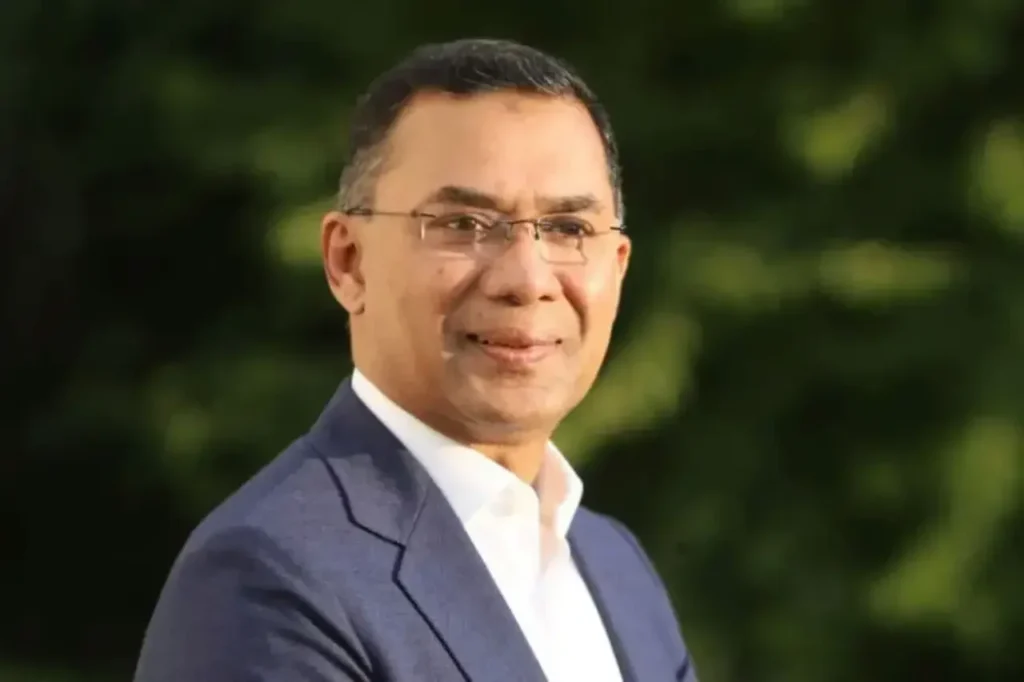
The return of Tareque Rahman to Bangladesh on Thursday, December 25, after seventeen years in exile in London marks a pivotal moment in the country’s political life. It is not merely a personal homecoming or a milestone for the Bangladesh Nationalist Party (BNP), but a signal event in Bangladesh’s evolving political order, emerging from the long shadow of Sheikh Hasina’s rule. His re-entry comes at a moment when entrenched political certainties have fractured, opening space for recalibration, contestation, and uncertainty.
As the son of Bangladesh’s first military ruler, Ziaur Rahman, Tareque Rahman embodies the country’s unresolved relationship between civilian politics and military power. Shaped by coups, repression, and prolonged exile, he now re-emerges as a principal contender for national leadership. His trajectory—from the shadow of military authority to the threshold of electoral politics—offers a revealing lens into the persistence of dynastic inheritance, the fragility of institutions, and the enduring model of “managed democracy” that continues to define much of South Asia.
For India, particularly New Delhi’s strategic and policy community, Tareque Rahman’s return is not simply a domestic Bangladeshi development. It carries implications for bilateral relations, regional security, and the future orientation of one of India’s most consequential neighbourhood partnerships. The significance of his return lies not only in who he is, but in what kind of political order Bangladesh may now be moving toward.
A Political upbringing forged by power and precarity
Born in 1965, Tareque Rahman grew up amid Bangladesh’s most turbulent political decades. His father, Major Ziaur Rahman, rose to prominence following the 1975 assassination of Sheikh Mujibur Rahman and eventually became Bangladesh’s first military ruler, later seeking electoral legitimacy. This blending of military authority and civilian governance left an indelible mark on the political environment in which Tareque was raised.
Ziaur Rahman’s assassination in 1981 permanently shaped the family’s political consciousness. It underscored how swiftly power could turn lethal in Bangladesh and embedded a sense of vulnerability alongside privilege. For Tareque, politics was never merely an arena of ambition; it was also a terrain of existential risk, where authority and exposure coexisted uneasily.
Growing up in this environment meant that political survival was learned early as a skill rather than an abstraction. The oscillation between power and persecution became a defining feature of the Zia family’s political inheritance. This background produced a leader acutely sensitive to both the mechanics of authority and the fragility of institutional protection—traits that would later define Tareque’s cautious but persistent political style.
Unlike many political heirs who inherit party machinery alone, Tareque inherited a deeper contradiction: the legacy of a military-shaped state that both enabled civilian politics and repeatedly destabilised it. Comparable trajectories are visible across South Asia. In Pakistan, political families cultivated under military patronage—most notably Nawaz Sharif’s—have navigated similar tensions. In Sri Lanka, political dynasties emerged within a state profoundly moulded by prolonged militarisation during and after civil war. Bangladesh’s experience fits squarely within this regional pattern, where political lineage confers advantage but also invites exceptional vulnerability.
Rise, controversy and informal power
Tareque Rahman entered active politics during the anti-Ershad movement of the late 1980s, working alongside his mother, Khaleda Zia, as she rebuilt the BNP into a mass party after Ziaur Rahman’s death. His political ascent gathered momentum following the BNP’s electoral victories in 1991 and again in 2001, which restored the party to power with a strong mandate.
Despite holding no formal government office, Tareque became an influential figure within the BNP’s internal structure. He played a central role in party strategy, candidate selection, and electoral mobilisation. Supporters viewed him as an effective organiser with a keen sense of political management, capable of energising party cadres and consolidating support.
Critics, however, pointed to the emergence of “Hawa Bhaban” as a parallel power centre—a so-called mini-secretariat of Bangladesh—symbolising informal and unaccountable authority operating outside institutional frameworks. This coexistence of formal democratic structures and shadow power became emblematic of governance during the BNP’s tenure. Similar dynamics have recurred across South Asia, from Pakistan’s extra-constitutional decision-making hubs to Sri Lanka’s personalised executive authority. Bangladesh, during this period, was no exception.
2007 and the moment of rupture
The political crisis of 2006–07 marked a decisive rupture in Tareque Rahman’s career and in Bangladesh’s political trajectory. Amid violent electoral deadlock and mounting instability, an army-backed caretaker government imposed emergency rule, suspending normal democratic processes in the name of restoring order.
Tareque Rahman was arrested, charged in multiple cases, and subjected to prolonged detention. Allegations of custodial torture followed, with many analysts interpreting his treatment as part of a broader effort not only to enforce accountability but also to dismantle dynastic political dominance. The intervention reflected the military’s enduring belief that it could recalibrate civilian politics through coercive correction.
His departure for London in 2008 initiated one of Bangladesh’s longest political exiles. Yet, as Pakistan’s repeated military interventions have shown, attempts to engineer depoliticised governance often merely defer political reckoning rather than resolve it. In Bangladesh’s case, the underlying structural tensions remained intact.
Exile as political reinvention
Exile frequently ends political careers. In Tareque Rahman’s case, it reshaped one. Initially distanced from active political engagement, he gradually reasserted his authority within the BNP, particularly after Khaleda Zia’s imprisonment in 2018 weakened the party’s domestic leadership.
Operating from London under legal restrictions and media bans, Tareque adapted to a new mode of political management. He relied on digital communication, diaspora networks, and a younger cohort of party leaders inside Bangladesh to maintain organisational cohesion. This period marked a shift from overt power brokerage to symbolic leadership.
For a younger generation of BNP supporters with little direct memory of the early 2000s, Tareque was no longer defined primarily by controversy. Instead, he came to be seen as a leader who endured repression and preserved party continuity under adverse conditions. Comparable reinventions are evident elsewhere in South Asia, particularly in the case of Nawaz Sharif, whose exiles reframed him as a civilian counterweight to Pakistan’s military establishment.
Return amid a political reset
The mass uprising of July–August 2024 and the subsequent collapse of Sheikh Hasina’s long rule fundamentally altered Bangladesh’s political landscape. With Hasina now in exile and Khaleda Zia largely withdrawn from active politics due to ill health, a leadership vacuum emerged at the apex of national politics.
This rupture was not merely electoral but structural. The collapse of a long-standing regime dismantled entrenched networks of patronage and control, leaving institutions exposed and political actors scrambling to reassert relevance. In this fluid moment, legitimacy was no longer monopolised by incumbency, but contested through mobilisation, negotiation, and timing.
Tareque Rahman’s return occurred not through confrontation but coordination. Legal obstacles were cleared, security arrangements put in place, and state institutions facilitated his travel. The manner of his return underscored a familiar reality: major political transitions in Bangladesh continue to require military acquiescence, even when power is formally civilian.
Equally significant was the absence of resistance to his return from key state actors. This silence suggested not endorsement, but acceptance—an implicit recognition that Tareque had re-emerged as a central political fact that could no longer be deferred. His homecoming thus symbolised both personal rehabilitation and a broader political recalibration.
This pattern—where the military retreats from direct rule while retaining veto influence—resembles Pakistan more than India and remains Bangladesh’s central democratic vulnerability. Tareque’s re-entry therefore reflects not only his own political resurrection, but also the enduring limits of civilian autonomy during moments of national reset.
A Delhi-centric strategic view
For India, Tareque Rahman’s return inevitably revives memories of a more ambivalent bilateral phase. The BNP’s earlier tenure, particularly in the early 2000s, was marked by tensions over insurgent sanctuaries, intelligence cooperation, and India’s security concerns in the Northeast.
These memories remain embedded within sections of India’s strategic establishment, shaping cautious assessments of any BNP resurgence. Concerns persist not only about policy orientation but about institutional reliability—whether commitments made by a future BNP government would be durable or contingent on internal political bargaining.
Yet Bangladesh today is not the Bangladesh of 2001. Sixteen years of Sheikh Hasina’s rule following her 2008 electoral victory reshaped the country’s strategic posture. Economic interdependence with India deepened, physical and digital connectivity expanded, and Bangladesh’s role in India’s Act East and Indo-Pacific strategies became structurally embedded.
This transformation constrains all future governments, including a BNP-led one. Trade, transit, energy cooperation, and regional security frameworks now operate through institutionalised mechanisms that are costly to disrupt. For New Delhi, this means engagement with Dhaka is increasingly shaped by systems rather than personalities.
From India’s perspective, the key question is therefore not lineage but orientation: whether Tareque Rahman signals continuity in counterterrorism cooperation and regional integration, or reverts to transactional nationalism. India’s own experience suggests that stable neighbourhood relations depend less on individual leaders than on predictable institutions and routinised dialogue—an outcome that would require restraint and consistency from any future Bangladeshi leadership.
The policy challenge ahead
Tareque Rahman now confronts a test that many returning exiles in South Asia have failed: converting moral legitimacy into institutional restraint. His political survival is no longer in question; his capacity to govern responsibly remains unproven.
The first challenge lies in redefining civil–military boundaries. Pakistan’s experience demonstrates how “managed transitions” hollow out civilian authority over time. For Bangladesh, genuine democratic consolidation will require governing without informal military arbitration—a task that no post-1975 leadership has fully accomplished.
This will demand not confrontation but boundary-setting: resisting reliance on military mediation in political disputes while simultaneously professionalising civil institutions capable of absorbing conflict. Without this, civilian authority risks remaining conditional and reversible.
The second challenge concerns institutional reform. Reliance on personalised authority risks recreating the very conditions that once justified intervention. Strengthening parliament, enforcing party discipline, and revitalising independent oversight bodies will be essential if governance is to move beyond personality-driven rule.
The third challenge is inclusive governance. Sri Lanka’s recent collapse serves as a warning of what happens when elite politics becomes detached from economic realities. Inflation, employment, inequality, and public trust will matter far more to Bangladesh’s citizens than symbolism, lineage, or historical grievance. Failure here would not merely weaken legitimacy—it would invite instability.
A defining moment
Tareque Rahman’s political coming-of-age is complete. His exile, endurance, and return have placed him at the centre of Bangladesh’s post-Hasina political future. Whether he represents a genuine transition toward institutional civilian governance or another iteration of South Asia’s negotiated democracy remains uncertain.
For Bangladesh—and for India watching closely—the significance of his return will be measured not by spectacle but by restraint. History will judge not how long he waited to come home, but how firmly he governs within constitutional limits.
South Asia has seen many leaders emerge from exile as symbols of renewal. Few have succeeded in becoming custodians of institutions. Whether Tareque Rahman can do so will shape not only his personal legacy, but the trajectory of Bangladesh’s democracy and its place in the regional order.