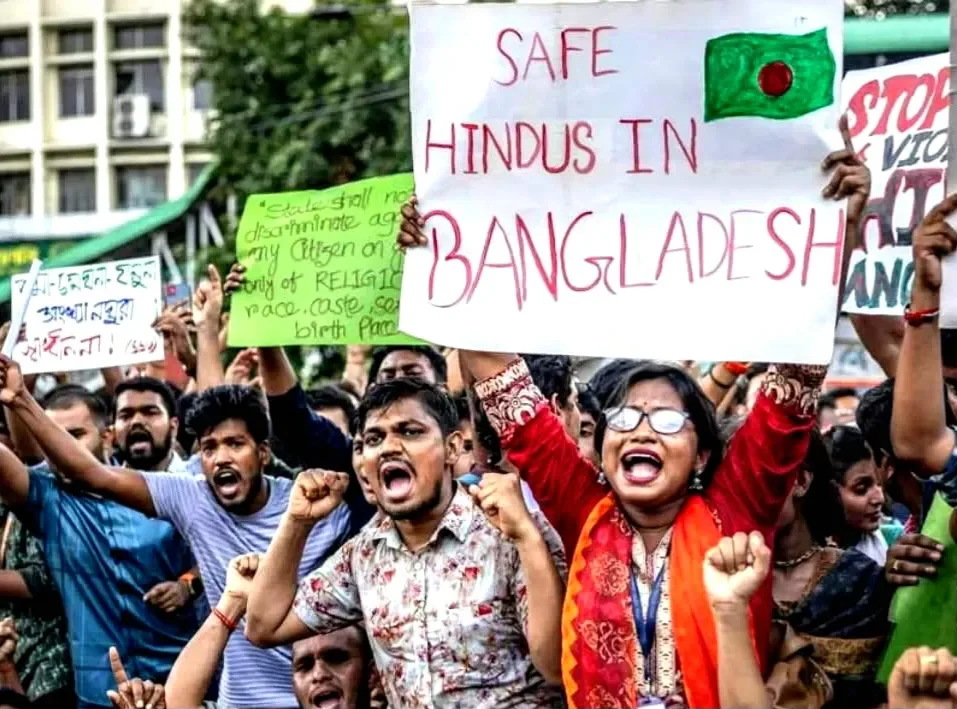
Khokon Chandra Das, the 50-year-old Hindu medical shop owner from southern Bangladesh died after being brutally attacked, sparking renewed fears among minority communities already facing a wave of extremist violence under Yunus rule.
Das succumbed to severe burn injuries and multiple stab wounds on Saturday at the National Institute of Burn and Plastic Surgery in Dhaka, three days after being assaulted while returning home from his pharmacy in Keurbhanga Bazar, Shariatpur district.
“He died from extensive burns and trauma,” confirmed Professor Dr Shaon Bin Rahman.
Police and local journalists reported that Das had been travelling in an auto-rickshaw late on Wednesday when the radicals stopped the vehicle on the Damudya–Shariatpur road.
He was dragged onto the roadside, stabbed repeatedly, doused with petrol, and set on fire.
In a desperate bid to survive, he jumped into a nearby pond, extinguishing the flames before residents rushed him to hospital.
“He was badly burned and bleeding,” said a local resident who helped rescue him. “No one feels safe walking at night anymore.”
Das’s wife, Sima Das, said the family had no known enemies. “My husband was a simple man who served the community. We cannot understand why he was attacked,” she said.
The incident follows a string of violent attacks against Bangladesh’s Hindu minority, who make up roughly 8% of the country’s 170 million population.
In the past two weeks, at least seven Hindu-owned homes were set on fire in Chattogram’s Raozan sub-district.
Residents said assailants locked doors from the outside, poured kerosene, and left threatening banners warning them to halt activities “against Islam” or face destruction of property and businesses.
Local community leaders described the attacks as coordinated and designed to instil fear. “This is organised terror,” one said.

“The intent is intimidation, displacement, and collective punishment.”
Earlier in December, two Hindu men were lynched in separate incidents.
Dipu Chandra Das, 25, a garment worker, was killed in Mymensingh over alleged blasphemy, which his family denies, and his body was reportedly hung from a tree and set on fire.
Amrit Mondal, 29, was beaten to death in Rajbari district, with authorities attributing the killing to a local dispute—a claim disputed by civil society groups.
Legal experts and human rights observers say the attacks reflect a broader climate of impunity under the interim government of Nobel laureate Muhammad Yunus.
Several individuals previously convicted for attacks on secular bloggers, including Avijit Roy, have reportedly been released, allowing extremist networks to regroup and target vulnerable minorities.
“These are not random criminals,” said a senior lawyer from the Bangladesh Supreme Court.
“They are organised networks emboldened by administrative inaction and political uncertainty. Minority communities, already vulnerable, are being deliberately intimidated.”
Local law enforcement confirmed they are investigating Das’s death.
“We have learned about the death from his relatives, and we are still investigating the matter,” said Additional Superintendent of Police Tanvir Hossain.
Community leaders have called for swift justice.
Amit Ghatak Chowdhury, president of the Bangladesh Puja Udjapan Parishad in Shariatpur district, said: “We are deeply saddened by Khokon Das’s death. We tried everything to save him and support him. To prevent such heinous incidents in the future, we demand that the offenders be brought under the law quickly and receive exemplary punishment.”
Residents said the attacks have heightened fear and insecurity. “We used to worry during elections,” said a local elder. “Now we worry every night.”
Former Prime Minister Sheikh Hasina has criticised the Yunus administration for failing to protect religious minorities and allowing extremist networks to operate with impunity.
For Bangladesh’s Hindu population, the death of Khokon Das underscores the heightened vulnerability of minority communities amid a fragile political transition.
The senior lawyer of Bangladesh Supreme Court said, “These attacks reflect a climate of impunity in which religious extremism has metastasised, compounded by administrative inertia and the erosion of state authority. Without decisive action, vulnerable communities will continue to be exposed to systematic violence.”