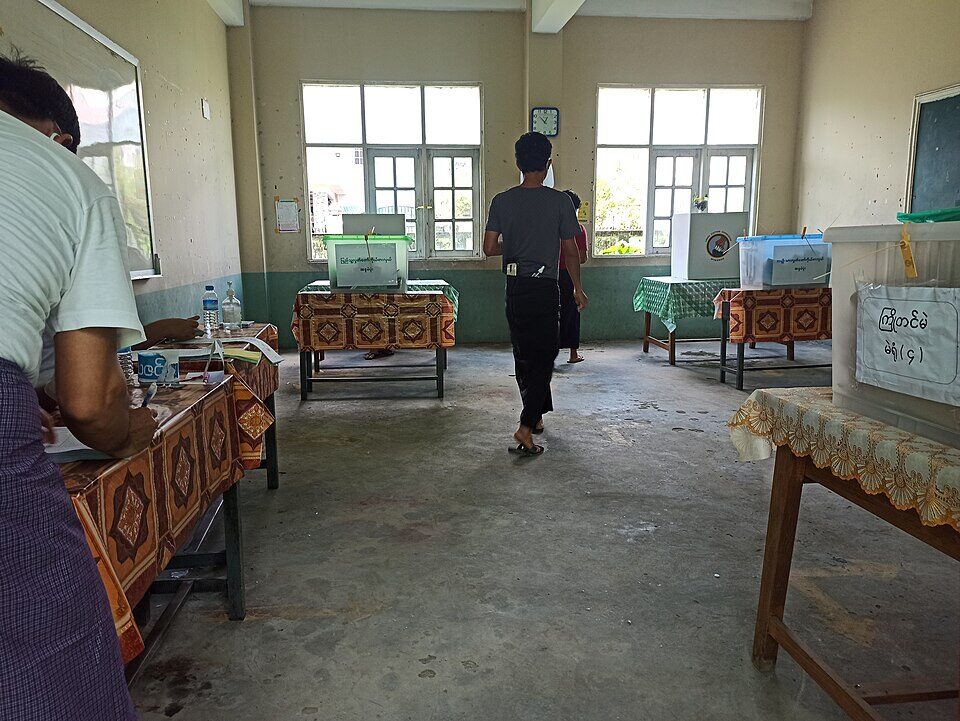
Myanmar’s military-backed Union Solidarity and Development Party (USDP) has emerged overwhelmingly ahead in the first phase of the junta’s 2025–26 general elections, according to preliminary results released by the regime’s Union Election Commission (UEC). State media reported that the USDP is poised to win 88 of the 96 seats declared so far in the Pyithu Hluttaw (lower house) following voting held on December 28 in 102 of the country’s 330 townships. The UEC claimed that around six million votes were cast and that voter turnout stood at 52 percent of more than 11 million eligible voters in this phase.
Media reports further indicated that partial tallies from 56 constituencies showed the USDP securing 38 of the 40 lower-house seats counted to date, with the remaining seats going to the Shan Nationalities Democratic Party—also known as the White Tiger Party—and the Mon Unity Party (MUP). Smaller parties, including the Naga National Party (NNP), National Unity Party (NUP), Shan-ni Solidarity Party (SSP), Shan and Nationalities Democratic Party (SNDP), and the MUP, accounted for only a handful of seats.
In State and Regional Hluttaws, the USDP won 14 of the 15 seats declared, while the Akha National Development Party secured one. For the Amyotha Hluttaw (upper house), only one seat has so far been announced, which was won by the Wa National Party.
Independent election analyst Htin Kyaw Aye told Democratic Voice of Burma (DVB) that the results clear the path for regime leader Senior General Min Aung Hlaing to appoint himself—or a close loyalist—as president once the electoral process is completed. He described the polls as fundamentally lacking credibility, sharply contrasting them with the 2020 elections, which were widely regarded as free and fair before being overturned by the military coup of February 1, 2021.
The military authorities have portrayed the election as a step toward restoring political order, yet the manner in which it was conducted undermines that claim. Official figures themselves reveal a sharp decline in voter participation compared with the roughly 70 percent turnout recorded in the 2015 and 2020 general elections, according to data from the International Foundation for Electoral Systems. Independent observers and local media accounts further challenge the regime’s narrative, suggesting that actual voter engagement was well below the declared 52 percent, particularly in urban centres and conflict-affected regions.
The voting period was marked by widespread violence and resistance activity. Explosions, grenade attacks, drone strikes, and rocket fire were reported near or at polling sites across Mandalay, Yangon, Sagaing Region, Kayin (Kawthoolei), Karenni (Karenniland), Chin, Shan, and Tanintharyi regions. In Mandalay, junta forces responded with heavy artillery fire, including howitzers, resulting in civilian injuries. Several attacks targeted polling stations or junta administrative offices, while in some locations, such as Loikaw, polling sites were reportedly empty at the time of the attacks. These incidents highlighted both the military’s limited territorial control and the depth of popular rejection of the electoral exercise.
Reports from across the country indicate that those who did vote were predominantly elderly, while large numbers of young people were absent—having fled junta-held areas, been forcibly conscripted, or choosing to boycott the process. In Hakha, the capital of Chin State, videos circulated by local outlets showed deserted streets and shuttered shops, with residents avoiding even regular Sunday church services.
In Lashio, northern Shan State, authorities reportedly bused in voters from distant villages to create the appearance of participation. In Naypyitaw, some voters told local media that they cast ballots out of fear of reprisals, believing they were expected not only to vote but to support USDP candidates specifically.
According to multiple local Burmese-language media reports, localized data further underscore the credibility gap. In Hakha—a town with a pre-war population of around 72,000, much of which has since fled—only about 2,800 votes were reportedly cast, overwhelmingly in favour of the USDP. These reports indicated that most of the voters were likely junta personnel and their families, pointing to the near-total absence of the civilian population. Such examples reinforce assessments that the vote reflects coercion and demographic distortion rather than genuine political choice.
Two further rounds of voting are scheduled for January 11 and January 25, intended to cover 265 additional townships, including areas where the military lacks full control. Whether voting can be meaningfully conducted in these regions remains uncertain.
Against this backdrop, the junta announced a mass prisoner amnesty to mark Myanmar’s 78th Independence Day, releasing 6,186 inmates nationwide, including 850 from Yangon’s Insein Prison. However, sources told DVB that only one political prisoner—former information minister Ye Htut, imprisoned for criticizing the military on social media—was included.
According to DVB, more than 106,000 prisoners have been released through periodic amnesties since February 2021, of whom at least 8,882 were political detainees. Over the same period, the Assistance Association for Political Prisoners has documented more than 30,000 politically motivated arrests, with over 22,000 people still in detention.
Analysts argue that, taken together, the conduct and outcome of the first phase of the elections—marked by restricted participation, pervasive violence, coercion, and a tightly controlled field of candidates—underscore the widespread view that the process is aimed less at restoring civilian rule than at formalizing and legitimizing continued military domination of Myanmar’s political system.