India, which shares a 1,643-kilometre-long porous land border with Myanmar, is keenly observing the ongoing national elections in the military-ruled Southeast Asian nation, with a cautious hope that the Buddhist-majority country of nearly 55 million people may witness some degree of stability in Naypyitaw.
Even as the global community continues to denounce the military-staged polling, India’s northeastern region, adjoining northern Myanmar, looks to developments across the border with particular concern. The unchecked flow of illicit drugs and arms, cross-border insurgent movement, and the long-standing use of Myanmar’s frontier regions as safe havens by Northeast militant groups remain key anxieties for New Delhi.
Border management has therefore remained central to India’s engagement with Myanmar. Over the years, India has repeatedly urged Myanmar to ensure that insurgent outfits from the Northeast—especially Valley-Based Insurgent Groups from Manipur—do not find shelter or operational space inside Myanmar’s bordering regions. These groups are widely believed to operate in close proximity to, and in some cases alongside, the Myanmar military junta.
Addressing such covert linkages, along with curbing arms trafficking and narcotics flows, is something India would closely watch once the polls are completed and a new government, under military supervision, takes office in Naypyitaw. Equally important for New Delhi is the early and orderly return of Myanmarese refugees who crossed into Indian territory following the escalation of conflict.
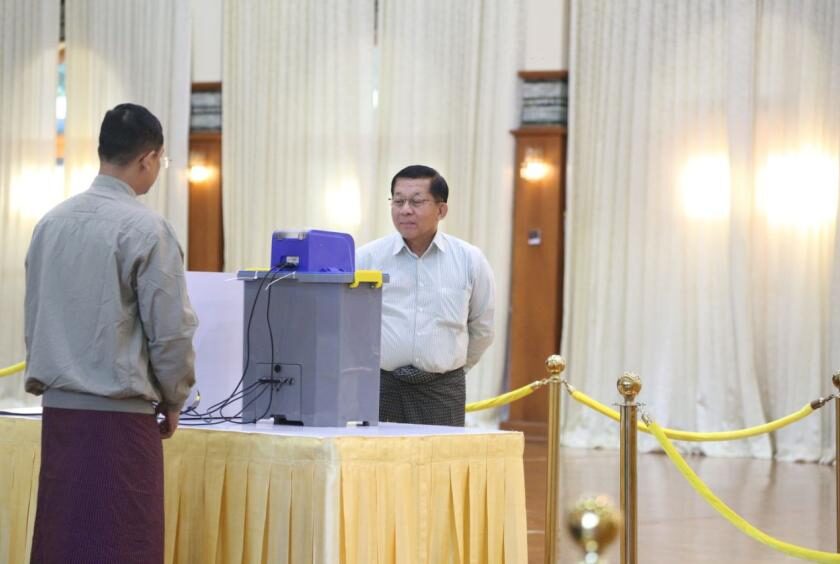
Against this backdrop, the poverty-stricken nation conducted two phases of general elections on 28 December and 11 January amid what many observers described as a civil war-like situation, resulting in low voter turnout. The polling covered 202 townships out of a total of 330, even as several localities remained excluded as they were not under the control of the military regime led by Senior General Min Aung Hlaing.
Anti-military ethnic armed organisations, People’s Defence Forces, and other resistance outfits—currently controlling nearly one-third of Myanmar’s territory—strongly opposed the polls. The third phase of voting is scheduled for 25 January, covering only 63 townships. The final results, based on electronic voting machines used for the first time in Myanmar, are expected by the end of the month.
Myanmar witnessed a military coup on 1 February 2021 that overthrew the democratically elected government of the National League for Democracy led by Nobel laureate Aung San Suu Kyi. Since then, former State Counsellor Suu Kyi, now facing 27 years of imprisonment, President U Win Myint, sentenced to 12 years, and thousands of NLD leaders, workers, and civilians, including media professionals, remain behind bars.
The absence of the NLD, which secured landslide victories in the 2015 and 2020 national polls, has severely undermined the credibility of the current electoral exercise. Pro-democracy activists across the world have unequivocally termed Myanmar’s electoral process a sham.
The junta-appointed Union Election Commission had initially planned polling in 274 townships, declaring the rest disturbed and unstable, particularly in Rakhine, Sagaing, and Shan provinces. Voting began at 6 am on both days under heavy security and continued until 4 pm.
The largely peaceful polling witnessed mostly elderly voters, many of whom appeared to participate more out of fear of intimidation by the armed forces than political conviction. Younger voters, especially those not belonging to military families, largely boycotted the election. The pro-military Union Solidarity and Development Party has already been declared the winner in most constituencies for the Pyithu Hluttaw, the lower house of Parliament.
Earlier, the Election Commission cancelled the registration of several mainstream political parties. Over 40 political parties, including the NLD, did not re-register. Only six parties were allowed to field candidates nationwide, while 51 smaller parties were permitted to contest regional assemblies. More than 4,850 candidates, including independents, remained in the fray.
Since the 2021 coup, Myanmar has recorded over 7,500 casualties during violent political protests. Nearly 3.6 million people have been displaced, and more than 20 million now require humanitarian assistance. Government forces continue crackdowns with indiscriminate airstrikes on crowded areas, hospitals, and schools.
Over 22,000 political prisoners remain under detention, while many pro-democracy leaders have fled to neighbouring countries such as Thailand, China, Bangladesh, and India. Despite this, the military leadership has sought to project the elections as a successful democratic exercise in an attempt to legitimise its unlawful seizure of power.
The United Nations has condemned the polls as a sham. UN Special Rapporteur Tom Andrews cited political repression, the detention of over 22,000 political prisoners, and the deaths of more than 7,600 civilians since the coup, stating that the exercise was not free, fair, or legitimate.
Strategic observers predict that soon after the polls, Min Aung Hlaing may assume the presidency and appoint one of his trusted associates as the top military commander. Under the military-drafted 2008 Constitution, which reserves 25 per cent of parliamentary seats and key ministries for defence personnel, elected lawmakers are likely to remain marginal to real power.
Myanmar’s neighbours, including India, have expressed growing concern over continued instability along border areas and the unchecked influx of Myanmarese nationals. With major investments in the Kaladan Multi-Modal Transit Transport Project and hopes linked to the India-Myanmar-Thailand trilateral highway, New Delhi continues to await an India-friendly administration next door.
Beyond connectivity and trade, India’s primary expectation remains firm action against cross-border insurgency. It will be closely watched how the military junta responds to India’s long-standing demand to dismantle insurgent bases, particularly those used by Valley-Based Insurgent Groups from Manipur operating in Myanmar’s border regions.
Compounding regional anxieties is the presence of 1.2 million Rohingya refugees in Bangladesh, displaced from Myanmar’s Arakan region. Persistent fears of attempts to push armed Rohingya militants into eastern India could once again destabilise the region, keeping border management and counter-insurgency cooperation at the heart of India’s Myanmar policy in the post-election period.