As Myanmar heads toward its third and final round of polling scheduled for January 25, a fresh spate of violence—particularly along key highways connecting the former capital Yangon with Naypyitaw and Mandalay—has further complicated an already contentious electoral process overseen by the military junta. Attacks by multiple armed groups have intensified along these routes, which are vital both for civilian movement and for the functioning of the military-led government and its administrative machinery.
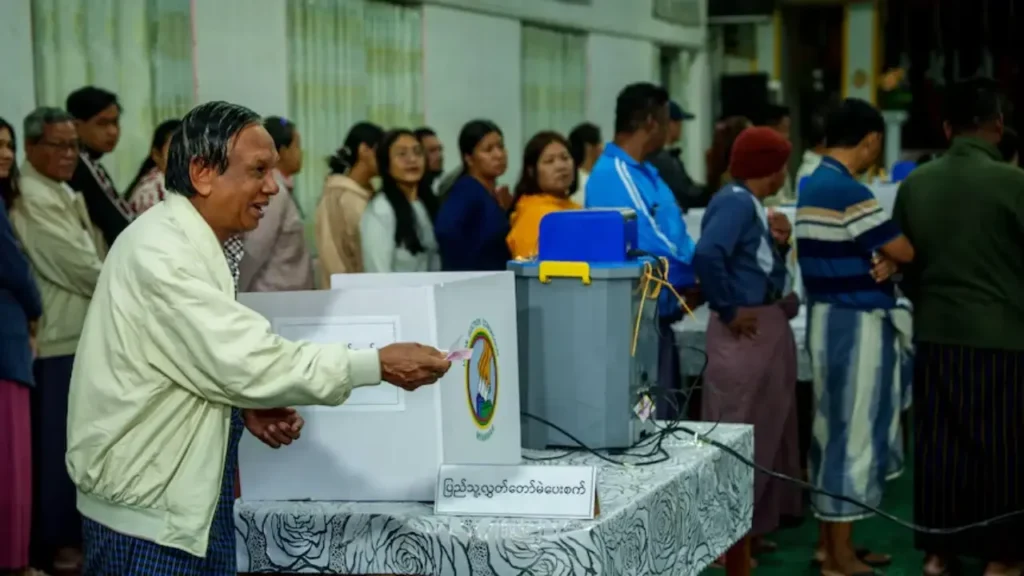
Elections under the supervision of the military-controlled Union Election Commission (UEC) are currently underway, with the first two rounds held on December 28 and January 11. In what has been widely described as a one-sided exercise, the military-backed Union Solidarity and Development Party (USDP) has emerged as the dominant winner in most constituencies where voting has taken place so far.
According to official figures, the USDP has won 52 of 78 seats in the Amyotha Hluttaw, or upper house of parliament, and 175 of 202 seats in the Pyithu Hluttaw, or lower house, following two rounds of voting conducted in 202 of Myanmar’s 330 townships. Independent election analyst Htin Kyaw Aye told Democratic Voice of Burma (DVB) that Senior General Min Aung Hlaing had effectively “campaigned” for the USDP by visiting polling stations in Yangon on January 11. He added that the regime leader is expected to appoint himself or a loyalist as president once the USDP forms the next government. Regime spokesperson Zaw Min Tun has said parliament will convene in March, with a new government to be formed by April.
Under Myanmar’s 2008 Constitution, a party that wins 295 of the 588 seats from 265 townships in the Pyidaungsu Hluttaw, or union parliament, can elect the president, though the military is constitutionally allotted 25 percent of all parliamentary seats—166 in total.
The elections, however, are taking place in an environment of escalating conflict. As many as 60 constituencies have been declared not conducive for holding any form of balloting due to ongoing fighting. While the junta-backed State Administration Council (SAC) had initially hoped to cover at least 274 of the 330 townships, the worsening security situation—particularly in strategically significant areas—has made that goal increasingly unlikely, with elections now expected to take place in no more than 250 townships at best.
According to the latest unverified information, purportedly emanating from the UEC and shared by DVB on its Facebook page, complete elections are to be held in 131 townships, partial elections in 118 townships, elections limited to urban areas in 16 townships, and no elections at all in 65 townships. In total, 3,995 areas—including 223 wards and 3,772 village tracts—have been excluded from Phases 1, 2 and 3 of the regime’s 2025–26 elections, according to the UEC.
A senior Yangon-based journalist said that while the USDP “is the clear winner” in what he described as a one-sided contest, “the situation has not changed, and violence seems to be taking a new dimension.” According to him, numerous armed groups, including the People’s Defence Force (PDF), are operating simultaneously and at times in conflict with one another. “It is difficult to say which group is involved in what, though the PDF has been most active in its offensives against the junta and in trying to disturb the elections,” he said.
The journalist expressed skepticism that the elections would bring any meaningful change, noting that the military junta has consolidated its position and is operating with “open support by China.” “The Chinese embassy has openly said that elections are happening because it wants it to happen,” he added, pointing to Beijing’s growing role in shaping Myanmar’s political roadmap.
The escalation of violence has been particularly pronounced along highways and in central regions such as Bago and Magway, areas that have increasingly disrupted the election process. “The armed rebellion particularly some factions of the PDFs are better armed and have been active in these regions and they are involved,” the journalist said.
When polling began on December 28, voting took place in 102 townships amid reports of violence, airstrikes and attacks on election-related infrastructure by resistance forces, including the PDFs. The military responded with counter-offensives relying heavily on air power. Despite the conflict, junta officials claimed visible voter participation, with turnout reported to be around 40 percent in Naypyitaw, while participation in major population centres such as Yangon, Mandalay and Ayeyarwady appeared uneven based on local accounts.
Amid the elections, factionalism among groups opposed to military rule has also intensified. In one such incident, the Burma National Revolutionary Army (BNRA) reportedly detained a member of the National Unity Government’s People’s Administration Team (PAT) in Sagaing Region during an incident at a checkpoint in Pale Township’s Pann village. BNRA leader Bo Nagar rejected claims that his forces had “raided” the checkpoint, describing the incident as a “quarrel” between the two resistance groups.
The BNRA was established on September 9, 2023, after changing its name from the Myanmar Royal Dragon Army, which was founded by Bo Nagar in January 2022. Bo Nagar has claimed that the BNRA is composed of 18 battalions drawn from Sagaing, Magway and Mandalay regions. While it is not under the command of the National Unity Government, Bo Nagar was a founding member of the PDF in Pale following the 2021 military coup.
Meanwhile, civil society groups in Myanmar have continued their campaigns against the junta, this time condemning ASEAN 2026 chair’s Special Envoy to Myanmar Theresa Lazaro for meeting regime leader Senior General Min Aung Hlaing and other senior officials in Naypyitaw on January 6. According to local media reports a coalition of 99 civil society organisations from Myanmar and the Philippines issued a joint statement condemning the visit, warning that engagement with the regime and its planned elections risks legitimising what they described as a “fabricated political order.”
The statement said the elections violate ASEAN’s Five-Point Consensus, a peace plan agreed to by Min Aung Hlaing in April 2021 but never implemented. The groups also criticised Manila for failing to hold Naypyitaw accountable for transnational crimes, including cyber scam operations linked to the trafficking of Filipino nationals, and urged Lazaro to prioritise human rights and engage with Myanmar’s democratic forces, including the National Unity Government and resistance groups.
As Myanmar approaches the final phase of voting, the widening disconnect between the junta’s claim that elections will restore normalcy and the reality of escalating violence across the country remains stark. While the military-backed USDP’s dominance appears assured, continued fighting—along highways, in central regions and within the resistance itself—suggests that the elections may entrench power without resolving the conflict that has gripped Myanmar since the 2021 coup.