An unprecedented churn in Bangladesh’s military leadership ahead of the February 2026 elections—set against intensifying foreign engagement and great-power rivalry—is placing the Army under rare diplomatic scrutiny, as questions grow over its role in safeguarding electoral credibility and regional security.
As Bangladesh approaches the high-stakes parliamentary election and referendum scheduled for February 12, 2026—following the July–August 2024 student-led uprising—the country’s military has emerged as a pivotal institution shaping both domestic stability and regional geopolitics. At a time when political legitimacy remains contested and institutional credibility is under pressure, the Bangladesh Army’s role has assumed heightened significance, both domestically and in the eyes of external stakeholders.
A sweeping reshuffle at the apex of the Army, intensified election-related security preparations, and expanded diplomatic engagement with Western and European partners are unfolding against the backdrop of sharpening strategic competition between the United States and China in South Asia. These internal and external developments are not occurring in isolation; rather, they intersect with broader concerns over governance, neutrality, and Bangladesh’s long-term strategic orientation amid a shifting regional balance of power.
Taken together, these developments point to a calculated recalibration of the Bangladesh Army’s institutional posture at a moment when political legitimacy, international confidence, and strategic alignment are under sustained scrutiny. As election day approaches, decisions taken within the military establishment—both in command appointments and diplomatic signalling—are increasingly viewed as bellwethers for the credibility of the electoral process and the trajectory of Bangladesh’s regional and global partnerships.
A sweeping reshuffle at the top
In recent weeks, Bangladesh has witnessed one of the most extensive reorganisations of its Army’s senior leadership in the run-up to a national election. The changes include the retirement of the serving Chief of General Staff (CGS) and the Commandant of the National Defence College. A senior officer from the Armed Forces Division, previously serving as Principal Staff Officer (PSO), is set to assume the CGS role, while the Quarter Master General is being elevated to the influential PSO position.
The reshuffle extends well beyond these top posts. Promotions and transfers have affected divisional commanders, training and doctrine institutions, military intelligence, logistics, and welfare bodies. Several officers have been elevated to the ranks of Major General and Lieutenant General, while others have been reassigned to sensitive civilian-facing roles, including positions within the Ministry of Foreign Affairs and strategic state-owned entities.
Officially, the interim authorities have framed these changes as routine institutional adjustments aimed at ensuring continuity, efficiency, and readiness during a politically sensitive period. However, the scale and timing of the reshuffle—coming just weeks ahead of national elections—have inevitably raised questions among analysts, diplomats, and regional observers about the broader intent behind the moves.
Can the army remain neutral as elections approach?
Historically, Bangladesh’s military has played a decisive role during periods of political uncertainty, particularly under caretaker or interim arrangements. While the Army does not constitutionally administer elections, its role in maintaining law and order, supporting logistics, and backing civilian authorities makes it a critical factor in the credibility and smooth conduct of the electoral process.
Against this backdrop, the current reshuffle has attracted heightened attention. Unverified claims circulating within Dhaka’s strategic and diplomatic community suggest that some newly elevated officers are perceived as ideologically sympathetic to Islamist politics or aligned with Pakistan-centric military doctrines. Although these assertions remain contested and lack public substantiation, their circulation reflects deeper anxieties about internal balance and cohesion within the Army at a moment when political legitimacy remains fragile.
From New Delhi’s perspective, developments within the Bangladesh Army are far from a purely internal matter. India’s long and porous border with Bangladesh has historically meant that political instability in Dhaka can spill over in the form of refugee flows, cross-border crime, or the revival of insurgent networks in India’s northeast. Consequently, India has consistently favoured a professional, apolitical Bangladeshi military committed to continuity in bilateral security and intelligence cooperation.
Foreign engagements draw quiet Western scrutiny
Adding another layer of complexity are recent interactions between the Bangladesh Army and foreign actors. Reports that a group of five foreign nationals—four Americans and one Canadian—visited sensitive military installations, including the headquarters of the 10th Infantry Division at Ramu near the Bangladesh–Myanmar border, have drawn quiet scrutiny within regional defence circles.
Officially, the visitors were linked to a US-based organisation working on autism and special-needs education, and earlier engagements had been framed in humanitarian terms. Defence sources, however, have privately described the latest visit as unusual, given Ramu’s proximity to volatile areas of Myanmar’s Rakhine State and the continuing security implications of the Rohingya crisis.
While no public evidence links the visit to intelligence-gathering or military cooperation, the episode has reinforced speculation about growing Western interest in Bangladesh’s security establishment at a time when Dhaka’s defence procurement choices and strategic orientation are under close international observation.
The China factor and US signalling
That international scrutiny became more explicit with recent remarks by the newly appointed US Ambassador to Bangladesh, Brent T. Christensen. Speaking publicly in Dhaka, Christensen voiced concern over China’s expanding influence in South Asia, including Bangladesh’s deepening military-to-military cooperation with Beijing.
While highlighting extensive US engagement with Bangladesh’s armed forces—ranging from maritime security cooperation to training programmes and peacekeeping support—the ambassador issued a clear caution that deeper involvement with China in certain defence and infrastructure sectors carries long-term strategic risks.
For Bangladesh, China remains its largest defence supplier, providing submarines, naval platforms, armoured vehicles, and missile systems over the past decade. Beijing’s footprint is also deeply embedded in Bangladesh’s infrastructure landscape through the Belt and Road Initiative. From Washington’s—and increasingly New Delhi’s—standpoint, this raises concerns about strategic dependency and potential dual-use vulnerabilities.
Europe outreach, peacekeeping focus, and election security
Against this geopolitical backdrop, Bangladesh’s outreach to European partners has gained added significance. A recent visit by a high-level delegation from Italy’s Ministry of Defence to Army Headquarters in Dhaka focused on expanding bilateral military cooperation and exploring European support for Bangladesh’s defence industrial capacity.
The Italian delegation praised the professionalism of Bangladeshi peacekeepers serving in United Nations missions and paid tribute to soldiers killed in action in Abyei, Sudan. The presence of Italy’s ambassador underscored the diplomatic weight of the engagement, signalling Europe’s interest in sustaining defence ties with Dhaka during a sensitive political transition.
At the same time, Bangladesh continues to foreground its role in UN peacekeeping as a source of international goodwill and institutional legitimacy. The recent rotation of a Bangladesh Air Force aviation transport unit deployed in the Democratic Republic of Congo was accompanied by high-level messaging emphasising discipline, professionalism, and operational reliability.
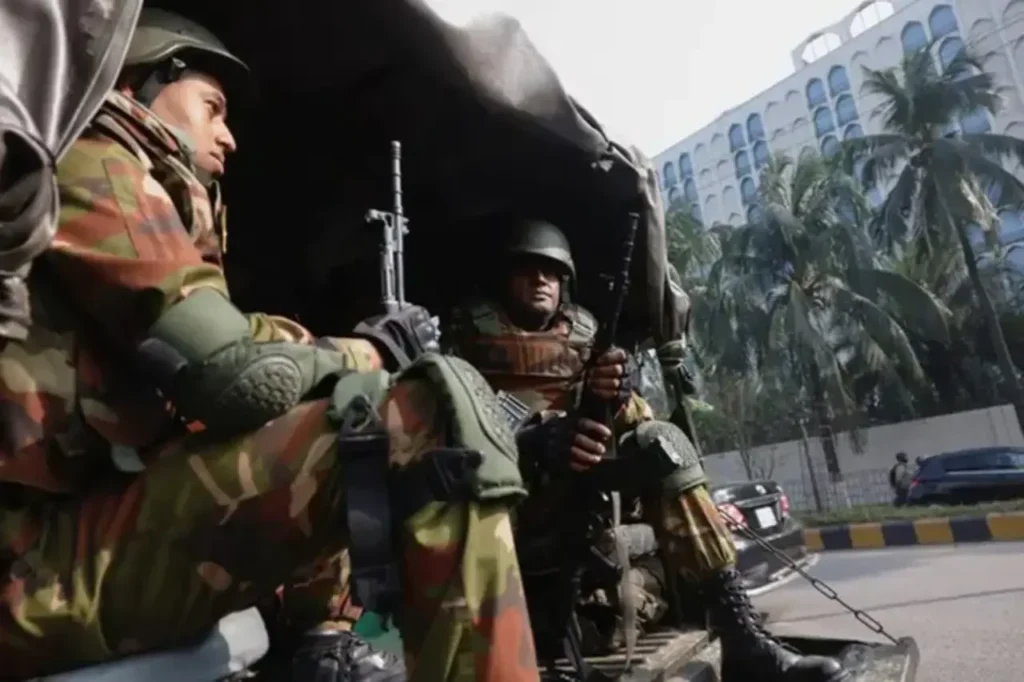
Domestically, the Army Chief has intensified field-level engagement ahead of polling. A recent visit to Chattogram—a politically sensitive commercial hub—involved coordination meetings with senior civil administrators, law enforcement agencies, and military commanders to ensure peaceful and credible elections. Emphasis was placed on neutrality, restraint, and citizen-friendly conduct by personnel deployed under the ‘in aid to the civil power’ framework.
A delicate balancing act ahead
Bangladesh now finds itself navigating a complex triangular dynamic involving China, the United States, and India, while managing a fragile internal political transition. For the military leadership, maintaining operational autonomy while engaging multiple external partners has long been the preferred strategy. During an election period, however, this balancing act becomes far more sensitive and politically consequential.
India has largely refrained from public comment, but strategic circles in New Delhi are closely monitoring shifts within Bangladesh’s military—particularly in intelligence, training, and border-area commands that have direct implications for regional security and stability in the Bay of Bengal.
As election day approaches, the Bangladesh Army’s posture will be critical—not only in ensuring a peaceful polling environment but also in signalling continuity, professionalism, and reliability to international partners. Whether the current recalibration remains strictly institutional, as official narratives maintain, or reflects deeper strategic and ideological realignments will become clearer in the months ahead. For now, the convergence of internal command changes, external diplomatic engagement, and great-power pressure has placed the Bangladesh Army at the centre of a widening regional conversation—one that extends well beyond cantonments into the evolving balance of power in South Asia.