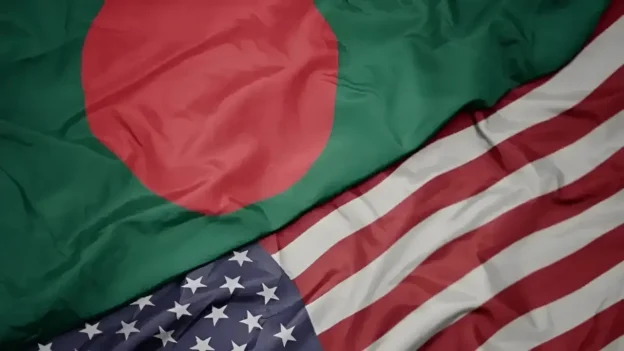

The United States is now openly acting against the very democratic and secular values it claims to uphold by signalling support for Jamaat-e-Islami, Bangladesh’s largest Islamist political party, ahead of next month’s national election. According to a report by The Washington Post, Washington is assessing closer engagement with Jamaat—an organisation that opposed Bangladesh’s independence in 1971, has a documented history of rejecting secular democracy, and has long been associated with political Islam. The move represents not pragmatic neutrality but a striking contradiction between America’s stated principles and its conduct on the ground.
What makes this moment particularly consequential is not merely diplomatic engagement, but the tone and substance of recent remarks by a senior US diplomat in Dhaka, now circulating widely on social media. The comments, captured in audio recordings from a closed-door meeting held on 1 December with Bangladeshi women journalists and later posted by a Facebook user, suggest an unusually candid—and deeply contradictory—American posture toward Bangladesh’s political reset.
For critics, the episode confirms a familiar pattern: Washington publicly champions democracy, secularism, and minority rights, while quietly enabling forces that undermine them when such actors appear electorally useful. In Bangladesh, that calculation increasingly appears to involve legitimising Islamist parties with entrenched conservative ideologies, even as the US continues to warn other countries about the dangers of radicalisation and democratic backsliding.
Jamaat-e-Islami, banned for years under former Prime Minister Sheikh Hasina’s government, is expected to register its strongest electoral performance in the 12 February vote. It leads a new alliance that includes the National Citizen’s Party (NCP), formed by student leaders of the 2024 anti-government uprising that dismantled Bangladesh’s long-standing political order.
The controversy intensified after The Washington Post reported on the existence of the audio recordings. The diplomat—part of the political and economic affairs team at the US Embassy in Dhaka and regarded as well placed within Washington’s diplomatic hierarchy—was heard saying in the audio that Bangladesh had become “more Islamic” and that Jamaat was likely to outperform its previous electoral results.
“We want them to be our friend,” the diplomat said, referring explicitly to Jamaat-e-Islami. He went further, indicating openness to engagement with other Islamist groups, adding: “We are going to talk to Hefazat. We are going to talk to Islami Andolon. We want them to be our friends.”
The remarks, which quickly went viral, were received as something more than neutral observation. Bangladeshi newspapers ran headlines such as “The US wants friendship with once-banned Jamaat,” prompting criticism from secular groups, civil society organisations and political rivals. Jamaat supporters, by contrast, celebrated the comments as international validation of the party’s growing political centrality.
The US Embassy later sought to contain the fallout. Spokesperson Monica Shie described the meeting as a routine, off-the-record discussion and reiterated that Washington supports no particular party, pledging to work with whichever government emerges from a credible election. Yet the content of the recordings has made that assurance difficult to sustain.
In the audio, the diplomat repeatedly veers between acknowledging democratic deficits and endorsing outcomes produced by them. Referring to the International Crimes Tribunal (ICT) that investigated Sheikh Hasina, he conceded: “The ICT is not a tribunal—we recognise it was not a free and fair trial… what have you.” Yet he immediately contradicted this by adding, “But she is guilty and they proved it. They did it within their mandate, which was impressive.”
For critics, this encapsulates the problem: a readiness to dismiss due process while simultaneously endorsing verdicts that align with Washington’s preferred political transition.
The contradictions extend to the current administration under Nobel laureate Muhammad Yunus. While downplaying reports of rising violence—particularly against minorities—the diplomat praised Yunus’s political manoeuvring in strikingly admiring terms. “Yunus as a manager of the BNP when the students failed to form a real party was a genius,” he said, lauding Yunus’s trip to London to negotiate with BNP leader Tarique Rahman as evidence of “political acumen we never thought he had.”
He also emphasised that Yunus “did not back down to the army,” portraying the interim leadership as a stabilising force despite growing concerns about law and order.
Most strikingly, the diplomat spoke about the election almost as an exercise in managed outcomes. He suggested that the fate of Jamaat—and the broader Islamist alignment—would be settled on polling day, implying a degree of confidence in how the political process would unfold. Coming from representatives of a government that had repeatedly criticised Sheikh Hasina’s administration for allegedly failing to hold free and fair elections, the remarks have fuelled accusations of double standards.
Bangladesh’s political landscape has been radically reshaped since the student-led protests of mid-2024 that forced Hasina from office after 15 years in power. Her Awami League was subsequently banned, and an interim administration led by Yunus was installed to oversee reforms and elections. The upheaval created space for long-marginalised actors, most notably Jamaat-e-Islami.
Under Hasina, several senior Jamaat leaders were executed following war-crimes convictions linked to the 1971 Liberation War, while others were jailed or barred from politics. Despite this, Jamaat preserved a robust grassroots network through religious institutions and its student wing, Islami Chhatra Shibir, enabling a rapid political resurgence.
Under its current leader, Dr Shafiqur Rahman, Jamaat has sought to soften its image, emphasising anti-corruption, transparency and good governance while downplaying earlier calls for Islamic law. Party spokesperson Mohammad Rahman has claimed Jamaat will operate within Bangladesh’s constitutional framework and has no intention of restricting women’s participation in public life. The party has nominated two Hindu candidates and engaged Christian leaders, offering assurances that religious laws would not be imposed.
Scepticism remains strong. Political analyst Mobasher Hassan notes Jamaat’s return to mainstream politics after years of exclusion, while Professor Syed Ferdoous of Bangladesh Open University warns that the moderation may be tactical. He points out that Jamaat has not nominated any female candidates, calling into question its reformist claims.
Jamaat’s alliance with the NCP combines organisational depth with urban youth appeal. NCP convenor Nahid Islam has acknowledged ideological differences but described the partnership as a practical necessity.
According to a report in the Daily Star surveys by the International Republican Institute and local groups suggest Jamaat’s support is nearing 30%, placing it in close competition with the BNP. BNP leader Tarique Rahman has acknowledged Jamaat’s strength but remains hesitant about any governing coalition.
From Washington’s perspective, analysts frame the outreach as realism. Local news reports quote The Washington Post, say that the US diplomat dismissed fears of Jamaat imposing Islamic law, while warning that restrictions on women’s rights or democratic norms would trigger economic retaliation, including potential tariffs on Bangladesh’s garment exports, which account for over 80% of export earnings.
Critics argue this exposes a deeper hypocrisy: Washington appears willing to accommodate forces hostile to secular democracy so long as leverage can be applied later. This stance recalls America’s role during Bangladesh’s Liberation War in 1971, when the US—despite detailed reports of mass killings—stood by Pakistan and obstructed international action. For many Bangladeshis, the echoes are unmistakable.
India, while not central to Washington’s immediate calculations, is watching closely. New Delhi has long viewed Jamaat-e-Islami as a security concern due to its opposition to Bangladesh’s independence and ideological proximity to Pakistan. Greater Western engagement with Jamaat, analysts warn, could complicate regional stability.
As Bangladesh approaches polling day, the issue is no longer just electoral arithmetic. The episode lays bare a recurring global reality: when strategic convenience collides with democratic principle, the United States repeatedly chooses the former. In siding with Islamist forces while preaching secular democracy elsewhere, Washington risks reinforcing a perception that its values are negotiable, its standards elastic, and its moral authority increasingly hollow.
With inputs from our Senior International Affairs Correspondent