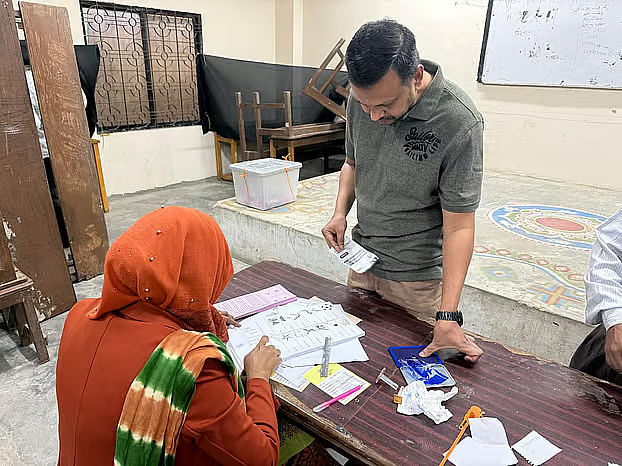
Polling began across Bangladesh at 7:30 a.m. today as voters turned out to cast their ballots in the 13th Jatiyo Parishad elections. The vote is widely viewed as a litmus test for the country’s return to full-fledged democracy after years of political turmoil.
Yet the promise of democratic restoration remains shadowed by controversy. The election is being held without the participation of the country’s largest political force, the Awami League. Its ban continues to raise serious questions about the future trajectory of Bangladesh’s democracy.
Voting is scheduled to conclude at 4:30 p.m., after which ballot counting will commence. Election Commission officials have confirmed that formal announcements of results are expected to begin from Friday morning, February 13, once the counting process is completed.
The scale of the election underscores its significance. Bangladesh has 12.77 crore registered voters. More than 4.9 crore are under the age of 35, and over 2.1 crore fall within the 18 to 25 age bracket.
A total of 2,028 candidates are contesting under 50 political parties across 42,779 polling centres nationwide. Of these, 21,506 have been designated as vulnerable. To secure the process, approximately 9.58 lakh security personnel have been deployed, marking one of the largest mobilizations of state machinery for an election in the country’s history.
The political landscape itself has shifted dramatically. What was once a predictable Awami League versus Bangladesh Nationalist Party (BNP) contest has transformed into a direct confrontation between two former allies—the BNP and Jamaat-e-Islami.
Both parties, sidelined for years under Sheikh Hasina’s Awami League-led rule, now find themselves locked in an intense battle for power. The rivalry has escalated sharply, with each accusing the other of attempting to manipulate the vote even before polling began.
Reports of irregularities surfaced throughout the night preceding the election. There were large-scale allegations of ballot stuffing, with videos circulating on social media showing individuals—mostly alleged Jamaat workers—entering polling stations and attempting to stuff ballots in advance.
One video reportedly showed a Jamaat candidate from the Chattogram-8 constituency caught by locals in connection with such accusations.
Clear video evidence shows Jamaat activists occupying polling centers and casting votes the night before the election. This is outright election rigging and a theft of people’s rights. Such an election is unacceptable.#BangladeshElections #BangladeshElections2026… pic.twitter.com/qFA0YAbZqH
— CrackPlatoonBD24 (@CrackPlatoonBD) February 11, 2026
In Cumilla-4 constituency, tensions escalated further. Sohel Rana, described as a trusted vanguard of the NCP’s candidate and Debidwar upazila NCP leader, along with his associate Alamgir, were reportedly caught by locals carrying weapons in Padmakot village of Gunaighar Union. They were subsequently handed over to joint forces.
Despite these incidents, voter turnout since morning has appeared strong. In Dhaka, voting is proceeding at a rate of 5.42 percent per hour, suggesting that more than 50 percent of ballots could ultimately be cast if the pace continues. Reports from across the country indicate steady lines of voters at polling centres, signaling public engagement despite the charged atmosphere.
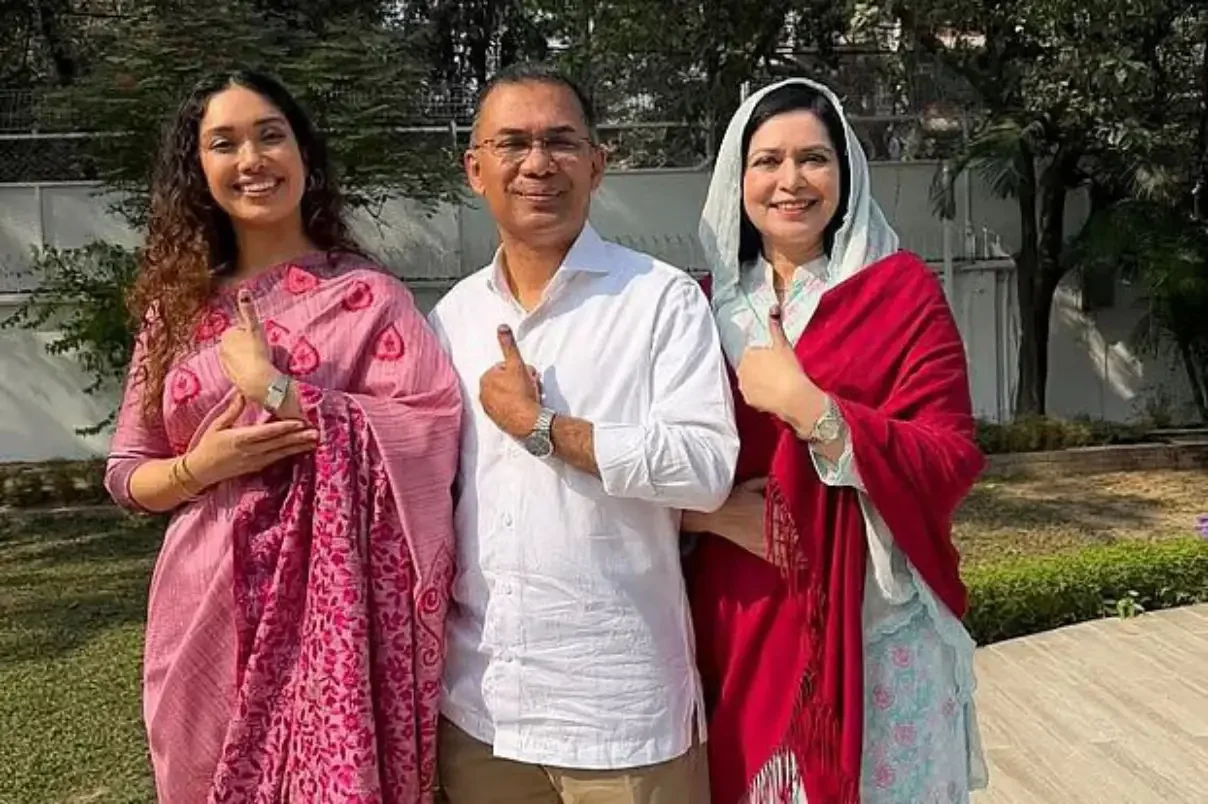
Much of the media attention has focused on BNP leader Tarique Rahman and Jamaat-e-Islami’s Ameer Dr. Shafiqur Rahman, both of whom expressed confidence while casting their votes.
“Victory of BNP is certain,” declared Tarique Rahman after voting at Gulshan Model High School and College in Gulshan-2, Dhaka. The son of former Prime Minister and BNP Chairperson Begum Khaleda Zia, he formally assumed office as Chairman of the Bangladesh Nationalist Party on January 9.
“I have exercised my constitutional right to vote. For more than a decade, the people of Bangladesh have been waiting for this day,” he said.
At the same time, Tarique Rahman acknowledged concerns over reported irregularities.
“I have not yet received updates from across the country, but last night we received reports of some undesirable incidents from different areas, which were unexpected. We firmly believe that law enforcement agencies acted strictly to suppress these incidents, as we saw on television until late at night and early this morning. Personally, I strongly believe that if people across Bangladesh come out throughout the day and exercise their right to vote, any conspiracy can be thwarted. I am hopeful — firmly hopeful.”
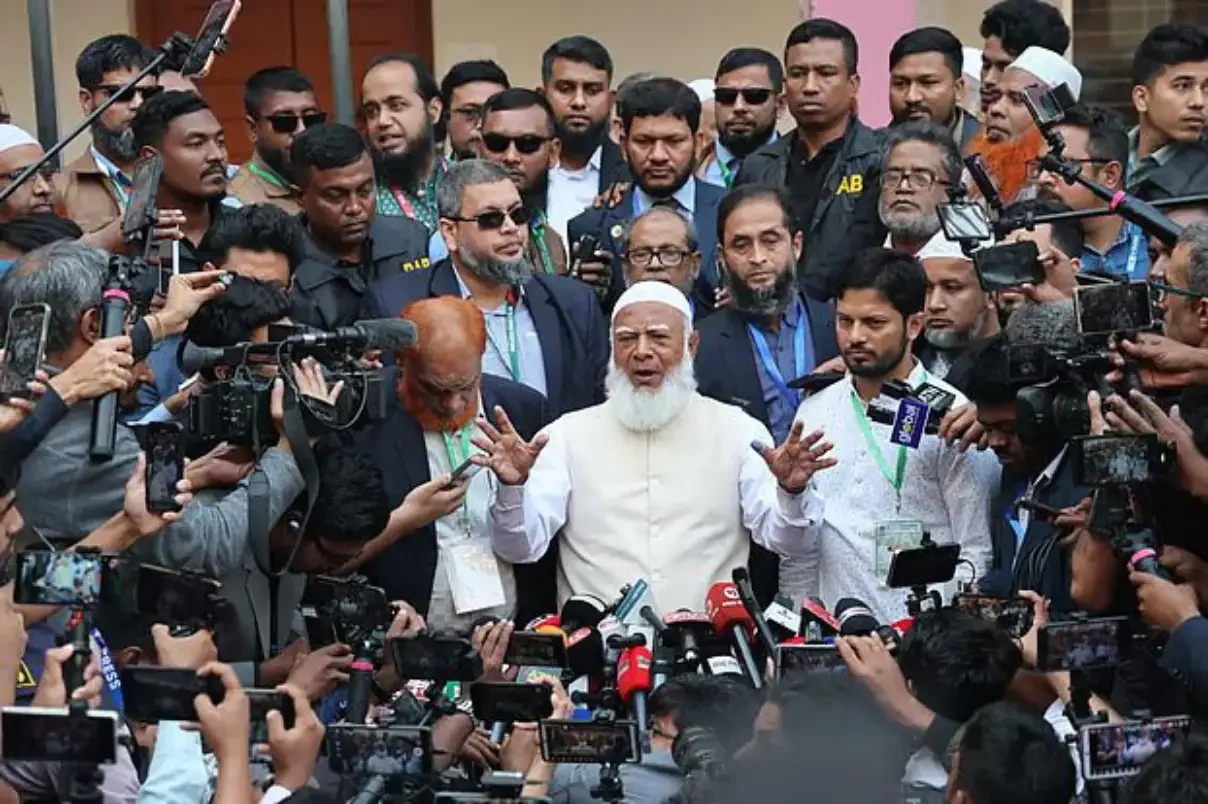
Jamaat-e-Islami leader Dr. Shafiqur Rahman likewise projected confidence, while conditioning his party’s acceptance of the outcome on the integrity of the process.
After casting his vote at the Monipur High School polling station (Boys’ Section) in Mirpur-2, he stated that Jamaat would accept the results only if the polls are conducted in a free and fair manner. Shafiqur Rahman is contesting from the Dhaka-15 seat on behalf of the 11-party electoral alliance led by Jamaat-e-Islami.
“We may ignore minor issues, but we will not let any major issue go unchecked. We will do whatever is necessary because we can never allow people’s voting rights to be compromised,” he said.
Reflecting on previous elections, he added, “In 2014, 2018, and 2024, we were in jail. After losing those three elections, Alhamdulillah, Allah has granted us the opportunity to cast our votes today. We pray that this election marks the beginning of a new chapter in Bangladesh.”
“I believe it’s not just me; the youth of this country, many of whom have never voted before, have eagerly awaited this moment. We pray that this election is peaceful, fair, conflict-free, and acceptable to all,” he added.
On the issue of minorities, Shafiqur Rahman said, “Regardless of their religion, they are all Bangladeshi citizens. There are no second-class citizens in my country. India is our nearest neighbour, and it will remain a priority. I do not consider anyone a minority. We are all Bangladeshis, and everyone is a first-class citizen. We do not endorse divisions based on minority or majority.”
Perhaps the most dramatic statement of the day came from Interim Government head Muhammad Yunus.
“today is the birthday of new Bangladesh. We will celebrate this birthday throughout the day,” he declared. He also urged citizens to participate in the “Gono Vote” referendum, reminding voters to cast their ballots on the constitutional question alongside the parliamentary race.
The broader electoral arithmetic underscores how fluid the contest has become. Surveys indicate that around 80 percent of former Awami League voters are leaning toward BNP; approximately 15 percent toward Jamaat-e-Islami; and the remainder remain undecided or are considering abstention.
Yet a February survey by Prothom Alo placed the BNP-led alliance at 44.1 percent and the Jamaat-led 11-party coalition at 43.9 percent—a razor-thin statistical dead heat.
Jamaat’s voting was already finished before the voting even started. Sham election is on the way.
Location: Narayanganj, Dhaka. pic.twitter.com/aZqfb1O16h
— Redowan Ibne Saiful (@Redowanshakil) February 11, 2026
This election is therefore not a conventional two-party contest but a struggle to capture the largest displaced vote bank in Bangladesh’s electoral history. With the Awami League absent, millions of voters are effectively being politically reallocated, reshaping the country’s ideological balance.
The unprecedented deployment of security forces—including the army, police, Border Guard Bangladesh (BGB), Rapid Action Battalion (RAB), Ansar, navy and air force—reflects both a commitment to maintaining order and recognition of the volatility surrounding the vote. Never before has Bangladesh mobilized such extensive state capacity for a national election.
As the day unfolds, the direction in which this election heads will depend not only on turnout and counting but also on whether allegations of manipulation can be contained and public confidence sustained. For a nation seeking to reset its democratic course after upheaval, the 13th parliamentary election represents both an opportunity and a test—one whose outcome will shape Bangladesh’s political trajectory for years to come.