The night before the vote, an elderly man in a white panjabi stood outside the Election Commission building in Agargaon, clutching a faded national ID card.
“This time, I don’t understand who to vote for to save the country,” he said quietly. “Before, it was either the boat or the sheaf of paddy—one of two. Now it’s the anchor and the scale. But money, too, is everywhere I look.”
His confusion is not merely personal. It is structural.
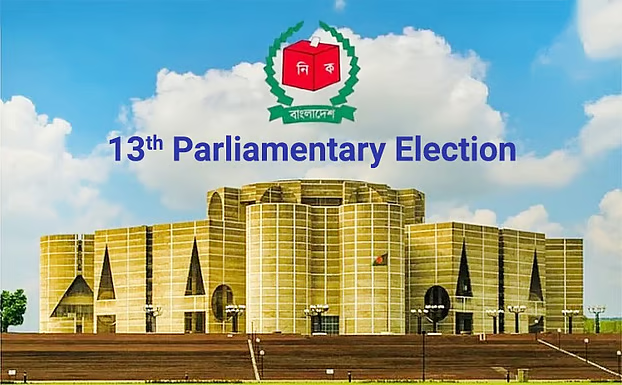
As Bangladesh heads into its 13th parliamentary election on February 12, the country is not simply choosing a government; it is testing whether democratic competition can function without being overwhelmed by the expanding role of money in politics.
An election without its dominant party
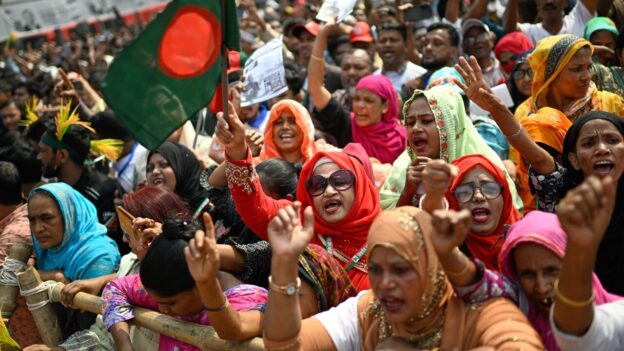
For fifteen years, Bangladeshi politics operated within a familiar binary: Awami League versus BNP; the boat versus the sheaf of paddy; power versus protest.
That equilibrium collapsed on August 5, 2024, when a student-led mass uprising toppled Sheikh Hasina’s government. In the aftermath, the interim administration suspended the Awami League’s registration, citing legal and accountability concerns. For the first time since the restoration of parliamentary democracy in the 1990s, a national election is being held without the party that ruled for sixteen of the last eighteen years.
The arithmetic of that absence is enormous. Historically, the Awami League commanded between 35 and 48 percent of the national vote—roughly four to five crore voters—and that entire bloc is now politically unmoored.
Surveys suggest that around 80 percent of former Awami League voters lean toward BNP; approximately 15 percent toward Jamaat-e-Islami; and the remainder remain undecided or are considering abstention. Yet a February survey by Prothom Alo placed the BNP-led alliance at 44.1 percent and the Jamaat-led 11-party coalition at 43.9 percent—a statistical dead heat.
This is no longer a conventional two-party contest; it is a reallocation battle over the largest displaced vote bank in Bangladesh’s electoral history.
The scale and volatility of the contest
The magnitude of this election is reflected in its numbers: 12.77 crore registered voters; more than 4.9 crore under the age of 35; over 2.1 crore aged between 18 and 25; 2,028 candidates contesting under the banners of 50 parties; 42,779 polling centres nationwide; 21,506 centres marked as vulnerable; and a security deployment of approximately 9.58 lakh personnel.
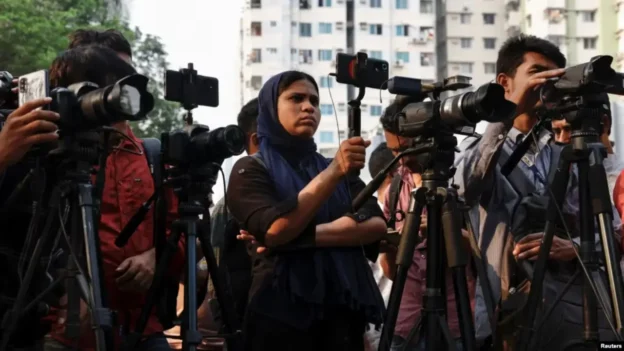
Never before has Bangladesh mobilized such state capacity for a national vote. The army, police, Border Guard Bangladesh (BGB), Rapid Action Battalion (RAB), Ansar, navy and air force have all been deployed across the country. Officially, this signals a commitment to ensuring a free and fair election; politically, it reflects how volatile and uncertain the contest has become in the absence of the Awami League’s organisational machinery.
Cash as strategy in a knife-edge race
Against this backdrop of tight margins, money has emerged as a central instrument of influence.
The Election Commission reports 468 violations of the code of conduct and fines exceeding Tk 32 lakh; yet formal penalties capture only a fraction of the financial undercurrent shaping the campaign.
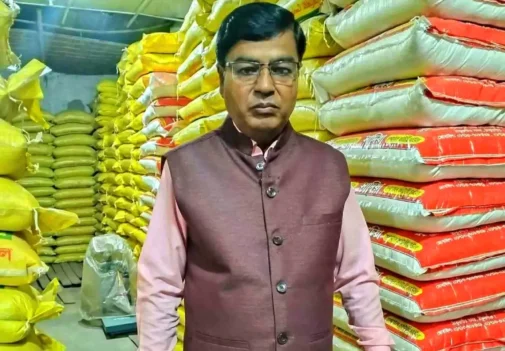
BNP leaders this week met Chief Election Commissioner A.M.M. Nasir Uddin, alleging that Jamaat-e-Islami is conducting a coordinated nationwide vote-buying operation. Among the claims are Tk 74 lakh seized from a Jamaat district leader at Saidpur Airport; cash recoveries reported in Lakshmipur, Chapainawabganj, Sirajganj, Barguna, Noakhali, Rajshahi, Mymensingh, Cox’s Bazar and Bogura; and the distribution of envelopes containing Tk 500 notes in Dhaka’s Sutrapur, which resulted in a mobile court sentence.
Jamaat has categorically denied the accusations, calling them “manufactured dramas.” In Sirajganj’s Kamarkhand, Jamaat leaders have counter-alleged that BNP activists themselves snatched nearly Tk 2 lakh from their workers.
The truth likely lies in a gray zone familiar to South Asian elections: informal funding networks; opaque expenditures; and selective enforcement. What distinguishes 2026 is not the presence of money but its scale in a knife-edge contest where even minor financial interventions could prove decisive.
FPTP and the power of micro-margins
Bangladesh’s first-past-the-post electoral system magnifies small swings; a national lead of just 3 to 5 percent can translate into a 60 to 100 seat advantage in parliament. When polls show a gap of merely 0.2 percent, constituency-level micro-swings become critical, and in marginal seats even modest cash disbursement can alter outcomes.
Jamaat’s organisational discipline, Gulf-linked funding channels and strong student wing presence have made it particularly competitive among first-time voters; surveys indicate that 37.4 percent of 18–25-year-old voters express a preference for Jamaat.
Youth voters now constitute roughly 44 percent of the electorate, and their turnout rate may determine whether Jamaat achieves a historic breakthrough or falls short.
BNP, meanwhile, relies on broader national acceptability and the migration of Awami League’s centrist base; yet 92 rebel BNP candidates complicate the arithmetic in dozens of constituencies, fragmenting what might otherwise have been a consolidated vote.
The political relocation of millions
What is underway is not ordinary swing voting but political re-socialisation.
For decades, Awami League voters identified with secular nationalism and the legacy of 1971. Now they confront difficult choices: support BNP despite memories of the 2001–2006 period marked by instability; support Jamaat despite longstanding controversies linked to the Liberation War; or abstain, thereby fragmenting their own political voice.
This mass reallocation could permanently alter Bangladesh’s ideological balance. The removal of one dominant pole has opened space for a more fluid, competitive and potentially polarised political order.
A Referendum on governance itself
Thursday’s vote carries an additional layer of consequence in the form of a constitutional referendum tied to the “July Charter” reforms proposed after the 2024 uprising.
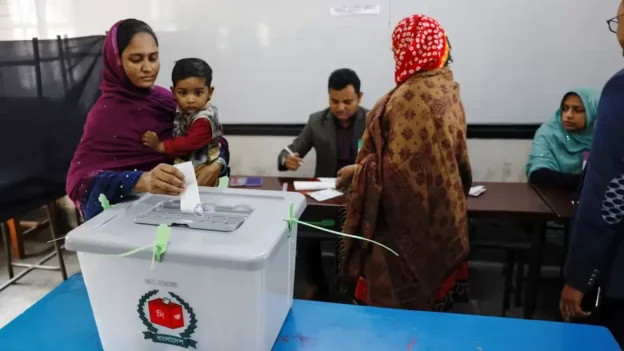
Voters will cast a white ballot for parliamentary candidates and a pink ballot for constitutional change; both ballots will be placed in the same box.
If passed, the reforms could restructure presidential authority; alter judicial appointment mechanisms; and establish a National Consensus Commission. Yet the merging of parliamentary and constitutional mandates risks conflating immediate political preference with long-term structural endorsement. In effect, voters are deciding not only who governs but also how governance itself will be organised.
Security, State authority and post-result risks
The deployment of nearly 9.58 lakh security personnel and the designation of more than half of polling centres as vulnerable reflect two overlapping realities: the absence of the Awami League’s entrenched administrative apparatus; and the expectation that post-result street reactions could become volatile.
The military, which facilitated the 2024 transition, remains visibly present yet politically restrained. If margins are narrow and disputes escalate, its stabilizing role may prove pivotal.
Voter anxiety in a digital transition
Beyond the grand political realignment lies a quieter, practical unease.
Digital searches over the past 24 hours show spikes in phrases such as “vote centre check”; “voter serial number”; and “Smart Election Management BD.” Unlike previous elections, many voters did not receive physical voter slips, and in rural areas connectivity gaps complicate reliance on digital platforms.
For voters like Selina Akter in Chandpur, the concern is straightforward. “I don’t know my polling station,” she says. “Before someone brought the slip.” Institutional modernisation, in this sense, has outpaced voter familiarity.
The structural money problem
At its core, the deeper challenge remains systemic. Bangladesh’s campaign finance regime is largely symbolic: corporate donations lack transparency; spending caps are routinely exceeded; and remittance-linked election funding flows through opaque channels.
Neither BNP nor Jamaat has advanced substantive reform proposals; both accuse the other while benefiting from the same structural opacity. The 13th election therefore becomes a referendum on whether competitive politics alone can dilute the influence of illicit cash—or whether money will simply recalibrate itself within new political alignments.
Possible outcomes and regional stakes
Four broad scenarios emerge from the present arithmetic: a BNP majority in the range of 180 to 215 seats, with Jamaat emerging as principal opposition; a narrow BNP victory constrained by coalition pressures; a hung parliament triggering intense post-election bargaining and placing presidential discretion at the centre; or a Jamaat breakthrough driven by youth turnout, producing an ideological shift with regional repercussions.
For South Asia, the stakes extend well beyond Dhaka.
India seeks stability and continuity in security cooperation; China aims to preserve infrastructure commitments; and the United States watches the credibility of democratic practice. Bangladesh’s internal vote balance will reverberate across the Bay of Bengal.
The final test
This is the first genuinely competitive national election in nearly two decades and the first major political exercise after a popular uprising reshaped the country’s power structure.
But the defining question is not simply who wins. It is whether Bangladesh can meaningfully reduce the influence of cash in shaping electoral outcomes—or whether money will remain the invisible hand guiding its democracy.
As polls open at 7:30 a.m., 12.77 crore citizens will answer the elderly man’s question in their own way.
The vote balance will determine the next government; the money balance will determine whether that government inherits a democracy strengthened—or compromised—by the very contest that brought it to power.