As the Bangladesh Nationalist Party (BNP) moves decisively toward forming the next government, its chairperson Tarique Rahman has struck a measured tone—projecting confidence at home while signalling balance abroad. With a landslide mandate in the 13th Jatiya Sangsad elections, Rahman is expected to be sworn in as prime minister within days.
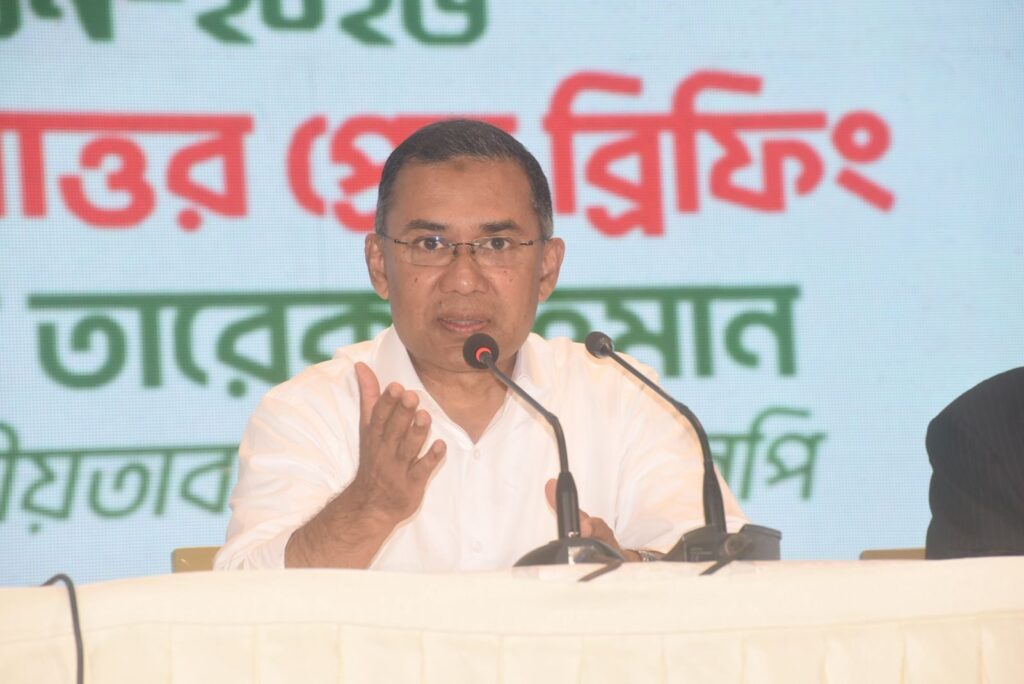
Addressing a packed press conference at Hotel InterContinental Dhaka on Saturday afternoon, Rahman called for unity, restraint and “responsible conduct” from party leaders and supporters. “Now is the time to build the country with the support of political parties and stakeholders,” he said, stressing that national unity is Bangladesh’s strength.
The BNP has secured a commanding majority, winning 213 of 297 declared seats, with allies adding a few more—placing the bloc well beyond the threshold required to govern. The Election Commission has published the gazettes for elected members, clearing the way for oaths and cabinet formation. Officials indicated that the swearing-in ceremony could take place within three to four days at Bangabhaban.
Rahman, who returned to Bangladesh in December after 17 years in exile, appeared more assured and deliberate than during his earlier years as a central figure within the BNP during its 2001–2006 term in government—a period that later became subject to significant legal and political scrutiny. International and domestic journalists pressed him on foreign relations, particularly ties with India and China, but he avoided signalling any shift toward a specific camp.
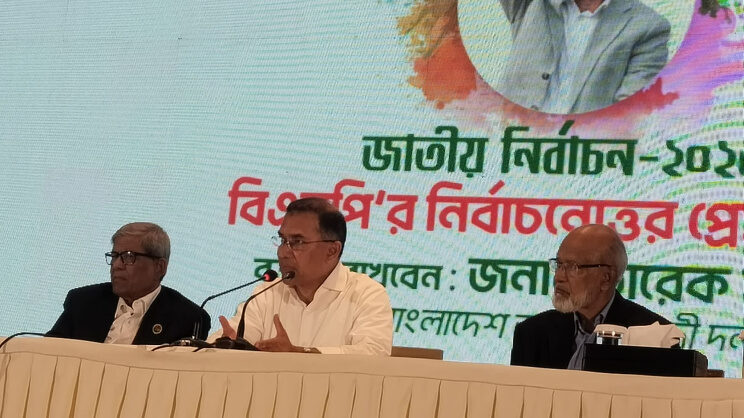
He stated that his government would “maintain good relations with all countries” and pursue a foreign policy guided by “the greater interests of Bangladesh and its people.” Without naming preferences, he suggested that decisions on partnerships—including large infrastructure initiatives—would be assessed strictly through the lens of national interest.
For those who have followed Bangladesh’s politics closely and assessed Rahman’s re-entry into the country’s current political landscape, his remarks offered subtle clues. While he stopped short of outlining a detailed foreign policy framework, his responses could be interpreted as signalling the emergence of an approach that avoids overdependence on any single country.
This was reflected in his answer to a question regarding Bangladesh’s future relations with China and the Belt and Road Initiative. Rahman stated that his government would seek to “protect the interests of the people of Bangladesh. If something is not in Bangladesh’s interest, naturally we cannot pursue it. I am certain that mutual interests will be our first priority.”
On relations with India, which have been strained since the July 2024 uprising and the interim government’s tenure under Muhammad Yunus, Rahman did not offer specifics but acknowledged the importance of maintaining stable ties. Given India’s geographic proximity and deep economic and cultural linkages with Bangladesh, observers expect the new administration to tread carefully.
He was notably silent on the extradition of former prime minister Sheikh Hasina, who remains in India, and did not comment on the International Criminal Tribunal’s verdict sentencing her to death over her alleged role in the July crackdown. His restraint signalled an attempt to avoid inflaming diplomatic sensitivities at a delicate moment.
The July National Charter referendum, held alongside the parliamentary vote, was approved with a decisive majority and a turnout of over 60 percent. Although the BNP had previously expressed reservations over certain provisions, Rahman said points of dissent would be discussed thoroughly. The reforms aim to curb executive concentration of power and restructure the political system, setting the stage for significant institutional change.
While the election process was largely orderly—earning praise from international observers—sporadic post-election violence underscored the fragility of the transition. In Bagerhat’s Kachua upazila, a supporter of a BNP rebel candidate died following clashes between rival factions. Rahman appealed for calm, warning supporters against provocation and urging discipline during the transition.
He thanked the interim administration and the Election Commission for conducting what he described as a credible poll and acknowledged the sacrifices of party activists during years in opposition. “We must repay the people’s trust by improving their lives,” he said.
For a party returning to power after nearly two decades, the mandate is sweeping—but so are the expectations. Cabinet formation is imminent, and attention will soon shift from electoral triumph to governance. How Rahman balances domestic reform, economic recovery and complex regional diplomacy will define the next chapter of Bangladesh’s political trajectory.
For now, the message from the BNP chief is clear: unity at home, balance abroad, and decisions anchored in Bangladesh’s national interest.