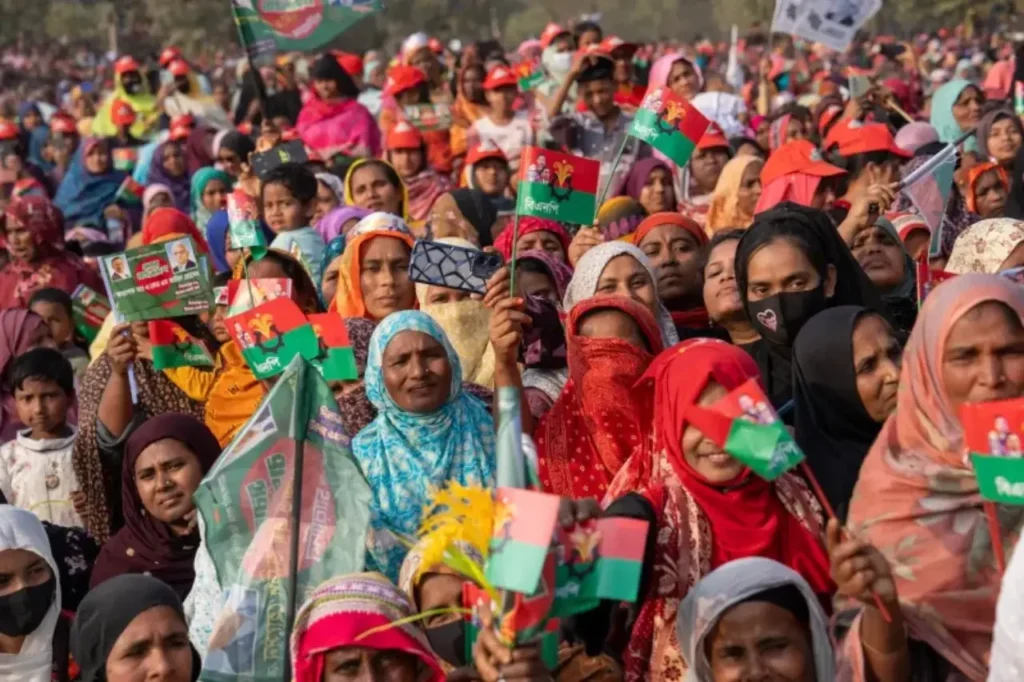
Bangladesh’s 13th parliamentary election on 12 February has been followed by a surge of violence that suggests the contest did not end with the counting of ballots. Within forty-eight hours, at least three people were killed, hundreds injured, and scores of homes, businesses and religious sites attacked.
The scale of unrest indicates that post-election confrontation may become a defining feature of the transition. In much of South Asia, electoral rivalry often spills into the streets, triggering retaliation, local power struggles and communal friction. Bangladesh appears to be witnessing a similar pattern.
According to the Human Rights Support Society (HRSS), more than 200 violent incidents were recorded across 30 districts in just two days after the vote. Victims included political activists, civilians and a child. At least 35 0 establishments were reportedly vandalised or set ablaze, pointing to a coordinated wave of disruption rather than isolated flare-ups.
One of the most brutal incidents took place in Char Feson of Bhola district. Abdur Rahim, 45, a former local Awami League activist, was hacked to death late on Saturday night. Police linked the killing to disputes over livestock theft and narcotics.
Local residents, however, alleged that the attackers were followers of a victorious Bangladesh Nationalist Party (BNP) candidate from the Bhola-4 constituency. Rahim had reportedly protested attacks on his son and the forcible slaughter of his goats days before the election. The episode underlines how local political victories can embolden rival groups and blur the line between crime and political reprisal.
Such micro-level clashes carry wider implications. Political instability in Bangladesh has historically generated cross-border pressures for India, including irregular migration and security concerns along the India–Bangladesh border. Localised violence can therefore acquire regional significance.
Communal tensions have also surfaced. In Sylhet, arsonists set fire to the Gour Nitai temple inside a tea estate, destroying religious texts and idols. Although BNP leaders condemned the act and demanded an investigation, the timing has heightened fears among minority communities.
In Khulna, supporters of Bangladesh Jamaat-e-Islami accused BNP activists of torching a supporter’s home after Jamaat-backed candidates outperformed the BNP locally. In several rural areas, electoral outcomes appear to be translating into coercive assertions of dominance.
For New Delhi, these developments revive longstanding concerns over minority security in Bangladesh. While Dhaka has previously rejected allegations of systemic targeting, such incidents are closely monitored by Indian policymakers, particularly during political transitions.
The post-election phase has also seen deaths in custody and allegations of political retribution. Shamikul Islam, a detained Awami League leader in Gaibandha arrested in post-2024 cases, died in hospital due to cardiac complications.
Days before the 12 February poll, veteran politician Ramesh Chandra Sen, former Minister for Water Resources and former MP from Thakurgaon-1, died on 7 February after falling ill inside Dinajpur District Jail. The 86-year-old was transferred to Dinajpur Medical College Hospital in critical condition and declared dead shortly after arrival. Such cases reinforce perceptions of selective justice during politically sensitive periods.
BNP leaders have argued that the violence stems from personal disputes or criminal rivalry rather than organised party action. However, HRSS and police data suggest a broader pattern involving activists from the BNP, Jamaat and independent groups across districts. Clashes in Natore and Sirajganj further point to entrenched factionalism.
The pattern reflects structural weaknesses: competitive elections without effective post-election conflict management. Weak local policing, politicised administration and entrenched patronage networks create conditions in which violence can flourish once national attention shifts.
Election day itself saw at least nine deaths across multiple districts, including voters and polling officials. In Khulna, Mohibuzzaman Kochi (60), a former BNP metropolitan secretary, collapsed at Khulna Alia Madrasa. BNP leaders allege he was pushed during a clash with Jamaat activists, an accusation Jamaat denies. Kochi had a history of heart disease.
In Brahmanbaria, polling officer Mujahidul Islam (48) collapsed and later died. In Mymensingh, presiding officer Rezaul Karim (48) died while on duty. Voters Anath Ghosh (65) in Satkhira, Monu Mia (57) in Chattogram, Babu Mia (70) in Manikganj and Bachher Chowdhury (60) in Gaibandha also died after collapsing.
In Dhaka, former marine engineer Abu Sayeed Sarkar (53) collapsed inside a school polling station. In Kishoreganj, Razzak Mia (55) reportedly died after being chased and jostled near a polling centre. While most deaths appear linked to health complications, the stressful environment of long queues and sporadic clashes highlights the physical and psychological toll of a charged election.
Restoring order will require more than arrests. Credible investigations, depoliticised law enforcement and visible protection for minorities are essential to prevent street confrontations and communal threats from becoming entrenched features of the post-election landscape.
For India, stability in Bangladesh remains critical for regional connectivity, counterterrorism cooperation and Bay of Bengal security. If violence persists, it could complicate this delicate balance.
As Bangladesh moves into its next political phase, the real test of its democracy will lie not only in how votes were cast, but in whether the aftermath is governed by restraint and rule of law rather than by intimidation and unrest.