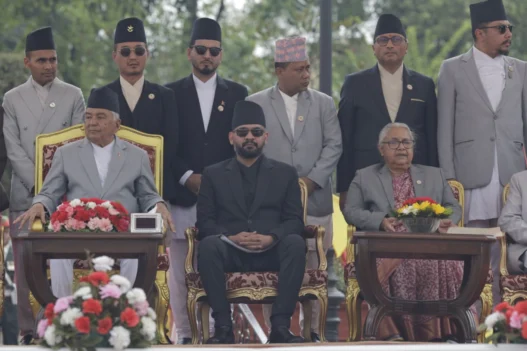
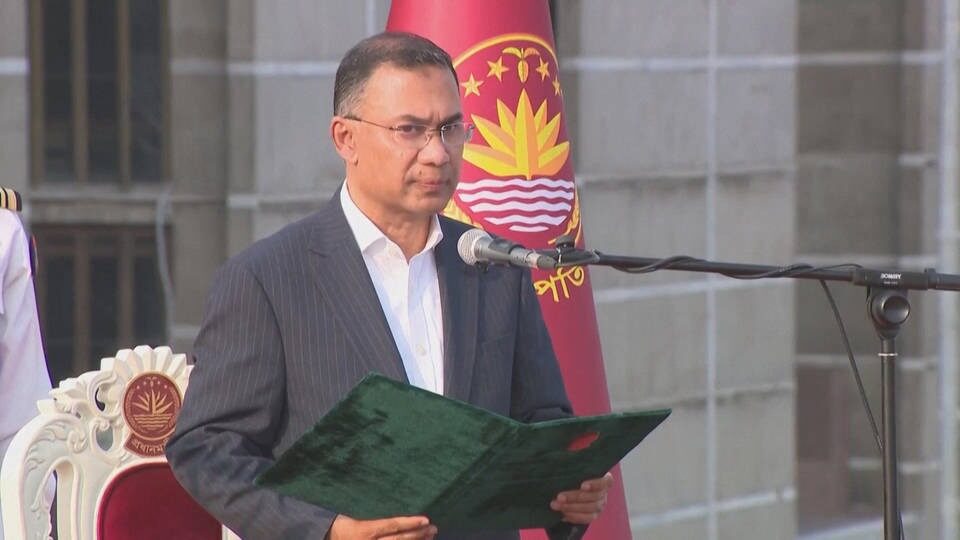
When U.S. President Donald Trump congratulated Bangladesh’s newly sworn-in Prime Minister Tarique Rahman on February 18, the message appeared cordial. But the substance was unmistakable: trade comes first — and it comes on Washington’s terms.
The letter, released by Bangladesh’s Ministry of Foreign Affairs, followed the February 9 signing of the “Agreement on Reciprocal Trade” under the interim government led by Muhammad Yunus. The timing was deliberate. A new administration had just taken office, and the White House moved swiftly to reinforce continuity. The congratulations were real; so were the expectations.
At the center of the communication lies the trade agreement — structured as a stabilizing mechanism for Bangladesh’s exports, yet anchored in binding concessions. The deal reduces additional U.S. “reciprocal tariffs” on selected Bangladeshi exports from 20 percent to 19 percent, averting an earlier threat of 37 percent tariffs. Compared regionally, however, the adjustment is modest — India’s new rate stands at 18 percent.
The most visible concession is a conditional zero-tariff window for a specified volume of garments manufactured using U.S.-origin cotton and man-made fibers. Those shipments would enter the United States at the standard Most-Favoured-Nation rate of roughly 12 percent. For Bangladesh’s export-driven apparel sector, this offers potential relief — but only within tightly defined parameters.
In return, Bangladesh must immediately eliminate or phase out duties on more than 4,500 U.S. tariff lines, with another 2,210 lines liberalized over five to ten years. Roughly 38 percent of customs-based revenue collected from U.S. imports would be forgone. The commercial commitments extend further: $3.5 billion annually in U.S. agricultural imports, including 700,000 metric tons of wheat for five years and up to $1.25 billion in soy products; $15 billion in U.S. LNG purchases over fifteen years; acquisition of fourteen Boeing aircraft for Biman Bangladesh Airlines; and expanded procurement of U.S. military systems.
For Washington, the agreement guarantees market capture and predictable demand for American farmers, LNG exporters, aerospace manufacturers, and defense contractors. For Dhaka, the advantages hinge on costly supply-chain adjustments. In 2024, Bangladesh imported $16.1 billion in textile materials — $9 billion from China and $3.1 billion from India — compared to just $274 million from the United States. Reorienting production inputs to qualify for the zero-tariff window will not be frictionless.
Beyond trade: The strategic and security undertone
Trade is the visible pillar. Strategy is the underlying architecture.
Trump’s letter explicitly calls for accelerating defense agreements that would enable Bangladesh’s armed forces to deploy advanced U.S. systems. Embedded within the trade pact are commitments aligning Bangladesh with U.S. Export Administration Regulations (EAR), strengthened cybersecurity standards in ports and logistics, and tighter intellectual property enforcement.
Most consequentially, the agreement contains a geopolitical clause: if Bangladesh enters into a free trade agreement with a “non-market country” — a U.S. regulatory designation widely associated with China and Russia — Washington reserves the right to terminate the pact and reinstate punitive tariffs.
In effect, the agreement establishes guardrails around Dhaka’s future trade diplomacy. Economic access is tied to strategic alignment within Washington’s Indo-Pacific framework.
Domestic unease and questions of legitimacy
The deal has triggered serious debate within Bangladesh’s policy community. Economist Anu Muhammad has described the agreement as a form of subordination, arguing that an interim administration lacked democratic legitimacy to bind the country to long-term structural commitments. He has warned that the pact extends beyond tariff adjustments, reshaping regulatory sovereignty and trade autonomy in ways that demand parliamentary scrutiny.
The Centre for Policy Dialogue (CPD) has similarly expressed caution. In a policy briefing, CPD researchers highlighted the fiscal implications of large-scale tariff waivers. Forgoing significant customs revenue while committing to extensive commercial purchases, they argue, could complicate macroeconomic management at a sensitive fiscal moment.
There are also structural concerns. Bangladesh’s apparel sector remains deeply integrated with Chinese and Indian supply chains. Whether the zero-tariff apparel clause will materially enhance competitiveness depends on whether manufacturers can economically pivot toward U.S.-origin inputs.
Industry relief — and lingering uncertainty
Within the business community, reactions are divided. Some senior apparel exporters privately acknowledge that the agreement removes what they viewed as an existential threat — the possibility of 37 percent tariffs under a protectionist White House. Avoiding escalation stabilizes market expectations.
Yet uncertainty persists. The zero-tariff provision applies only to a “to-be-specified volume,” leaving manufacturers unclear about allocation thresholds and long-term sustainability. Stability, for now, is conditional.
Why the White House is moving fast
The urgency embedded in Trump’s letter reflects three overlapping objectives.
First, trade rebalancing — narrowing Bangladesh’s trade surplus through binding agricultural and energy purchases.
Second, industrial gain — securing guaranteed export markets for politically influential U.S. sectors, including agriculture, LNG, aerospace, and defense.
Third, geostrategic alignment — integrating Bangladesh more firmly into a “free and open Indo-Pacific” architecture while limiting policy flexibility toward Beijing.
Speed reinforces leverage. By reiterating expectations immediately after Rahman’s inauguration, Washington frames the agreement as an operational commitment rather than a negotiable draft.
The choice before Dhaka
Prime Minister Rahman now faces a complex strategic calculation. His government can fully implement the agreement, securing short-term tariff stability and strengthening ties with Washington. It can seek parliamentary review and recalibration under democratic scrutiny. Or it can attempt selective renegotiation — a path that risks friction with an administration known for transactional diplomacy.
The letter congratulates. But it also signals timelines, obligations, and alignment. Whether Dhaka treats the pact as an economic necessity or a negotiable framework will shape not only U.S.–Bangladesh relations, but also Bangladesh’s strategic posture in an increasingly polarized Indo-Pacific order.