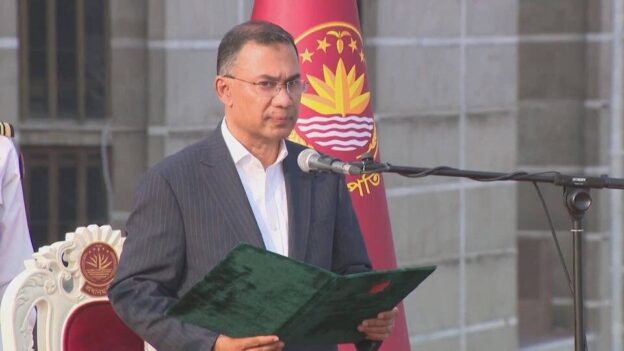
Bangladesh’s President Mohammed Shahabuddin has launched an extraordinary public criticism of former interim government Chief Adviser Muhammad Yunus, accusing him of repeatedly failing to comply with constitutional provisions during his 18-month tenure.
In an exclusive interview with the Bangla daily Kaler Kantho at Bangabhaban on Friday night, the president alleged that Yunus disregarded constitutional obligations, attempted to marginalize the presidency, and presided over efforts that risked “creating a constitutional vacuum.” The remarks constitute the sharpest institutional rebuke yet from the head of state against the interim administration that governed Bangladesh following the collapse of former Prime Minister Sheikh Hasina’s government in August 2024.
Allegations of Constitutional non-compliance
President Shahabuddin claimed that during Yunus’s tenure, numerous ordinances were promulgated without sufficient justification. While acknowledging that some may have arisen from immediate necessity, he maintained that many were unnecessary and that constitutional provisions were not properly followed.
Citing established protocol, the president noted that whenever the chief adviser traveled abroad, he was required to brief the president upon return. According to Shahabuddin, Yunus traveled abroad 14 to 15 times but did not once report back or seek an audience with him. He further alleged that elements within the interim government attempted to remove him from office during a politically volatile period, adding that the chiefs of the armed forces refused to support any unconstitutional move and stood by the presidency.
Military support during “Night of Nightmare”
Recalling October 22, 2024, the president described the day Bangabhaban was reportedly surrounded by mobs as a “terrifying nightmare.” He alleged that attempts were made to storm the presidential residence in a manner similar to earlier attacks on state properties.
He praised the armed forces for intervening decisively, quoting military leaders as telling him, “You are the Supreme Commander. Your defeat means the defeat of the armed forces.” Despite intense pressure to resign, Shahabuddin said he remained firm and was prepared to “shed blood” to protect constitutional continuity.
Praise for BNP leadership
In remarks carrying political significance, the president said the Bangladesh Nationalist Party (BNP) leadership supported him during the crisis. He specifically referenced BNP Chairperson Tarique Rahman, stating that his perception of Rahman had changed and describing him as cordial. According to Shahabuddin, the BNP’s cooperation during his difficult period was “one hundred percent.”
The BNP subsequently secured a two-thirds parliamentary majority in the February 12, 2026 election, following a referendum in which proposed constitutional reforms were approved, according to the Election Commission.
Yunus’s defense: Reform, justice, election
Professor Yunus, who assumed office on August 8, 2024, following a mass uprising, has defended his administration’s record. He stated that the interim government fulfilled its three core mandates: institutional and constitutional reform, trial of alleged crimes against humanity linked to the July uprising, and the conduct of a credible national election.
In his farewell address, Yunus insisted that the administration’s efforts had no shortcomings and that judicial proceedings were kept above politics and revenge. During its tenure, the interim government oversaw reforms through 11 commissions and established a National Consensus Commission, achieving cross-party agreement on at least 30 reform areas. Amendments to electoral laws were introduced, and a referendum was held alongside parliamentary elections.
Mixed assessment from analysts
Despite the ambitious reform agenda, local stakeholders have offered mixed evaluations of the interim government’s performance. Economist Debapriya Bhattacharya observed that the administration performed comparatively better in macroeconomic stabilization, with foreign exchange reserves reportedly increasing from $14 billion to over $28 billion under IMF methodology. However, inflation remained elevated, averaging 8.77% in 2025 according to official statistics. He remarked that while there was relative economic stabilization and political success in moving toward elections, the government fell short socially.
On governance and reform implementation, Iftekharuzzaman, Executive Director of Transparency International Bangladesh (TIB), acknowledged progress made through reform commissions but warned that implementation was inconsistent and suffered from pick-and-choose approaches and ad hocism. He also raised concerns about transparency in major agreements signed toward the end of the government’s tenure and questioned whether trials conducted under the banner of crimes against humanity risked being perceived as politically selective.
The International Crimes Tribunal sentenced Sheikh Hasina to death in one such case, a verdict that has drawn both domestic support and international scrutiny.
Law and order, mob violence, and minority concerns
The interim period was marked by reports of mob violence, attacks on media institutions such as Prothom Alo and The Daily Star, assaults on Sufi shrines, and incidents affecting minority communities. Human rights group Odhikar documented at least 40 alleged extrajudicial killings between August 2024 and September 2025. Critics argued that the government failed to effectively counter what they described as an empowered “mob culture.”
Minority leaders expressed alarm over attacks on Hindu households and businesses, although officials maintained that most incidents were politically motivated rather than religiously driven. Women’s rights advocates similarly criticized the government’s response to harassment and backlash following proposals from the Women’s Reform Commission.
Controversial U.S. trade deal
Just two days before the February election, the interim government signed a trade agreement with the United States, reducing reciprocal tariffs from 20% to 19%. The deal grants Bangladesh duty-free access to approximately 2,500 products in the U.S. market but requires large-scale imports from the United States, including wheat and aircraft purchases.
Critics questioned the timing of the agreement and whether adequate stakeholder consultation had occurred, while government officials defended it as essential to protecting Bangladesh’s garment exports, which account for roughly 80% of shipments to the U.S.
Institutional tensions surface
The president’s allegations — including claims that his press wing was effectively dismantled during the interim period and that he was excluded from state communications — underscore institutional tensions that were not fully visible during Yunus’s tenure. While Yunus characterized the 18 months as a disciplined transition culminating in a free, fair, and festive election, Shahabuddin’s remarks point to unresolved friction between constitutional offices at the highest level of the state.
The new BNP-led government now inherits both the reforms enacted during the interim period and the political divisions exposed by this public exchange. As Bangladesh moves beyond a turbulent transition, questions remain over whether the interim experiment will be remembered primarily for stabilizing democratic processes or for deepening institutional distrust within the state itself