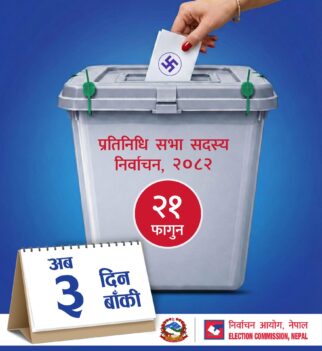
There is no mistaking the festival mood across Nepal as the country heads to the March 5 elections—an election born out of a historic Gen Z uprising. Yet beneath the colour, rallies, and loudspeakers, there is a distinct lahar—a wave—triggered by the protests of September 8, 2025. That movement left at least 75 civilians dead and more than 2,000 injured, the majority from gunshot wounds during clashes between demonstrators and security forces.
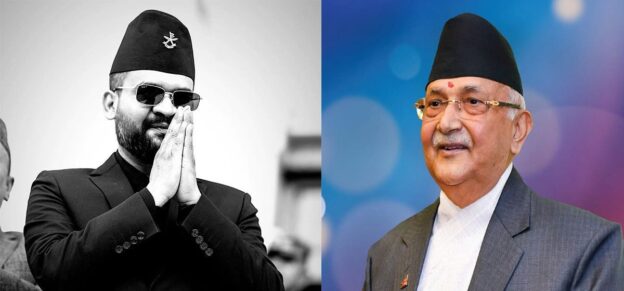
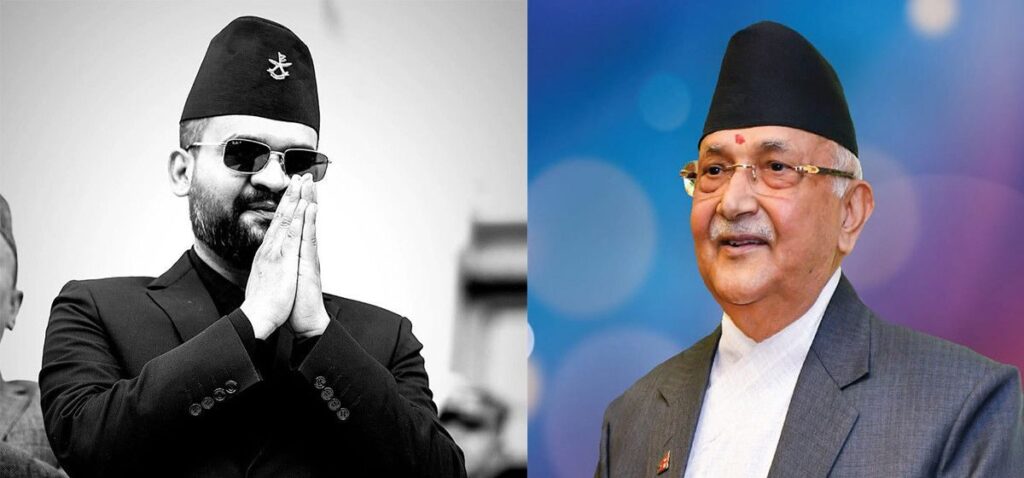
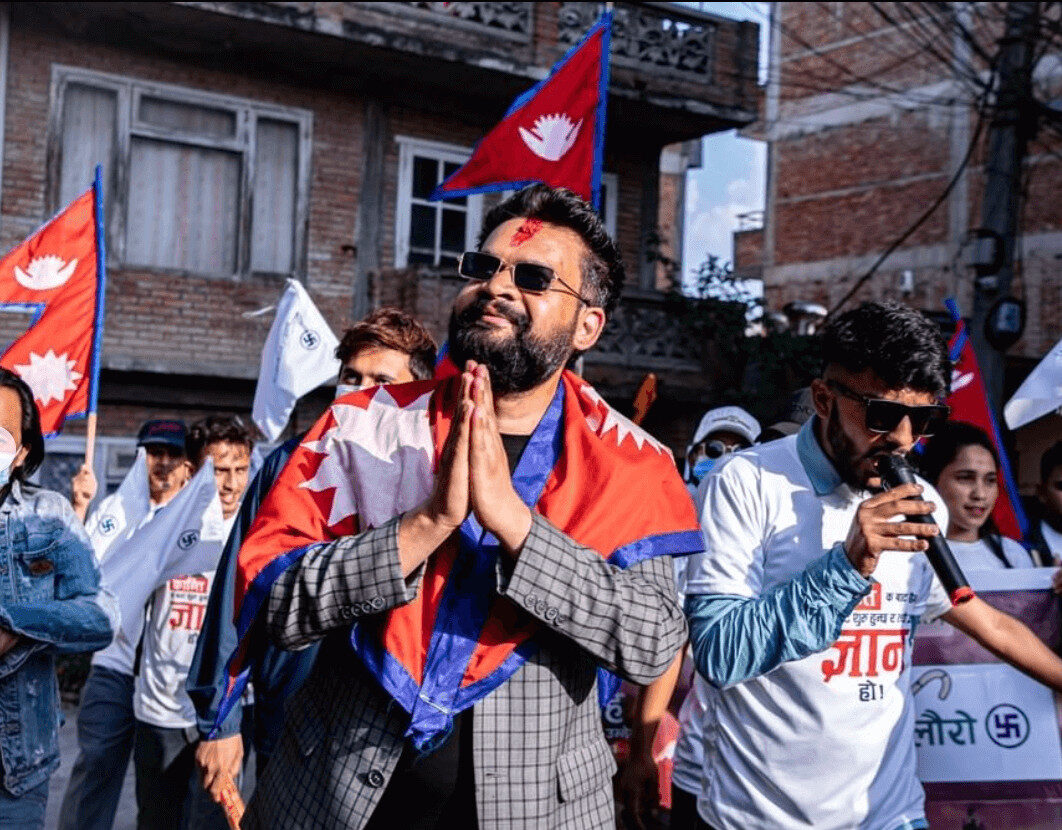
What began as seemingly leaderless protests near Parliament in Kathmandu has since found a political face. Kathmandu’s former mayor, rapper-turned-leader Balendra Shah—popularly known as Balen—may not belong to Gen Z himself, but he has come to embody its aspirations. Charismatic, unconventional, and fiercely direct, he has emerged as the poster boy of this election.
We experienced that wave firsthand while travelling through Kakarvitta to Bhadrapur airport. We almost missed our flight as we navigated through a sea of people and vehicles. Briefcases were lifted over bikes and cars as crowds waited to receive Balen. Young supporters waved the now-familiar blue flag bearing the ghanti (bell) symbol and chanted “Balen, Balen…” The excitement was unmistakable.
Our taxi driver, a self-described traditional and hardcore supporter of the Communist Party of Nepal (Unified Marxist–Leninist) (CPN-UML), cheerfully told us that this time, “we shall vote for Balen.” It did not matter to him that we were late and our names had already been announced at the airport. When we urged him to hurry, he smiled and replied, “Don’t worry, Balen is coming and everyone will wait. Your flight will not take off.”
There was no hiding his emotions. What mattered to him was the “need for change”—to weed out corruption and remove the old guard who, in his view, had harmed the country more than helped it.
During our flight to Kathmandu and in the days that followed, one question persisted: is the wave around Balen and the Rastriya Swatantra Party (RSP) truly what the Gen Z movement sought to achieve? The RSP itself is not a Gen Z party. Its founder and chairman, Rabi Lamichhane, remains a controversial figure who has spent time in jail on corruption charges and even escaped custody during the Gen Z unrest.
Nationwide, 3,406 candidates have filed nominations for the House of Representatives elections. Of them, 2,263 are party-affiliated, while 1,143 are independents. A central demand of the Gen Z protests was a generational shift in politics. Yet candidate lists suggest older politicians still dominate: 1,056 candidates are aged 25–40, 1,925 are 41–60, and 425 are over 60.
The electorate, however, is young. A Kathmandu Post report, quoting the 2021 census, states that youth comprise 42.5 percent of Nepal’s population. The National Youth Policy 2015 defines youth as those aged 16–40. Of Nepal’s 29,164,578 people, 12,412,173 fall into that category—an increase from 40.35 percent in 2011. The Election Commission reports 18,903,689 registered voters, 52 percent of whom are between 18 and 40.
Balen, who first shot to fame through his rap music before winning the Kathmandu mayoral race, maintains a distinct and independent persona. His straight-talking, get-the-job-done style set him apart as mayor. Many feel he has pushed aside controversies surrounding Lamichhane and positioned himself as the authentic face of reform.
The anger against the “old regime” remains palpable. Many believe successive governments since the fall of the monarchy in May 2008 failed to implement promised reforms. Corruption, slow governance, and unfulfilled commitments have eroded public trust.
Yet Nepal’s mixed electoral system—combining First-Past-the-Post and Proportional Representation—means the RSP is unlikely to form a government on its own. Established parties with strong cadre bases such as the Nepali Congress, CPN-UML, and the Maoists—Nepali Communist Party (NCP)—are expected to secure significant seats.
Still, the anger that erupted during the Gen Z uprising has not faded. From taxi drivers to young graduates, conversations repeatedly circle back to “change.” Even if Balen is not Gen Z, he has been cast as the symbolic representative of the youths who took to the streets—19 of whom died on the first day of protests.
Some see Balen as an outsider within the RSP, aligning with Lamichhane to shape a broader national political role. His decision to contest against former Prime Minister K.P. Oli in the latter’s stronghold of Damak-5, rather than choose an easier constituency, signals ambition—and perhaps conviction.
Journalist-turned-author and policy analyst Akhilesh Upadhyay calls Balen an “enigma.”
“That is Balen Shah for you. He has gone to Damak to win and defeat a guy who killed (I am talking in Gen Z language) our friends. What better revenge and justice can I deliver to the dead? That is the kind of person Balen is,” Upadhyay says, while acknowledging the political ambition driving him to become a national leader. Balen lacks a nationwide organisational network, but his charisma, Upadhyay notes, blends well with the RSP.
Only recently, Balen joining a political party—especially the RSP, tainted by corruption allegations against Lamichhane—would have seemed unimaginable. Yet the RSP now appears poised to emerge as a significant player.
The influence of Swarnim Wagle, the party’s vice-president, is widely acknowledged. His refined education, multilingual abilities, outreach skills, and reputation for integrity are seen as instrumental in Balen’s induction and the wave it has generated, even among rival party supporters. Wagle’s engagement with Gen Z voters has helped position Balen as the electoral face of the movement, though he himself belongs to the millennial generation.
According to local media reports the RSP has fielded a relatively young slate: of its 163 candidates, nearly 40 percent are under 40, including 12 under 30 and 53 aged 30–40. Fifty candidates are 40–50, 46 are 50–60, and only three are over 60. The Ujyalo Nepal Party has 40 of its 105 candidates under 40. Harka Sampang’s Shram Sanskriti Party (SSP) has fielded 109 candidates, mostly under 40; its youngest is 26-year-old Pankaj Kumar Thakur from Siraha-4, while six are over 60, the oldest being 74-year-old Man Bahadur Bairag from Bardiya-2.
By contrast, established parties such as the Nepali Congress, CPN-UML, and the Maoists appear to favour “experienced” candidates over youth, betting that governance requires tested hands rather than a wave of newcomers with limited political experience.
Professor Bishnu Upreti, Research Director of the Nepal Centre for Contemporary Research, calls the election “nothing short of old wine in a new bottle,” despite the excitement around Balen. He acknowledges youth anger but questions whether there is a clear roadmap for structural reform.
“This was the very purpose of the Gen Z movement and it was clear, but I can’t say it’s the same now,” Upreti says. He wonders how the RSP would govern if it secured a majority and dismisses the framing of old versus new parties as simplistic. More serious debates, he argues, should focus on constitutional amendments, stronger governance, and tackling malpractice.
He predicts the likelihood of another coalition government, given the mixed electoral system. “Therefore, coalition remains—they do exactly what they did before,” he opines.
According to him, the campaign rhetoric is filled with “blame, counter-blame, arrogance and charges, with some saying I will arrest you when I am PM, you all will be in jail.” If such forces come to power, he warns, “they will start revenge and retaliation,” reminding that conflict begins with mistrust—something Nepal has experienced before.
Others remain more hopeful. Upadhyay sees “parivartan” (change) as the defining word of this election. But he cautions that expectations can be mismatched. “Our idea of parivartan may not be my idea of parivartan.”
What gives the message strength, he argues, is the credibility of the messenger. That is where Balen stands apart. The RSP may not be a cadre-based party, but in a wave election, organisation may matter less than sentiment.
He bluntly critiques past governments: “Their performance has been so bad that you have to be wonderfully worse to be worse than them.” Corruption, he notes, has eroded the system to the extent that even routine legal work requires money, with ministers openly demanding it. The rise of so-called “nepobabies”—children of the powerful flaunting wealth—has only deepened public anger.
Yet contradictions persist. The RSP campaigns on anti-corruption while carrying the baggage of Lamichhane’s legal troubles. Voters may not openly question this paradox, but silence does not automatically translate into full endorsement.
Upadhyay reminds that in its first election in 2023, the RSP secured a 10.5 percent vote share and emerged alongside the Maoists as a significant force. Building a durable political base, however, takes decades.
Are we witnessing a moment akin to 2008, when the Maoists surged to power amid excitement and uncertainty? There is a similar buzz in the air today—a push for alternatives and the possibility of unexpected faces entering Parliament. Many believe articulate, well-read candidates in their thirties could emerge as serious voices.
“This is a very serious demographic transition,” one observer remarked. “I won’t be surprised if the RSP gets 70–80 percent of the votes of first-time voters.”
Elections come and go, convictions shift, but waves take time to crystallise into history. As Upadhyay reflects, it can take 20 to 25 years for a moment to define a political era. “You saw that in Bhadrapur,” he says. “I see that all the time.”