
Until barely six months ago, it would have seemed inconceivable that the grand old patriarch of Nepal’s politics, Khagda Prasad Sharma Oli, would find himself fighting to preserve the very political empire he spent decades constructing. That empire was built on a carefully cultivated blend of muscular nationalism and combative political strategy.
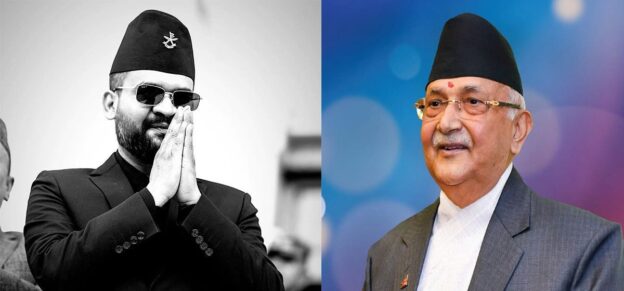
Tomorrow, however, the fortress he fashioned in Jhapa—where he has emerged victorious in every parliamentary election since 1991, except for the 2008 Constituent Assembly polls—faces a defining test. His stronghold in Jhapa 5, a constituency he retained in both 2017 and 2022, is no longer unassailable.
Challenging him is 35-year-old Balendra Shah, a figure widely viewed as emblematic of the change sweeping Nepal’s political landscape. Though seen as a political newcomer, it is precisely his newness—and the energy he draws from the Gen Z uprising of September 2025—that has unsettled Oli. The shifting mood has compelled the veteran leader not merely to recalibrate strategy, but to fight to prevent the erosion of his political citadel.
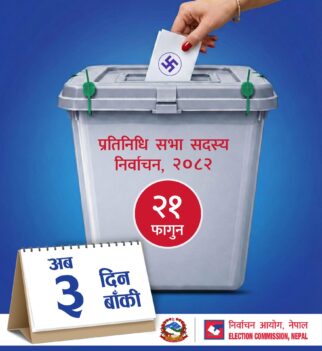
Nepal heads to the polls on March 5 with 3,406 candidates contesting seats in the House of Representatives. Of these, 2,263 are party-affiliated and 1,143 are independents. According to the Election Commission Nepal, there are 18,903,689 registered voters. Significantly, 52 percent fall between the ages of 18 and 40—a demographic widely expected to determine the outcome, as it is this very cohort that has been most vocal in demanding systemic change.
In contrast, Oli increasingly represents the old guard. Critics portray him as emblematic of entrenched misgovernance, patronage politics, and nepotism—accusations that have clung to his leadership in recent years. The images of him departing in a military helicopter on the second day of the September 9, 2025 protests remain vivid in public memory. For many, the lasting impression was not the violence that later marred the demonstrations, but the peaceful demands articulated on the first day: a generational transition in leadership.
Contrary to speculation at the time, Oli did not leave the country. Instead, he remained under the protection of security forces until the unrest subsided. Yet many believe that public anger might have softened had he acknowledged the deaths caused by police firing or conceded that his administration had erred.
The National Human Rights Commission (NHRC) subsequently held the government accountable for not foreseeing the magnitude of the Gen Z protests and for the low morale within security forces—factors the commission said led to the heavy loss of life and property on September 8 and 9.
Rather than strike a conciliatory tone, Oli adopted a defensive posture. After being ousted in the wake of the protests, he asserted defiantly that he would “not abandon Nepal by surrendering it to an groundless government.” The remark was widely interpreted as a veiled attack on the government that emerged with the backing of the Gen Z movement.
True to form, he embraced confrontation. He accused the government led by Sushila Karki of denying him adequate security despite threats, revoking his privileges, withholding his passport, filing cases against him, and “pushing the nation toward instability.”
For many—from farmers in Jhapa to taxi drivers, students, and intellectuals—these reactions signaled, perhaps for the first time, a shaken Oli. The once unbending leader, often described as possessing “akar manayta,” or an unyielding ego, appeared forced into a rare tactical retreat.
A local political analyst in Jhapa speaking on condition of anonymity, says this shift is reflected in the campaign strategy adopted by the Communist Party of Nepal (Unified Marxist–Leninist) (CPN-UML).
Instead of depending on massive rallies and overt demonstrations of power, the party has adopted what observers call a “peer-based mobilization strategy.” Its cadres have discreetly integrated themselves into everyday community spaces—tea stalls, markets, public transport stations, and even city rickshaws.
The analyst explained that UML workers intentionally move among the public as regular passengers, initiating casual political chats and subtly shaping viewpoints. “By engaging people informally at the peer level, they can influence undecided voters without triggering confrontation,” he observed.
The party is also creating small, issue-focused teams aimed at particular groups—Gen Z voters, women, youth, and the elderly. These units carry out subtle, door-to-door outreach, steering clear of high-profile rallies while fostering direct connections with households.
The messaging, sources say, is highly adaptive. Depending on the audience, narratives range from subtle public apologies to emotional appeals framed as “one final chance,” “for the party’s future,” or “for Oli’s legacy.” The objective is clear: rebuild sympathy, consolidate loyalty, and prevent further erosion of support as polling day nears.
Beyond UML’s own ranks, there exists a quiet but persistent narrative among senior figures from older parties such as the Nepali Congress, RPP, and NCP that Oli’s victory in Jhapa 5 would serve the constituency’s broader interests. The argument is less about party allegiance and more about strategic leverage—maintaining national-level influence and access to resources through his parliamentary presence.
Within the Rastriya Prajatantra Party (RPP), internal voices reportedly acknowledge that an Oli victory could benefit the region. The Mayor of Damak, Ram Thapa—who also serves as RPP’s provincial president in Koshi Province—has historically maintained personal goodwill toward Oli. Observers stress that this alignment appears rooted more in personal rapport than formal party coordination.
Locally, it is widely believed that the mayor commands influence over a decisive bloc of votes—perhaps 6,000 to 7,000—which, in a tight contest, could prove critical. Whether that support materialises depends on timing, political clarity, and the cohesion of his base.
Despite his recent vulnerabilities, Oli retains formidable influence. He remains capable of persuading or aligning leaders across party lines, often under a shared understanding that most parties are presently focused on “political survival” rather than open confrontation with UML.
Yet within his own ranks, reverence and restlessness coexist. Known affectionately as “Ba” or “Oli Ba,” he commands deep respect. At the same time, some party workers have begun to describe him as “hatdharmi”—stubborn and unyielding. The very fact that he now campaigns defensively underscores how precarious his position has become.
Demographically, the terrain is shifting. Jhapa 5 has registered approximately 10,900 new voters, with estimates suggesting that 75 to 80 percent may lean toward the Rastriya Swatantra Party (RSP). Among voters aged 18 to 30, the inclination toward RSP appears particularly strong.
Meanwhile, the main support for UML, the Nepali Congress (NC), Nepali Communist Party (NCP), and RSP continues to be anchored in voters over 50. For many in this age group, loyalty is passed down through generations. As one voter explained, “Our party isn’t merely a choice—it’s our inheritance.”
Still, confusion lingers. Much of the current political momentum is perceived to revolve around a single figure—Balendra Shah. There is a widespread belief that without his association, RSP’s surge would lack its current intensity. The party’s appeal seems driven less by organisational depth and more by personal credibility and symbolic resonance.
Another critical factor is foreign employment. Between 25 and 35 percent of the economically active population aged 25 to 40 works abroad. Though absent on polling day, their influence at home is palpable. Many reportedly urge parents and relatives to support RSP, extending the party’s reach beyond direct youth participation.
A telling anecdote involves a Pathao rider, himself unregistered to vote, urging his staunch UML-supporting family to back Balendra Shah. “Balen must win,” he insisted. “We have to make it happen—for our future. Otherwise, there will be another movement.”
Among young voters, hope has turned into excitement. “Balen will become Prime Minister, and we will finally see real change,” is a sentiment often repeated. The expectations are high, almost revolutionary.
Yet the deeper uncertainties refuse to fade. Is the RSP truly positioned to command a two-thirds mandate and translate electoral momentum into durable governance? And even if it exceeds expectations, can a single leader bear the weight of a generation’s long-deferred hopes—hopes that have simmered for more than three decades in search of genuine transformation?
Amid these uncertainties, one reality stands out: the once-invincible patriarch of Nepali politics is fighting to hold his ground. The urgency of his campaign reveals a truth that was once unthinkable—his dominance is no longer absolute. The empire built on nationalism and combative politics now shows visible cracks.