February 28 felt unlike any ordinary weekend in Shillong. The parking lot of the Directorate of Fisheries, usually a quiet space opposite St. Edmund’s College, transformed into a lively mosaic of colours, aromas and chatter. The occasion was the February edition of the Monthly Farmers’ Market, organised by 1917 iTEAMS and the Meghalaya Farmers’ (Empowerment) Commission (MFEC). What began as a simple marketplace has gradually grown into something far more meaningful—a symbol of economic independence for the state’s rural farmers.
The initiative, propelled by Chief Minister Conrad K. Sangma, is designed to bridge the long-standing gap between farmers in remote hill districts and urban consumers. The idea is simple but powerful: ensure that the “sweat of the brow” of farmers translates directly into fair profit without unnecessary intermediaries.
One of the most striking features of the market is the easy access it provides to rare and indigenous products that are usually difficult to find in the city. Demand for such items has steadily grown, and this edition lived up to expectations. Visitors encountered a variety of wild greens and traditional delicacies that are typically found only in the deeper rural pockets of West Jaintia Hills.
A farmer from the Jaintia region arrived with the famous Kharang, or smoked fish, along with dry fish varieties that have long been staples in local village haats. Historically, such products rarely made their way into Shillong’s urban markets, but this platform has brought these authentic flavours directly to the heart of the city.
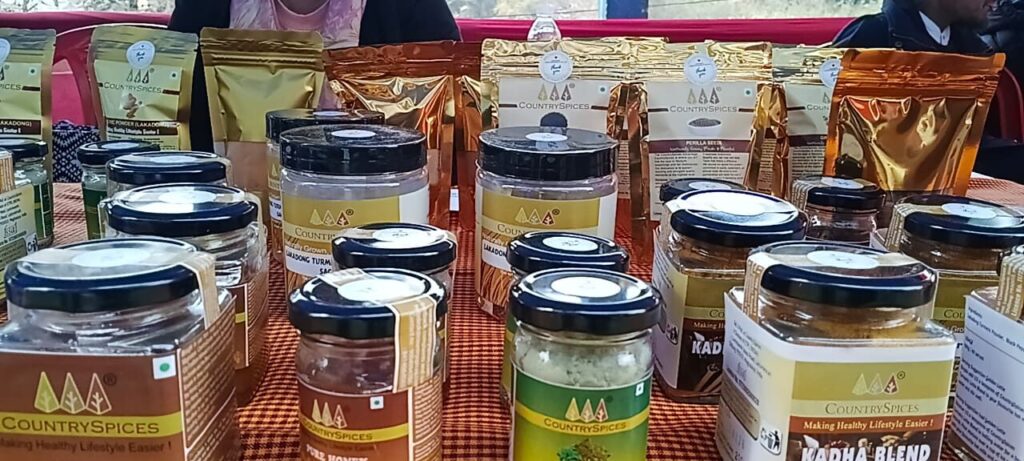
One stall in particular drew considerable attention. It displayed Lakadong Turmeric, widely known for its exceptionally high curcumin content, alongside Moringa powder, often described as a superfood for its medicinal properties, and premium black pepper known locally as Sohmarit.
The diversity of Meghalaya’s landscapes was reflected clearly in the produce on display. Farmers from Ri-Bhoi district brought unique vegetables such as Soh Danei, Jajew (Roselle) and Wang ka Pastor (Taro). The well-known sausages from the Umsning area were also a major attraction among food lovers. The market was not limited to distant districts alone. Farmers from nearby Lawsohtun also took part, bringing fresh Tyrso, or mustard greens, along with other seasonal vegetables. Together, they showed how the market has become a shared platform for farmers from both nearby villages and remote regions.

Perhaps the most powerful aspect of the market is how it frees farmers from the grip of “Mahajons”, or middlemen. For decades, many farmers were trapped in cycles of price squeezing. Often they were forced to sell their produce at extremely low prices, or worse, carry unsold goods back home when buyers refused to pay fairly.
One farmer recalled his usual struggle. “In the regular markets, I would have to lower my price every hour just to make a sale. Sometimes I had to carry my Soh Pyrshong (starfruit) back home because no one would pay a fair price,” he said.
At the Farmers’ Market, however, the story was completely different. Within just four to five hours, his entire stock was sold out, and this time at a price he himself had decided—reflecting the true value of his labour.
The February edition also highlighted two agricultural products that are rapidly gaining prominence in Meghalaya. Strawberries, often described as part of the state’s growing “strawberry revolution”, are now produced across around 250 villages, with an annual output of roughly 1,200 metric tonnes. Black pepper has also emerged as a strong performer. Cultivated by more than 2,600 farmers across 2,083 hectares, the state produces about 2,000 metric tonnes annually, attracting increasing attention from premium buyers.
What made the event even more appealing was the atmosphere, which felt more like a small festival than a routine marketplace. Members of the Van Dhan Vikas Kendra (VDVK), trained at the Institute of Hotel Management (IHM) Shillong, ran a live kitchen where they prepared farm-to-plate dishes. Visitors enjoyed strawberry-infused treats and pepper-spiced snacks, demonstrating how local produce can be transformed into value-added products.
Adding to the energy was live music performed by artists from the CM-MGMP Grassroots Music Program, creating an atmosphere that blended agriculture, food and culture. The event also reflected the growing digital integration of local markets. The SOMOI app, a homegrown quick-commerce platform, was present to purchase produce in bulk. This ensures that even if the number of visitors fluctuates, farmers still have a guaranteed bulk buyer to maximise their daily earnings.
Farmers also expressed appreciation for the support provided by the government. Smt. Stialinda Khasain from Nongwah and Shri Persevere Rani from Jirang explained that the assistance goes far beyond simply providing a stall. The Department of Agriculture and Farmers’ Welfare covers daily allowances and transportation costs, removing the financial risk for farmers travelling from distant villages.
In many ways, the Monthly Farmers’ Market has become more than just a place to sell produce. It represents a quiet but meaningful shift in how agriculture is valued in Meghalaya. By creating direct and transparent access to consumers, the state is building a model where farmers remain the primary beneficiaries of the value chain.
As one elderly woman farmer summed it up with quiet pride, “We aren’t just selling vegetables; we are regaining our pride.”