The Assam elections appear to have hit an unexpected roadblock across the border in Meghalaya—at least in the disputed areas of Block I—where sections of the Khasi Pnar community have decided to stay away from the polls, alleging political interference and coercion.
The Hynniewtrep Border Dispute Redressal Forum (HBARF) on Tuesday, March 24, claimed that people from the Khasi Pnar community are being influenced to campaign for political parties in Assam and are being “pressured or misled” into casting their votes there. The forum termed this trend an “extremely dangerous precedent,” especially given that the boundary dispute between Assam and Meghalaya over these areas remains unresolved.
The concern is rooted in the long-standing dispute over Block I and Block II. These areas were transferred in 1951 from the erstwhile United Khasi-Jaintia Hills district to the Mikir Hills—now part of Assam’s Karbi Anglong—through a government notification issued on April 13 that year. The move, based on a boundary commission’s recommendation, was justified at the time on grounds of administrative convenience, particularly for managing forest and hill tracts.
However, when Meghalaya was carved out of Assam in 1972, the blocks were not returned, triggering a dispute that continues to this day. Meghalaya maintains its claim based on historical maps and ethnic ties, arguing that administrative decisions were never meant to permanently alter traditional land ownership of Khasi-Jaintia communities. Assam, on the other hand, asserts that the areas were historically part of the Karbi Kingdom and that the 1951 notification merely formalised an existing reality. The issue remains one of the most sensitive points in ongoing border talks between the two states.
Against this backdrop, HBARF chairman Chandame Sungoh said that during elections in Assam—be it parliamentary or assembly—individuals from the Khasi Pnar community are often mobilised by political parties such as the Congress, BJP and the National People’s Party to campaign in bordering areas. According to him, these individuals then influence or pressure local residents to participate in Assam’s electoral process.
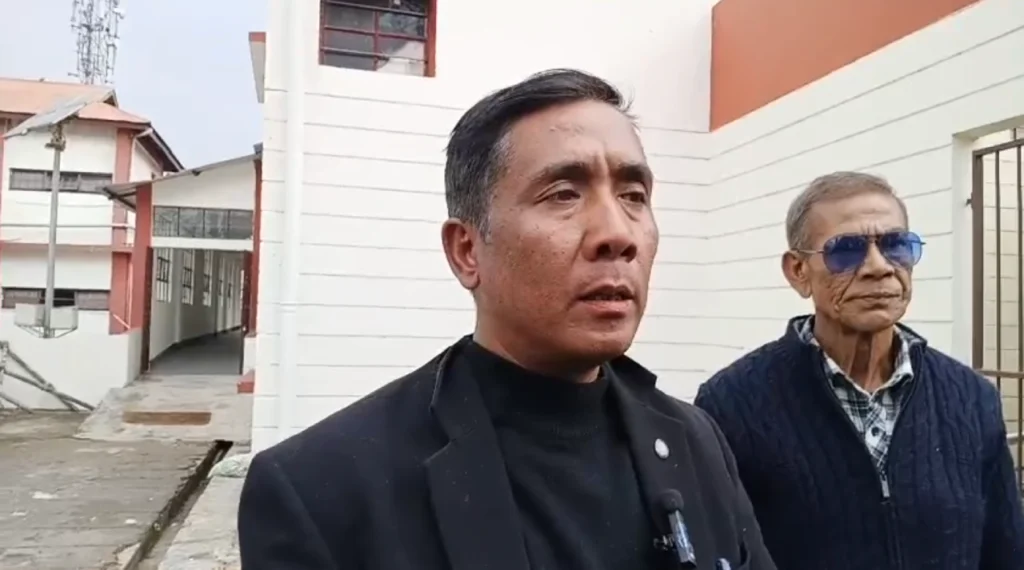
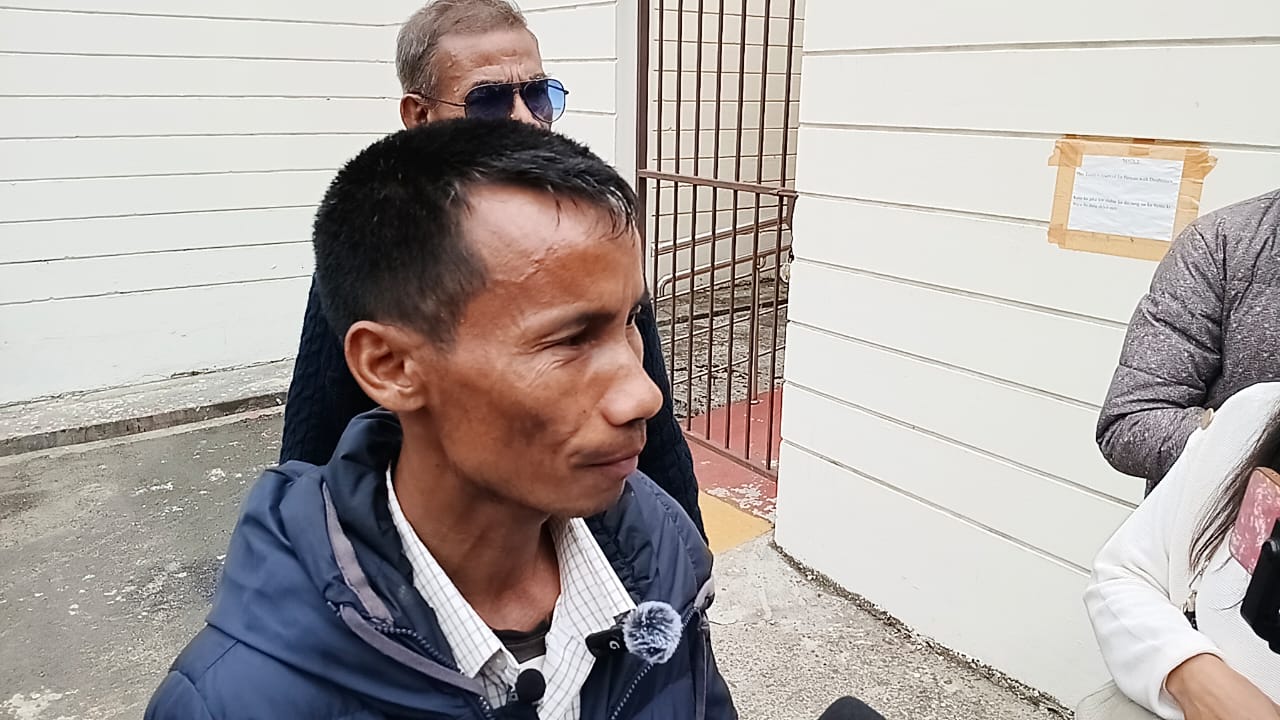
Chairman of the Hynniewtrep Border Dispute Redressal Forum (HBARF), Chandame Sungoh speaking to the press. (Video credit : Rilinda Manih)
“This goes against the decision of the public,” Sungoh said, referring to a series of resolutions taken by the community over the years. He pointed out that as far back as April 16, 2021, a meeting in Mukroh had resolved to adopt a Non-Cooperation Movement with Karbi Anglong in Assam. This stance was reaffirmed in a meeting held on May 3, 2025, and again on February 15, 2026, at Barato, where it was decided to boycott the upcoming Assam Assembly elections scheduled for April 9.
More recently, a meeting of Elaka Labang Nongphyllut Block I on March 5 also reiterated the decision to boycott the polls. Sungoh noted that this would not be the first such step—two earlier elections, including the Member of Autonomous Council election and the parliamentary election, were also boycotted.
He warned that despite these decisions, “black sheep” within the community continue to engage with political actors from Assam, creating divisions. “They should not go to Assam to entice or force the Khasi Pnar to vote,” he said, adding that many residents are either misled with promises of development or intimidated into participating.
According to Sungoh, there is a deeper strategy at play. He alleged that political actors are using development schemes to convince residents to align with Assam, especially since gaining control of Block I and II through other means has proven difficult. “Assam does not need the people; they need the land,” he said, claiming that earlier attempts were made to drive out Khasi Pnar residents, particularly around the year 2000.
He also pointed to recent political outreach efforts as unusual. On February 18, the Chief Executive Member of Karbi Anglong visited Lamara village for a mass joining programme, followed by another visit to Uriat village on March 8. “We never saw this before,” Sungoh remarked, suggesting that such moves are aimed at influencing Khasi Pnar villages.
The forum has urged residents not to fall for what it calls election-time “deception.” While acknowledging the need for development, Sungoh cautioned against promises that surface only during elections. He went further to say that people in these border areas have historically been used as vote banks without seeing any resolution to the boundary dispute.
“At the end of the day, whether it is Meghalaya or Assam, we vote—but the border remains unsettled,” he said.
A major grievance highlighted by the forum is the lack of administrative recognition for villages in Block I. Since 2023, the Jaintia Hills Autonomous District Council has issued sanats (appointment certificates) to Acting Dolois and Waheh Shnongs, effectively reviving the Elaka Labang Nongphyllut. However, the Meghalaya government has yet to formally recognise these villages.
This has created serious problems for residents, who are unable to access basic documents such as EPIC cards, Aadhaar, birth certificates and Scheduled Tribe certificates. The absence of official recognition has also prevented villages from receiving codes and administrative inclusion, leading to widespread confusion.
HBARF said it has repeatedly raised these issues with the government, including through letters and meetings with the Chief Minister, but has received no response so far. Sungoh argued that this administrative vacuum is precisely what allows external influence to take root.
Frustrated by what it describes as continued neglect, the forum has now decided to intensify its agitation. Formed in 2019 to highlight the grievances of Block I residents, HBARF says it has reached a point where protests are the only option left. Details of the agitation, Sungoh said, will be announced soon.
For now, the situation in Block I reflects a deeper crisis—where unresolved borders, administrative gaps and electoral politics are converging, leaving local communities caught in the middle.