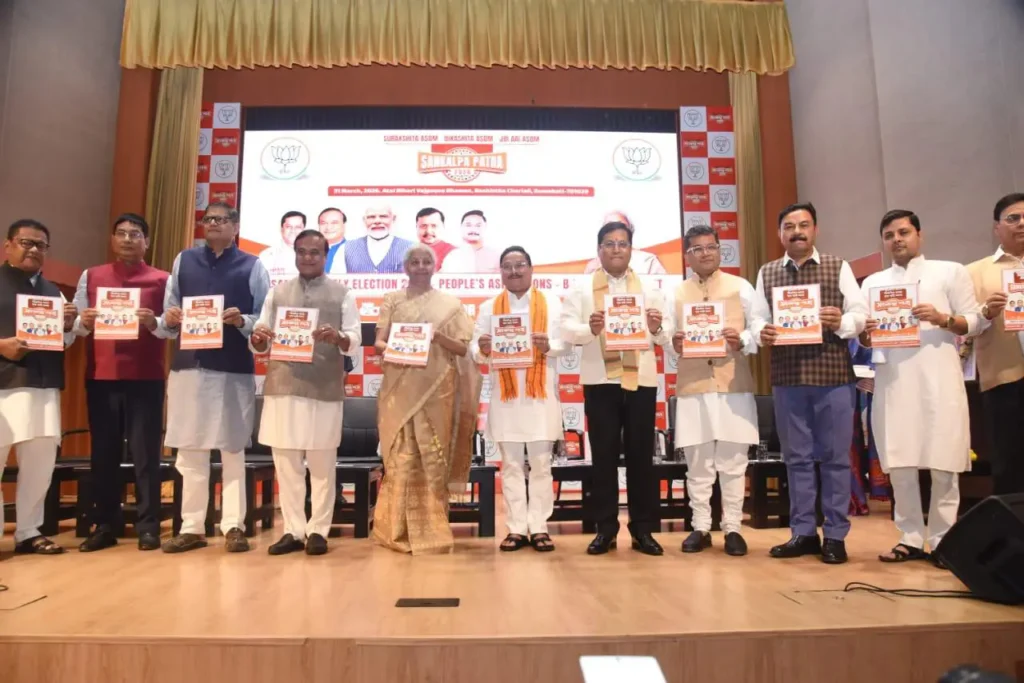
As the drums of the Assam Assembly elections begin to beat, the Bharatiya Janata Party (BJP) has unveiled its ‘Sankalp Patra’—a manifesto that seeks to bridge a decade of incumbency with the aspirations of a “New Assam”. Released by Union Finance Minister Nirmala Sitharaman in Guwahati, the document is a carefully crafted political text. It projects an image of an unstoppable economic juggernaut while blending welfare assurances and identity-driven commitments that carry unmistakable populist undertones.
At one level, the manifesto speaks the language of development and scale. At another, it leans on targeted welfare expansion and emotive political signalling—an approach that reflects a broader strategy of combining growth narratives with voter-sensitive populism. Yet, a closer forensic reading reveals a document that curates its successes while remaining strategically silent on structural vulnerabilities and long-standing political commitments.
The manifesto presents a sweeping vision of Viksit Assam, blending infrastructure ambition, expanded welfare nets, and a fortified stance on cultural identity. However, for the discerning voter, it raises as many questions as it answers.
The economic growth story
The centrepiece of the BJP’s pitch is a staggering claim of economic transformation. The manifesto states that Assam’s Gross State Domestic Product (GSDP) has risen from ₹2.27 lakh crore to a projected ₹8.71 lakh crore. On the surface, this suggests a dramatic structural shift.
However, these numbers require context. Much of this growth is nominal, shaped by inflation and a low-base effect.
While percentage growth appears impressive, the qualitative depth of the economy remains limited. Assam still lacks a strong industrial backbone and continues to rely heavily on agriculture and low-end services. The claim of being among India’s fastest-growing states may be statistically valid, but it does little to mask the absence of deep-rooted structural transformation.
Poverty and welfare expansion
The BJP foregrounds a major social achievement—the claim that over 80 lakh people have moved out of multidimensional poverty. Backed by frameworks from NITI Aayog and UNDP, this reflects the reach of welfare schemes such as Orunodoi, which have improved access to food, housing, and basic services.
Yet, this narrative also sits within a broader populist framework. Welfare expansion, while undeniably impactful, often functions as a stabilising mechanism rather than a pathway to durable economic mobility. In Assam’s flood-prone and economically fragile regions, many households remain one crisis away from slipping back into deprivation.
What is presented as poverty reduction may, in reality, be better understood as subsidised survival—an outcome that raises questions about long-term resilience versus short-term political dividends.
The fiscal shadow
One of the most notable omissions in the Sankalp Patra is the question of fiscal health. The expansion of welfare schemes and infrastructure projects has come at a cost, with public debt rising significantly in recent years.
The manifesto maintains a narrative of uninterrupted growth but avoids any discussion of debt sustainability. This silence becomes more significant when viewed alongside the populist expansion of state support systems. It raises a fundamental question—whether Assam’s growth story is structurally sustainable or increasingly dependent on borrowing to finance politically necessary expenditure.
By sidestepping the debt-to-GSDP debate, the document avoids confronting the long-term implications of its development model.
The employment question
The government highlights the creation of over 1.6 lakh jobs and promises continued opportunities for the youth. However, the issue is not merely the number of jobs, but their quality.
Ground realities suggest that unemployment among educated youth remains a persistent challenge. Many of the jobs generated are contractual or low-paying, offering limited upward mobility. In the absence of a robust private sector, migration out of the state continues, with skilled youth seeking opportunities in metropolitan centres.
The manifesto emphasises employment figures but stops short of addressing the structural weaknesses of a labour market that struggles to generate high-value, sustainable careers.
Identity and polarisation
On the emotive axis of “Jati, Mati, Bheti”, the manifesto takes a pronounced turn. It proposes the implementation of the Immigrants (Expulsion from Assam) Act, 1950—a move that predates the Assam Accord and the NRC framework.
After the extensive NRC process, the revival of a partition-era law appears less like a policy necessity and more like a calibrated political signal. At the same time, the manifesto makes no specific reference to the implementation of Clause 6 of the Assam Accord. Instead, it offers a broader assurance, stating that the party would ensure the “time-bound implementation of all signed peace accords” by establishing a “high-powered Accord Implementation Mission” under the Chief Minister for their execution, while noting that it is “working towards implementation” of the Assam Accord.
Alongside this, the manifesto introduces terms such as “Love Jihad” and “Land Jihad” into its policy framework. While politically resonant, these formulations remain legally undefined and socially sensitive. In a state marked by a complex ethnic and religious composition, such narratives may carry implications for social cohesion even as the government highlights its role in sustaining peace through insurgency accords.
The overall picture, therefore, reflects a balancing of two parallel strands—an emphasis on stability and peace alongside a continued reliance on identity-linked political messaging.
Flood control and recurring promises
Infrastructure development remains one of the BJP’s most visible achievements, particularly in roads and bridges. However, the promise of a “Flood-Free Assam”, backed by a proposed ₹18,000 crore investment, echoes a familiar pattern.
For decades, flood management in Assam has relied heavily on embankments, many of which have failed repeatedly. Experts have long argued that this approach is ecologically unsustainable and, in some cases, exacerbates flooding.
Without a fundamental shift towards more adaptive and river-sensitive planning, this large financial commitment risks becoming another cycle of expenditure without delivering a permanent solution.
A curated vision of progress
The BJP’s Sankalp Patra is, without doubt, a formidable political document. It combines aspirational growth with welfare assurances and identity-based mobilisation in a way that is both strategic and electorally effective.
However, the vision of Viksit Assam it presents is a curated one. It foregrounds visible gains while deferring difficult conversations—on fiscal sustainability, employment quality, ecological realities, and unresolved political commitments like the Assam Accord.
As Assam moves towards the polls, the question before voters is not whether progress has occurred, but whether the narrative being presented is complete. The manifesto offers a compelling story of advancement, but it is equally defined by what it chooses to leave unsaid.