As Assam votes under an overcast sky, one line seems to rise above the noise of the campaign: “Cast your vote wisely if you want a good government of your choice.” Spoken by Palmee Borthakur, sister of late music icon Zubeen Garg, the words are not political messaging—but they have triggered a deeper reflection. Are voters truly making considered choices, or are they being swayed by emotion and the rhetoric that has dominated this election?
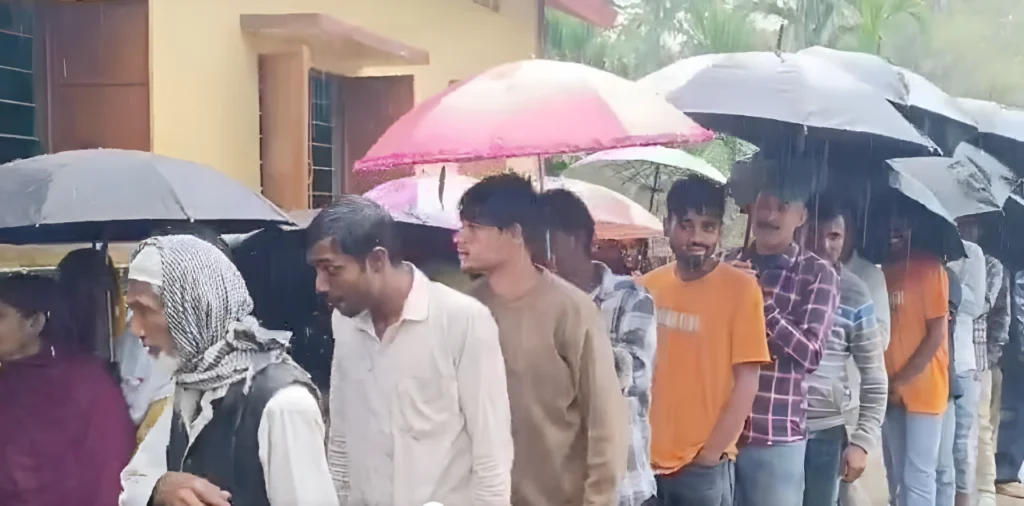
Polling began at 7 am on Thursday, April 9, 2026, across all 126 seats in the state. A total of 722 candidates are in the fray, with over 2.5 crore voters set to decide their fate. By around 3 pm, voter turnout had already reached an impressive 75.91 percent, reflecting strong participation despite early morning rains.
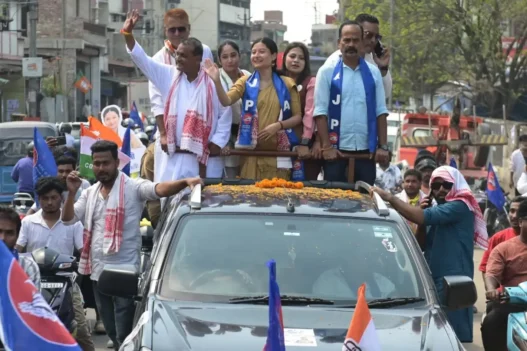
The ruling Bharatiya Janata Party-led National Democratic Alliance is seeking a return to power, attempting to overcome anti-incumbency. Chief Minister Himanta Biswa Sarma is contesting from Jalukbari, while his principal challenger, Gaurav Gogoi, president of the Pradesh Congress, is in the fray from Jorhat.
The past week has seen the electoral battle intensify sharply. The Congress, under Gogoi’s leadership, has mounted a strategic and aggressive campaign, while the BJP and Sarma have responded with equal force. The result has been a bruising contest, with the political environment turning increasingly toxic.
Amid this, the words of Zubeen Garg’s sister carry weight—not just emotionally, but historically. Garg himself had consistently spoken about the need for clean and fair governance that upholds the rights of all. He had often reminded people that the relationship between citizens and the state is not one-sided, once remarking, “what can the government give us, we are giving back to the government,” referring to Assam’s contribution of natural and cultural resources.
Those who heard Palmee Borthakur speak near the 116 Dispur Assembly Constituency polling booth, or saw the clip on social media, say it struck a chord. Many echoed a similar sentiment—that it is time to think carefully before voting and not be carried away by promises or rhetoric. A recurring theme in conversations was the need for progress, accountability, and a government that responds to people’s needs.
This brings into focus a fundamental question: what are voters really weighing today? Is it what governments promise, or what people feel they rightfully deserve in return as citizens?
#WATCH | Palmee Borthakur says, “Cast your vote wisely, if you want a good government of your choice.” https://t.co/ImOgvvmDbv pic.twitter.com/dmNL5weJ1b
— ANI (@ANI) April 9, 2026
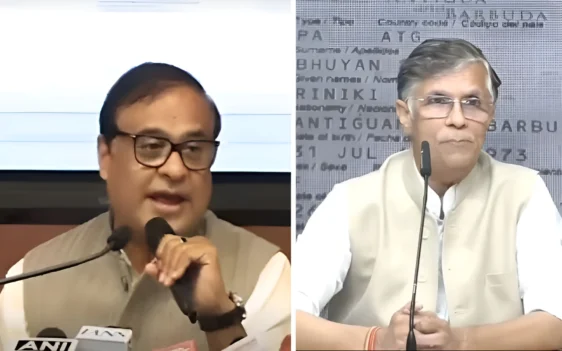
While most projections continue to give the BJP and its allies a comfortable victory, there has been a subtle shift in mood in recent days. This appears to have followed the Congress’s sharper attacks on the ruling camp. The BJP leadership, particularly Sarma, has seemed under pressure after allegations surfaced regarding undisclosed properties and foreign passports allegedly linked to his wife, Riniki Bhuyan Sharma.
The Congress has kept up the pressure. Its spokesperson Pawan Khera has presented additional documents, claiming they point to an overseas company in the United States linked to the Chief Minister and his spouse. The details of the company, however, remain part of a contested narrative.
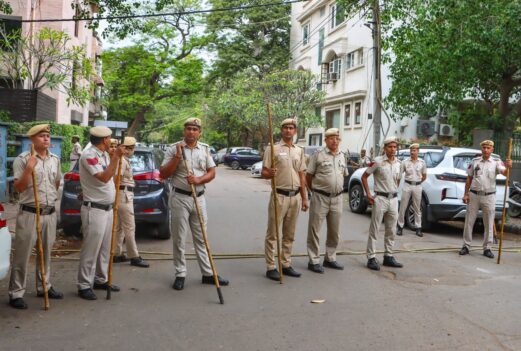
The Assam Police also entered the fray, dispatching a team to New Delhi to arrest Khera, though he was not found there. Khera has since moved the Telangana High Court seeking anticipatory bail and is believed to be in Hyderabad, where a Congress government led by Revanth Reddy is in power.
Yet, beyond these high-voltage exchanges, ground-level issues remain crucial. Concerns around welfare delivery, better roads, inflation, and daily livelihoods are likely to influence voting behaviour. Alongside these, community-based voting patterns are also expected to play a significant role.
The tea tribe community, for instance, which has largely supported the BJP since 2016, is said to be dissatisfied over unmet demands—particularly Scheduled Tribe (ST) status, land rights, and improved wages. While the BJP had initiated steps toward ST recognition, the community was eventually placed under OBCs, leaving many demands unresolved.
असम के लोगों में उमंग की लहर दिख रही है।
मुझे पूरा भरोसा है कि हम असम की सभ्यता, शालीनता, आदर्श और यहां के लोकतांत्रिक मूल्यों को संरक्षित रखते हुए एक ‘नए असम’ का निर्माण करेंगे।
: असम कांग्रेस अध्यक्ष @GauravGogoiAsm जी pic.twitter.com/wtmFuV2WxC
— Congress (@INCIndia) April 9, 2026
The issue has gained traction, especially with the involvement of Hemant Soren of the Jharkhand Mukti Morcha (JMM), who has campaigned in tea belt constituencies. Tea tribes remain a decisive factor in over 35 seats and influential in at least 10 more. Both major alliances have fielded eight candidates each from the community, while the JMM is contesting 18 seats.
The Congress has also foregrounded the demand for Scheduled Tribe (ST) status in its ‘Raijor Istahar’ released on April 2, with Hemant Soren noting that many tea tribe communities are already recognised as STs in states such as Jharkhand, West Bengal, Chhattisgarh, and Odisha—unlike in Assam.
On the other hand, BJP leader Pallab Lochan Das, in a recent interaction with The Borderlens in Biswanath, said that measures including land rights for over 3.5 lakh tea garden families and a phased increase in daily wages to ₹500 are being rolled out.
Another key electoral bloc is the Miya Muslim community, which has turned out in large numbers. Their voting pattern is expected to favour the Congress and its allies, including Raijor Dol and Assam Jatiya Parishad (AJP). Many within the community feel politically marginalised, particularly following delimitation.
The redrawing of constituencies has reduced Muslim-majority seats significantly—from around 35 to about 20. Critics argue that the process disregarded geographical contiguity and concentrated minority voters into fewer constituencies.
In several seats, earlier demographic balances have shifted. For instance, in Katigorah, former Congress MLA Khalil Uddin Mazumder has been quoted in a report by Al Jazeera as saying that before delimitation there were about 1,74,000 voters. “But about 40,000 Hindu voters from neighbouring legislative constituencies have now been merged with Katigorah, making it a predominantly Hindu-majority constituency,” he said. This, he argued, has significantly reduced the chances of electing a Muslim candidate from the seat.
Muslims make up over 34 percent of Assam’s population—one of the highest proportions in India. Yet, their electoral influence is being reshaped through these structural changes.
VIDEO | Assam polls: CM Himanta Biswa Sarma offers prayers at Doul Govinda temple in Guwahati.
He says, “People will vote for the state’s development. People will vote for their state, country and their region.”#AssemblyPollsWithPTI #AssamPollsWithPTI
(Full video available… pic.twitter.com/YqHmjQcR6z
— Press Trust of India (@PTI_News) April 9, 2026
Similar trends are visible in seats like Nowboicha in Lakhimpur district, which has transitioned from a Muslim-majority constituency to a reserved seat for a Hindu candidate from a disadvantaged community. Despite this, Muslim voters—still a sizeable segment—appear inclined toward Congress candidate Dr. Joy Prakash Das.
Nowboicha had elected Muslim legislators three times in the past. However, following delimitation, its Muslim-dominated areas have been “split into four neighbouring Hindu-majority constituency seats,” as pointed out by AIUDF leader Azizur Rahman in a report by Al Jazeera. This restructuring, according to him, has significantly altered the constituency’s electoral dynamics.
Even as these shifts play out, voter turnout has remained strong. Around 60 percent voting was recorded by 1 pm, and the numbers are expected to rise further by the close of polling. The high turnout, despite intermittent rains, may indicate something deeper—a possible shift in how people are thinking, particularly among the middle and upper middle classes.
As Assam votes, the outcome may still align with predictions. But beneath the numbers lies a quieter, more important story—of voters pausing, reflecting, and perhaps asking harder questions before making their choice.