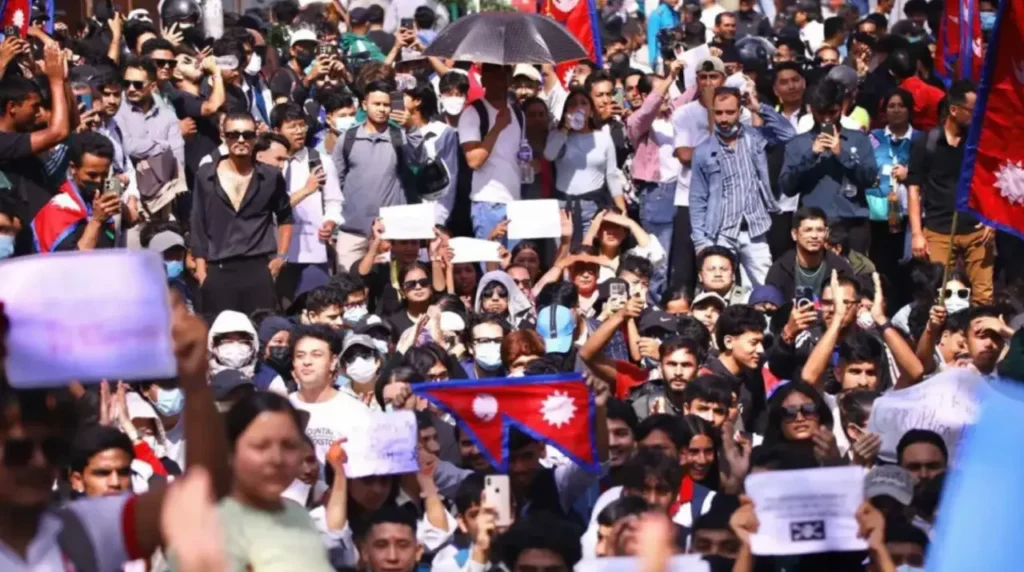
In the aftermath of Nepal’s 2025 youth-led political rupture—driven by digitally native Gen Z activists disillusioned with the entrenched party structures, rampant corruption, and nepotism—the reverberations have begun to reshape political imaginaries beyond its borders. Among the most vibrant sites that have been implicitly affected is the political space of the Darjeeling Hills, a Nepali-ethnic borderland within India, whose historical, cultural, and linguistic ties to Nepal render it a reflective surface for transnational political currents.
Yet Darjeeling does not merely echo Kathmandu’s upheavals; however, it refracts them through its own layered and persistent struggles for autonomy, political identity, and generational hardships over the last eleven decades.
Just like the political undercurrents in Nepal led by the Gen Z youths totally fragmented the state apparatus within a few days of violence and loss of human lives over the ban on social media by the then ruling government of KP Sharma Oli, initially citing non-compliance on regulatory and localization issues, however, disguised as a political move to curb dissent digitally led to a massive political vacuum for an interim period in Nepal.
On the contrary, Darjeeling, for decades, stands as a liminal space which has its own history of systemic oppression and disillusionment with the ruling state elites, and where it hardly fits into the political imaginaries of the Indian state thereby manifesting itself as a passive peripheral region totally neglected in terms of development, governance and necessary infrastructure leading to cultural and political fragmentation from the inside.
While earlier iterations of Darjeeling’s political assertion relied heavily on Gorkha ethnic solidarity and territorial claims within the Indian Union, recent years have seen a generational shift. Of late, youths of Darjeeling hills, increasingly disillusioned with the semi-autonomous territorial administration & its stagnant leadership and fragmented party politics, are turning to digital platforms like facebook, whatsapp and many other social media platforms to articulate their grievances and aspirations expressing grave concerns over the dwindling political future of Darjeeling and its youths thereby manifesting a surge in the use of digital platforms post-2017 Gorkhaland agitation.
Therefore, a drastic change in the earlier form of overt political mobilization took place post-2017 in Darjeeling, thereby giving way to a more nuanced form of ethno-pragmatism.
As such the recent political upheaval by Gen Z youths in our neighboring state Nepal not only offered the youths of Darjeeling hills an inspiration to challenge and critic the political authority and their elite driven narratives but it also opened up a new political discourse in reimagining a highly sensitive and a contested borderland region like Darjeeling in terms of political agency- one that resonates with but does not replicate Kathmandu’s upheaval. The Political discourse in Darjeeling post-2017 can now be mostly understood in terms of subtle acts of symbolic resistance and affective politics.
Furthermore, the Darjeeling post-2017 mobilization has witnessed the emergence and rise of many youth-driven informal political orders, aligning with the formal state institutions to fill the political vacuum by empowering disillusioned and discontent youths who have lost all hope and aspirations in the aftermath of the Gorkhaland agitation.
What emerges in Darjeeling recently is not only a replication of Nepal’s Gen Z uprising, but a localized re-articulation shaped by its own political grammar wherein youth activism is filtered through the constraints of India’s federal structure, or more broadly in terms of asymmetrical political agency. So, the Gen Z youth activism in the political space of Nepal not only mirrors the harsh political realities of a fragmented state apparatus for the youths of Darjeeling, but it also gave them the opportunity to use the digital media as a tool for political as well as civic assertion. In this refracted mirror, Nepal’s post–Gen Z political imaginary becomes a catalyst, not a blueprint; it animates new forms of digital dissent, reconfigures notions of belonging, and inspires Darjeeling’s youth to reimagine ways to challenge decades of political negligence.
Darjeeling of late acts as a transnational mirror wherein political events outside the physical boundaries of the state can heavily influence the local political imagination. So, it can be said that Nepal’s Gen Z movement, led by the digitally and tech-savvy youths, reshapes the contours of political possibility and generational transformation.
On the contrary, Darjeeling’s youth respond not with imitation but with innovation— broadly reflecting inherited generational struggles through the lens of digital agency and civic reinvention, effectively using the already fragmented digital landscape for collective mobilization & amplifying criticism of the policies of the ruling elites through memes and other forms of digital action in the contemporary political discourse.
Long considered a peripheral region, the Darjeeling hills have now become a focus of political imagination. By reflecting the political changes in the state of Nepal recently, Darjeeling provides an insight into how a borderland and a liminal space can serve as a testing ground for future politics and where the decades of generational struggles for political identity, autonomy, and dissent can evolve in new and unexpected forms.