Myanmar’s military junta is pushing ahead with an election process set to begin on December 28 and unfold in three phases through January 2026—an exercise it desperately hopes will project an image of political normalcy and legitimacy. Yet the ground reality tells a far more volatile story.
The credibility of this election has been questioned even before ballots are cast, and the political atmosphere is crackling with resistance, fear, and violent coercion. While the junta-backed State Administration Council (SAC) is leaving little to chance—deploying every tool from forced early voting to diplomatic manoeuvring—the task of manufacturing legitimacy is proving increasingly difficult in a country still reeling from the 2021 coup and the nationwide uprising that followed.
Across Myanmar, protests, strikes and armed offensives continue to erupt. One of the clearest early signals came from Yangon. On Tuesday, the Yangon People’s Strike, an anti-coup protest group, shared photos of a signboard at the Sule Pagoda–Anawrahta intersection declaring: “Reject and defy the regime’s sham election.”
The group called for a nationwide silent strike on December 10—Human Rights Day—urging citizens to stay indoors and suspend all economic activity between 10 a.m. and 3 p.m. A source in Naypyidaw told DVB that regime employees have been “forbidden”from taking leave on that day, revealing the junta’s fear of visible public dissent.
In Yangon’s northern townships of North Okkalapa and Shwepaukkan, residents report that local officials forced business owners to sign pledges agreeing to remain open on December 10 under threat of closure by military authorities. Silent strikes are not new: the latest follows similar nationwide actions held in February 2024 and in December 2021, soon after the coup. But the regime’s determination to suppress even symbolic forms of resistance shows how fragile its control remains.
Signs of instability are everywhere. Violence and intimidation have intensified in the run-up to the polls, including the abduction of candidates.
The most emblematic case so far is the detention of 37-year-old Wai Lin Htet of the Shan and Nationalities Democratic Party, allegedly kidnapped by three members of a local resistance group in Pakokku Township. While resistance groups have not confirmed the junta’s narrative, the incident underscores the high-risk environment in which the election is unfolding—and the junta’s eagerness to paint all opposition as destabilising insurgents.
Acts of defiance continue to multiply. Election posters have been sabotaged; in one surreal incident, a man was imprisoned simply for laughing when the wind blew down a junta party poster.
In Kyaikto, three young people were abducted by troops after reading anti-election posters on a wall on December 3. In Mandalay, a peaceful anti-election demonstration led by resistance leader Dr. Tazar San prompted the junta to demolish the nearby marketplace and threaten to kill participants if caught. Despite years of attempts by the regime to eliminate him, Dr. Tazar San remains at large.
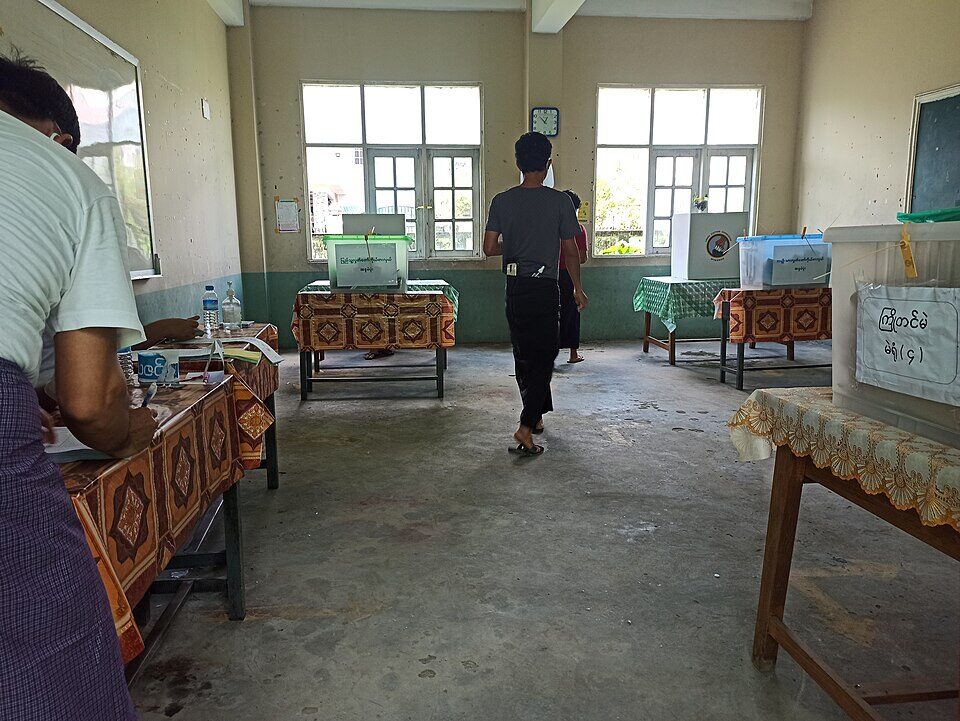
Alongside repression, the junta is aggressively engineering voter turnout. It has expanded early voting in embassies, universities, and government offices. University students in junta-controlled institutions have reportedly been compelled to vote early in order to continue their courses.
Government staff face similar pressure. Prisoners in Loikaw are being forced to cast advance ballots. Even Burmese nationals abroad must vote to access basic consular services. According to Khit Thit Media and Network Media Group, coerced votes now appear likely to far exceed voluntarily cast ballots.
Independent electoral analysts say the regime needs turnout of at least 50 percent—by force or otherwise—to claim domestic and international legitimacy. “It really depends on how the junta manages to get people to vote, which many media reports suggest is clearly against the will of the people,” said an experienced observer preparing to visit Myanmar, speaking anonymously.
According to a DVB report in South Korea, where over 80,000 Burmese nationals work under the Employment Permit System, early voting has already faltered. The Myanmar embassy extended its early voting period from two days (Dec. 6–7) to seven (Dec. 8–12) after almost no one showed up. The report further adds that protesters outside the embassy say they have heard diplomats admit that not a single ballot was cast over the weekend. Demonstrations against the junta’s “sham election” have also swept across cities in Asia, Europe, and North America.
Sources from inside Myanmar say that the regime has begun posting voter lists at municipal offices, urging citizens to verify their eligibility. Few have complied. In response, the junta has dispatched troops and administrators door-to-door in Yangon to force residents to check their status—a measure that underlines the lack of voluntary participation.
International bodies have echoed domestic concerns. UN human rights officials have warned that the election will unfold in an atmosphere “rife with threats and violence,” with political participation severely restricted.
Several opposition groups and civil society organisations have labelled the election a sham. In an effort to monitor and expose abuses, exiled Burmese groups have launched the Sham Election Tracker Working Group (SET WG), a collaborative project providing real-time reporting, data visualisation, and documentation of violations. The initiative was formally launched at the Foreign Correspondents’ Club of Thailand on December 10, aligning symbolically with Human Rights Day.
ASEAN has refused to send official observers, with Secretary-General Kao Kim Hourn stressing that the bloc will not endorse the polls. However, individual member states may send observers, exposing ASEAN’s internal divisions.
Thailand’s stance reflects this ambiguity: while Foreign Minister Sihasak Phuangketkeow declared the election non-transparent due to thousands of political prisoners, he also visited Naypyidaw, met with Min Aung Hlaing, and welcomed the election as part of a “political transition.” Thailand and Myanmar also agreed to deepen cooperation on narcotics suppression, cybercrime, border security, and reopening the Second Thai-Myanmar Friendship Bridge.
Outside ASEAN, the junta has secured more explicit support. Russia and Belarus have agreed to send observers following high-level bilateral meetings.
China has taken a more strategic approach. In October, Chinese envoy Deng Xijun expressed conditional support for the election and discussed deploying Myanmar’s electronic voting system. Beijing wants the exercise to appear “free and fair” but is primarily concerned with border stability and safeguarding investments.
China has pressured ethnic armed groups near its borders—the Myanmar National Democratic Alliance Army (MNDAA,) – Ta’ang National Liberation Army (TNLA),– Wa State Army (WSA- which is often used interchangeably with UWSA – United Wa State Army, the armed wing of the United Wa State Party), and recently the Kachin army—to limit hostilities.
According to local media reports after reports emerged of Kachin involvement in clashes around Mogok and Momeik, China summoned a Kachin representative to Kunming and ordered non-interference in troop movements. With northern Shan largely stabilised under its guidance, China is tightening its influence. It has revived the long-stalled railway project from the Chinese border to Mandalay, a 400 km, US$10 billion undertaking.
Amid this manoeuvring, the election itself increasingly resembles political theatre. The junta’s goal is not to persuade the world of its legitimacy, but to demonstrate that it alone can stage a nationwide vote. A recent Ayeyarwaddy Times report describes videos from Yangon’s Hlaingthaya Township show the USDP flinging cash into the air to draw crowds to its campaign rallies—an indication of just how hollow its popular base is.
What emerges, then, is a picture of an election being engineered rather than embraced—an elaborate performance staged under duress, surveillance, and violence. Whether Myanmar’s people believe in the process is irrelevant to the junta; what matters is the image it projects. Yet every protest, every empty polling booth, and every act of defiance—from Yangon’s silent strike to Korean diaspora demonstrations—reveals a nation refusing to be coerced into legitimising its oppressor.