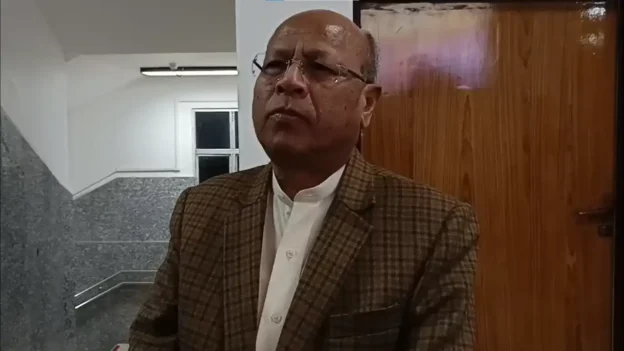
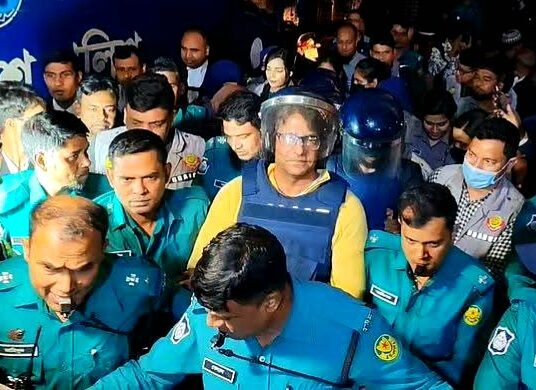
“Honorable court, I am a journalist. I question those in power. I have no connection with anyone. If Dr. Yunus wishes, he can turn all of Bangladesh into a prison.” These were the words of veteran journalist Anis Alamgir on Monday, as he appeared before a Dhaka court after being detained under Bangladesh’s Anti-Terrorism Act, delivering a scathing critique of the interim government while defending his journalistic independence.
Alamgir, who first gained national recognition in 2003 covering the Iraq war for the Bengali daily Ajker Kagoj, has reported across major media outlets and taught journalism at a private university.
In recent months, he has become an outspoken critic of the Yunus-led interim government, condemning what he calls institutional overreach, political retaliation, and the distortion of Bangladesh’s history on television talk shows and social media.
His posts provoked coordinated online attacks from supporters of various radical groups as well as senior officials within the Yunus administration.
On Sunday evening, Alamgir was taken from a gym in Dhanmondi by a team from the Detective Branch (DB) of Dhaka Metropolitan Police, who told him he was required to meet the DB chief.
The meeting quickly escalated into a formal arrest. He was later presented before Additional Chief Metropolitan Magistrate Jashita Islam, who approved a five-day police remand for questioning.
Alamgir appeared in court handcuffed, wearing a helmet and bulletproof vest, amid a large crowd.
Witnesses said he was visibly emotional, wiping tears from his eyes while interacting with colleagues and legal representatives before proceedings began.
In his court statement, Alamgir directly confronted the interim government:
“My job is not to bow to anyone. Those who want to turn me into a puppet of a particular party—that’s their problem. I have spoken about an attack on the house of Yunus, but the reasons I mentioned it—attacks on Dhanmondi 32—are about politics of revenge. That will come back. I have also talked about how the spirit of July will grow. I don’t know what mistake I have made.”
Recently in his Facebook post, Alamgir responded to the shooting of Osman Hadi, a spokesperson for Inqilab Mancha who identified himself as a “July fighter” and was wounded on Friday by unidentified gunmen.
As social media filled with both messages of support and celebrations of the attack, Alamgir warned that the growing acceptance of retaliatory violence marked a dangerous moral collapse.
“Playing with the lives of political opponents is not politics,” he wrote. “It is barbarism.” He cautioned that since the change of power in August 2024, a culture of vengeance had been normalised, pushing both politics and society towards instability.
In other posts, Alamgir directed his criticism at television talk shows and mainstream media outlets, arguing that they had become key enablers in the distortion of Bangladesh’s 1971 Liberation War.
He questioned whether responsibility lay with controversial guests who described central figures of the independence movement as traitors, or with the broadcasters who repeatedly gave them a platform.
Referring to his own appearances alongside a polarising commentator, Alamgir accused television channels of prioritising ratings over responsibility and amplifying propaganda long associated with Islamist student groups.
Alamgir argued that under the interim government, public discourse was shifting in ways that weakened the moral and historical foundations of the state, pointing to changes in official language and educational materials that he said diluted the legacy of the Liberation War.
While governments would come and go, he wrote, those who sought to erase or trivialise the country’s history would ultimately be judged by history itself.
International press freedom organisations expressed alarm.
Speaking at a seminar organised by the Canada-based Global Centre for Democratic Governance, Charlotte Jacquemart, editor of Public Radio of Switzerland, cited official data showing 195 criminal cases filed against journalists between August 2024 and July 2025—a 550% increase over the previous year—while 878 journalists were reportedly harassed or intimidated in Bangladesh.
She called for the immediate withdrawal of fabricated cases and the release of detained journalists.
Transparency International Bangladesh (TIB) executive director Dr. Iftikharuzzaman said the interim government cannot evade responsibility for “continued use of force, legal overreach, and institutional abuse of power to suppress free media, freedom of speech, and dissent.”
From Dhaka, a senior journalist speaking on condition of anonymity said Alamgir’s detention has sent shockwaves through newsrooms. “This is not just about one journalist. We are now facing direct threats to our lives from Yunus-led law enforcement authorities. Independent reporting, holding power to account, and defending historical truth can put any journalist in serious danger,”
Source : The Chittagong Hill Tracts