As conflict-ridden Myanmar (also known as Burma or Brahmadesh) prepares for its next general elections following the 2021 military coup that ousted the democratically elected government in Naypyitaw, calls are growing for the immediate release of journalists held in detention.
International media watchdogs, including the Geneva-based Press Emblem Campaign (PEC), have urged the Myanmar military regime to free all imprisoned media professionals and repeal a newly enacted election-related law that has intensified harassment of journalists and social media users in the name of ensuring a “clean” electoral process ahead of the proposed multi-phase polls.
According to PEC, more than 200 journalists have been detained or imprisoned since the February 2021 coup that toppled Aung San Suu Kyi’s government, with nearly 40 media professionals still behind bars across the Southeast Asian nation. The military junta has also cancelled the licences of around 15 media outlets, forcing them to operate clandestinely, while foreign media access to India’s eastern neighbour remains severely restricted.
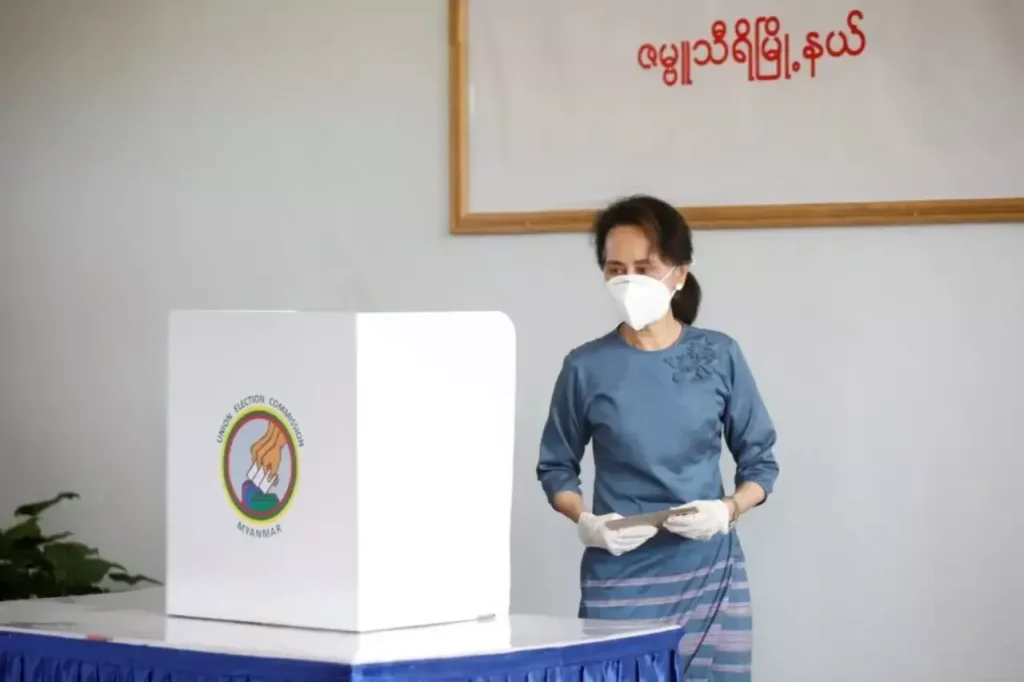
The proposed elections, scheduled to begin on 28 December 2025, are to be conducted in three phases, with subsequent rounds planned for 11 and 25 January 2026.
However, the polls will bar several major political parties, including the National League for Democracy (NLD), led by Suu Kyi, which won a landslide victory in the November 2020 general elections. With only junta-backed proxy parties allowed to participate nationwide, the electoral exercise is widely expected to be one-sided, with results anticipated by the end of January next year.
Myanmar, a predominantly Buddhist country of nearly 55 million people, is currently experiencing what observers describe as a de facto civil war. The Min Aung Hlaing-led Tatmadaw continues to battle armed resistance groups and people’s militias, resulting in thousands of deaths, hundreds of thousands of detentions, and the displacement of millions.
Under Operation 1027, launched by anti-junta forces in October 2024, government troops suffered significant defeats, and by now nearly half of Myanmar’s territory, including several key towns and military bases, has slipped out of the junta’s control.
In these contested areas, voting is either impossible or likely to witness extremely low participation, making the prospect of a free, fair, and comprehensive election increasingly remote. Despite this, the junta-appointed Union Election Commission (UEC) has continued preparations, planning to hold polls in around 274 of Myanmar’s 330 townships.
Meanwhile, millions of Myanmar nationals are currently living abroad, both legally and illegally, and more than 22,000 political prisoners—including President Win Myint and Nobel Peace Prize laureate Aung San Suu Kyi—remain incarcerated.
The state-run Global New Light of Myanmar recently reported that the State Administration Council, Myanmar’s ruling military body, has enacted a stringent new election law imposing penalties of up to seven years’ imprisonment for speech, protests, incitement, or the distribution of leaflets opposing the electoral process.
The law also prescribes severe punishment for damaging ballot papers, vandalising polling stations, or intimidating candidates, election workers, and voters. Numerous citizens who criticised the polls on social media have already been sentenced to lengthy prison terms, and rights groups warn that the number of victims may rise further as polling approaches.
Since the 2021 coup, civilian casualties have crossed 5,350, while over 3.5 million people have been internally displaced due to indiscriminate military crackdowns, including aerial bombardment of densely populated areas.
Many pro-democracy leaders have fled to neighbouring countries such as Thailand, Bangladesh, and India to escape persecution. With only six political parties permitted to contest nationwide, critics argue that the elections are unlikely to fulfil any democratic purpose, though the junta appears intent on projecting the exercise as a successful transition to secure legitimacy for its continued rule.
An editorial published recently in Mizzima, one of Myanmar’s most widely read independent news platforms, observed that the junta has sought to consolidate its authority since 2021 by cloaking military rule in the appearance of electoral legitimacy. The editorial noted that the sustained crackdown on dissent ahead of the polls exposes the regime’s authoritarian foundations.
From the outset, the election has been widely viewed as a mechanism to legitimise the coup through a controlled and deeply compromised political process. Although Min Aung Hlaing has repeatedly promised a return to “disciplined democracy,” the editorial argued that his primary objective remains the consolidation of long-term control over Myanmar’s political system.
Observers and critics, both within and outside the country, maintain that elections held under such circumstances cannot be inclusive or credible. Thousands of political activists, journalists, and ordinary citizens have been arrested since the coup, with many reportedly tortured or killed.
The National Unity Government (NUG), an exile administration formed largely by elected representatives barred from assuming office, has appealed to the international community to denounce what it describes as a sham election and has urged foreign governments not to send election observers. The Association of Southeast Asian Nations (ASEAN), frequently criticised for its muted response to the Myanmar crisis, has decided not to deploy observers from its member states.
In a recent development, the junta announced a mass amnesty for 3,085 political prisoners and dropped charges against 5,580 others, paving the way for their release ahead of the elections. According to state-run MRTV, the move was intended to allow the freed detainees to exercise their voting rights and to promote goodwill among the electorate.
Those released were reportedly warned against committing offences related to opposing the military regime or the proposed polls. However, there has been no confirmation that Suu Kyi, now an ailing octogenarian serving a cumulative 27-year sentence, is among those released.
Crucially, no concrete reports have emerged regarding the release of jailed journalists. Speaking to this writer from Geneva, PEC president Blaise Lempen expressed deep concern over the plight of media workers in Myanmar. He said the military authorities have used the election process to justify the imposition of sweeping restrictions on journalists and social media users, effectively silencing debate over the credibility of the polls. Lempen noted that more than five journalists have been killed by the military in recent years, while many others have fled their homes to seek refuge in neighbouring countries such as Thailand and India.