The killing of Sharif Osman Hadi has come to represent far more than the violent silencing of a controversial political activist. It has exposed, with unsettling clarity, the depth of Bangladesh’s law and order crisis at a moment when the country stands on the brink of an election and a promised democratic transition. In the days following his death, civic order unravelled rapidly—marked by mob violence, targeted arson, attacks on major media institutions, and a growing diplomatic strain with India. Together, these developments point to a state struggling to retain authority over the streets and contain an expanding governance vacuum.
Hadi’s death did not create the crisis. It merely hastened it, stripping away pretence and laying bare long-standing structural failures.
The killing and the immediate fallout
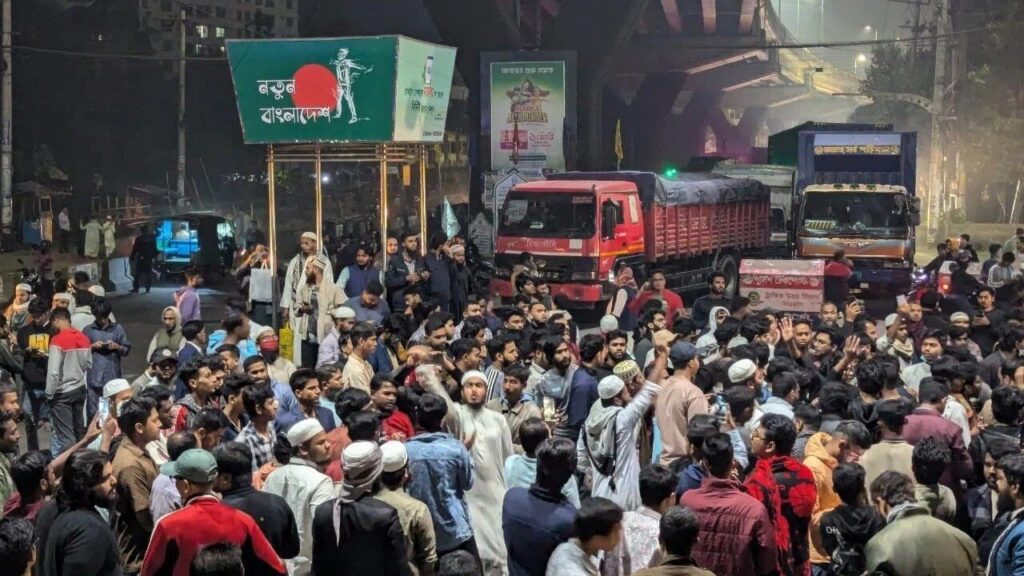
Sharif Osman Hadi was shot in broad daylight in Dhaka, initially survived after emergency treatment, and was later flown to Singapore for advanced medical care, where he ultimately succumbed to his injuries. The brutality and symbolism of the attack—a political activist gunned down during an election season—sent shockwaves across the country. News of his death sparked immediate protests in Shahbagh, which quickly spread across Dhaka and to other cities.
What followed was grimly familiar from Bangladesh’s recent past, but unprecedented in scale and choice of targets. Demonstrations rapidly turned into organised mob violence. In Dhaka’s Karwan Bazar, attackers torched the offices of Prothom Alo and The Daily Star, the country’s most influential Bengali and English-language newspapers. Journalists were trapped inside, equipment and archives were destroyed, and both newspapers were forced to suspend operations temporarily—an extraordinary rupture in Bangladesh’s media history.
These were not random acts of anger. The deliberate targeting of major news organisations suggested intent: to intimidate, silence critical voices, and signal that even the most powerful civic institutions were no longer beyond reach.
Press freedom under attack
An attack on the media is always a warning sign for a democracy. In Bangladesh’s case, the signal could not have been clearer. Prothom Alo and The Daily Star failed to publish their print editions for the first time in 27 and 34 years respectively, citing severe security threats. International organisations, including the Committee to Protect Journalists (CPJ) and the Media Freedom Coalition, condemned the attacks as direct assaults on press freedom and the public’s right to information.
For journalists working in Bangladesh, the message was deeply chilling. Truth-telling itself appeared to have become dangerous. In fragile political environments, violence against the media often precedes broader democratic decline. When reporters are forced to flee burning offices, claims of democratic normalcy lose credibility, and the space for independent scrutiny narrows sharply.
A worsening law and order situation
The violence following Hadi’s death fits into a broader and deeply troubling national trend. Over the past year, Bangladesh has seen a sharp increase in murders, extortion, armed robberies, political clashes, and incidents of mob justice. Lynchings over alleged blasphemy, public beatings, and summary street executions have increasingly replaced due legal process.
Human rights organisations estimate that dozens have been killed in mob attacks in recent months alone. Law enforcement responses remain largely reactive rather than preventive. Police and security forces frequently arrive only after violence has peaked, reinforcing public perceptions of state paralysis and loss of control.
The interim government has repeatedly pledged zero tolerance for mob justice. Yet these pledges have failed to translate into effective deterrence. Analysts cite weak intelligence coordination, overstretched policing, political interference, and a deeply entrenched culture of impunity as key reasons for the continued breakdown of law and order.
Blame-shifting and the failure of accountability
A Bangladeshi contributor, reflecting a growing strand of domestic criticism, argues that the deeper crisis lies not only in rising violence, but in how the state explains it.
In recent months, the deterioration of law and order—marked by murders, robberies, extortion, and street violence—has become increasingly visible. Yet instead of serious introspection and accountability, there has been a tendency to deflect blame. India is frequently accused, or the Awami League (AL) is held responsible, creating narratives that divert attention from the state’s own security failures.
This pattern of blame-shifting is not new. Questions about weak policing, poor intelligence coordination, administrative inefficiency, and ineffective local governance are often countered with claims of “external interference” or “political conspiracies.” As a result, core institutional weaknesses remain unaddressed while public debate is deliberately redirected.
Such narratives may provide short-term political cover, but they are damaging in the long run. They delay essential reforms, embolden criminal networks, and deepen public insecurity. Law and order cannot be restored by externalising responsibility; it requires honest assessment, transparent investigations, and acceptance of institutional failure. Avoiding scrutiny only allows lawlessness to take deeper root.
Why India is concerned
The crisis has not remained confined within Bangladesh’s borders. New Delhi has been watching developments with increasing concern. Protests targeting Indian symbols, aggressive anti-India rhetoric by political figures, and security threats to the Indian High Commission in Dhaka have prompted a clear diplomatic response.
India’s decision to summon Bangladesh’s high commissioner signalled that instability in Dhaka now carries regional consequences. For New Delhi, Bangladesh’s internal disorder intersects directly with core security concerns: stability in India’s northeastern states, risks of cross-border extremism, illegal migration, and the safety of diplomatic missions.
While Indian officials have avoided overt interference in Bangladesh’s domestic politics, their unease is unmistakable. A Bangladesh gripped by mob violence and political volatility is not merely a neighbour in crisis; it is a potential source of broader regional instability.
Elections amid fear and uncertainty
The timing of the unrest could hardly be more damaging. Bangladesh is approaching a national election and referendum scheduled for February 12, 2026—processes already burdened by deep distrust and political polarisation. Violence following Hadi’s death has intensified fears that insecurity itself may be used either to undermine the credibility of the vote or to justify delays.
Opposition leaders accuse the interim government of losing control, while the administration claims that shadowy forces are attempting to sabotage a historic democratic transition. The reality may lie somewhere between these competing narratives. What is undeniable is that elections held amid fear, censorship, and street violence risk losing legitimacy, regardless of the outcome.
A critical test for the State
Hadi’s killing has become a defining test for Bangladesh’s institutions. The central issue now extends far beyond identifying those directly responsible for the shooting. It is whether the state can reassert its monopoly over violence, protect journalists and vulnerable communities, and restore public confidence in the rule of law.
Attacks on media houses, unchecked mob violence, and rising diplomatic tensions with India all point to the same conclusion: Bangladesh is facing a crisis of governance, not merely a security breakdown.
Condemnations and official statements are no longer sufficient. What is urgently needed is visible accountability—swift and credible prosecutions, professional policing insulated from political pressure, and a clear rejection of narratives that externalise blame. Without these steps, criminal networks will grow bolder, mobs more confident, and democratic institutions increasingly fragile.
For India, the lesson is equally clear. Stability in Bangladesh cannot be taken for granted, and engagement must balance restraint with vigilance. For Bangladesh, the stakes are far higher. This moment will determine whether the country halts its slide into lawlessness—or allows violence, fear, and scapegoating to shape its political future.