Myanmar’s military-organised 2025–26 multi-party general election concluded on January 25 after three phases of voting, setting the stage for the formation of a new government even as the process remains unrecognised by many domestic and international actors. The polls were conducted amid ongoing armed conflict, large-scale disenfranchisement, and the exclusion of key political forces.
As voting ended, the military-backed Union Solidarity and Development Party (USDP) claimed a sweeping victory. According to a DVB report, the party announced that it had won all 17 townships in Yangon Region during the third and final phase of voting, though the outlet said it was unable to independently verify the claim. USDP central executive committee member Maung Myint stated on social media that the party secured all Yangon Region seats in the Pyithu Hluttaw, or lower house of parliament.
Earlier figures released by the military’s Union Election Commission (UEC), and cited by local media reports, showed the USDP winning 181 of 202 seats in the Pyithu Hluttaw and 52 of 78 seats in the Amyotha Hluttaw, or upper house, after the first two phases held on December 28 and January 11.
Veteran democracy activist and former political prisoner Ko Ko Gyi, founder and chairperson of the People’s Party, was among those reportedly defeated in the final round. He contested the Pyithu Hluttaw seat in Yangon’s Lanmadaw Township and told BBC Burmese on January 26 that he was awaiting official confirmation from the UEC.
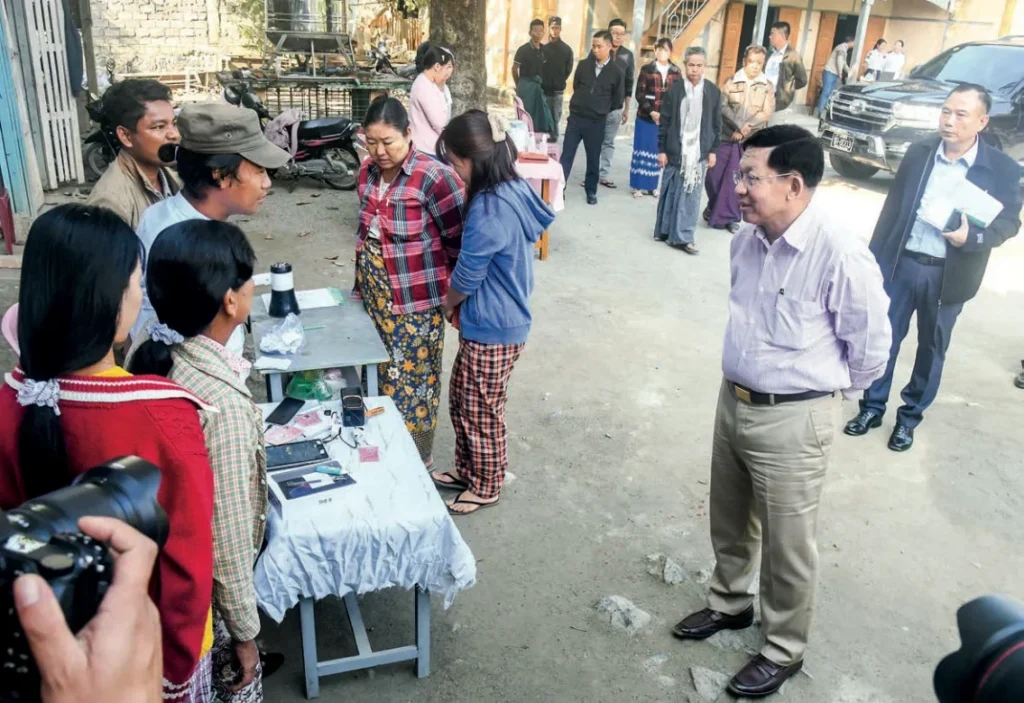
As the election concluded, regime leader Senior General Min Aung Hlaing dismissed international criticism and reiterated the military’s position that the vote reflected public will. Speaking to pro-regime media Global New Light of Myanmar during a visit to polling stations around Mandalay, he said Myanmar would move toward a “multiparty democratic” system and avoided specifying what role he might play in the next government.
On international recognition, Min Aung Hlaing said, “The people who live inside Myanmar vote. Those who live outside do not. The people vote for whoever they want, and we recognize the people’s vote.”
The Association of Southeast Asian Nations (ASEAN) did not endorse the elections and refrained from sending an official observer mission, but noted that member states were free to take their own positions; Cambodia, Laos, Thailand and Indonesia were among those that sent observers individually.
Ming Aung Hlaing acknowledged that some voters stayed away either because their preferred candidates were not contesting or due to security concerns, but added that those who wished to support participating parties were able to vote freely.
Responding to criticism from abroad, he said, “The international community needs to know the true situation in Myanmar. What people hear outside is different from what is happening inside.” Asked whether he would take part in the next government, he said, “I can’t say anything yet. These decisions will be made after parliament is convened.”
Voting in Phase (3) took place on January 25 from 6:00 a.m. to 4:00 p.m. across 61 townships in Kachin, Kayin, Sagaing, Tanintharyi, Bago, Mandalay, Yangon, Shan, and Ayeyarwady regions. Elections were cancelled in two townships in Kachin State due to security concerns. International observers included delegations from India, Belarus, Indonesia, Nepal, Cambodia, Nicaragua, and representatives of the International Conference of Asian Political Parties, along with diplomats from foreign embassies.
Out of Myanmar’s 330 townships, elections were held in 102 during Phase (1), 100 in Phase (2), and 61 in Phase (3), leaving 67 townships without voting.
Local media reports quoted Major General Zaw Min Tun, head of the Information Team of the National Defense and Security Council, as claiming that more than 24.22 million people were eligible to vote nationwide, with over 13.14 million casting ballots, resulting in an overall turnout of approximately 55 percent.
He provided a phase-wise breakdown as Phase (1): 11.69 million eligible voters; 6.09 million voted (52.13 percent turnout); Phase (2): 7.59 million eligible voters; 4.24 million voted (55.95 percent turnout) and Phase (3): 4.94 million eligible voters; 2.79 million voted (56.48 percent turnout)
“Voter participation increased gradually from Phase (1) to Phase (3),” Zaw Min Tun said, adding that overall turnout exceeded 54 percent, at around 55 percent.
Despite the military’s emphasis on participation figures, opposition voices remain sceptical. Ko Ko Gyi argued that Myanmar requires a national unity–style government rather than a winner-takes-all administration, especially amid intensifying conflict.
Speaking after casting his vote on January 25, he said that even if one party secures a parliamentary majority, it should still include ethnic leaders and democratic forces to help resolve the country’s crises. He stressed that political maturity, openness, and empathy were essential, warning that deepening polarisation would undermine national recovery. He also urged the next parliament to prioritise dialogue and negotiations, noting that one-party dominance weakens checks and balances.
Responding to whether the election could serve as a political exit from Myanmar’s turmoil, Ko Ko Gyi said it was not an ideal solution, but one that might minimise harm, while acknowledging that serious challenges lie ahead.