
China’s stated commitment to execute the Teesta River water-management project signals a potential deepening of Beijing’s influence in Bangladesh at a time when Dhaka is reassessing its regional alignments. While water-sharing remains a sensitive issue between Bangladesh and India, recent developments suggest that the interim government under Chief Adviser Muhammad Yunus has shown a growing eagerness to broaden engagement with China, signalling a shift that goes beyond the Teesta alone.
In Dhaka, Chinese Ambassador Yao Wen confirmed Beijing’s readiness to take up the Teesta project, one of the largest proposed irrigation initiatives in the region. In articulating China’s approach, Yao emphasised that Beijing’s engagement with Bangladesh transcends political regimes and is framed as serving the interests of the Bangladeshi people—language that mirrors China’s broader Belt and Road Initiative (BRI) outreach across South Asia.
China’s expanding presence in Bangladesh, particularly through proposed infrastructure initiatives such as the Teesta Barrage project and planned healthcare investments, introduces a new layer of strategic complexity. Alongside the river project, Beijing has announced plans to establish three hospitals under the BRI: a 1,000-bed specialised hospital in Nilphamari as a “gift”, a 500–700-bed facility in South Karnaphuli, Chittagong, and a 100-bed rehabilitation centre in Dhamrai, Dhaka. Notably, two of these proposed facilities—Nilphamari and Karnaphuli—are located close to India’s border, including near the strategically sensitive Chicken’s Neck corridor, inevitably drawing regional scrutiny.
Within Bangladesh, the China-backed Teesta Master Plan is increasingly portrayed as a vehicle for northern development, promising irrigation expansion, employment generation, and economic revitalisation. However, the broader geopolitical context cannot be overlooked. With the 1996 Ganga Water Sharing Treaty nearing expiry in 2026, unilateral interventions on shared rivers—particularly those involving extra-regional actors—carry implications for regional trust, water security, and long-term cooperation.
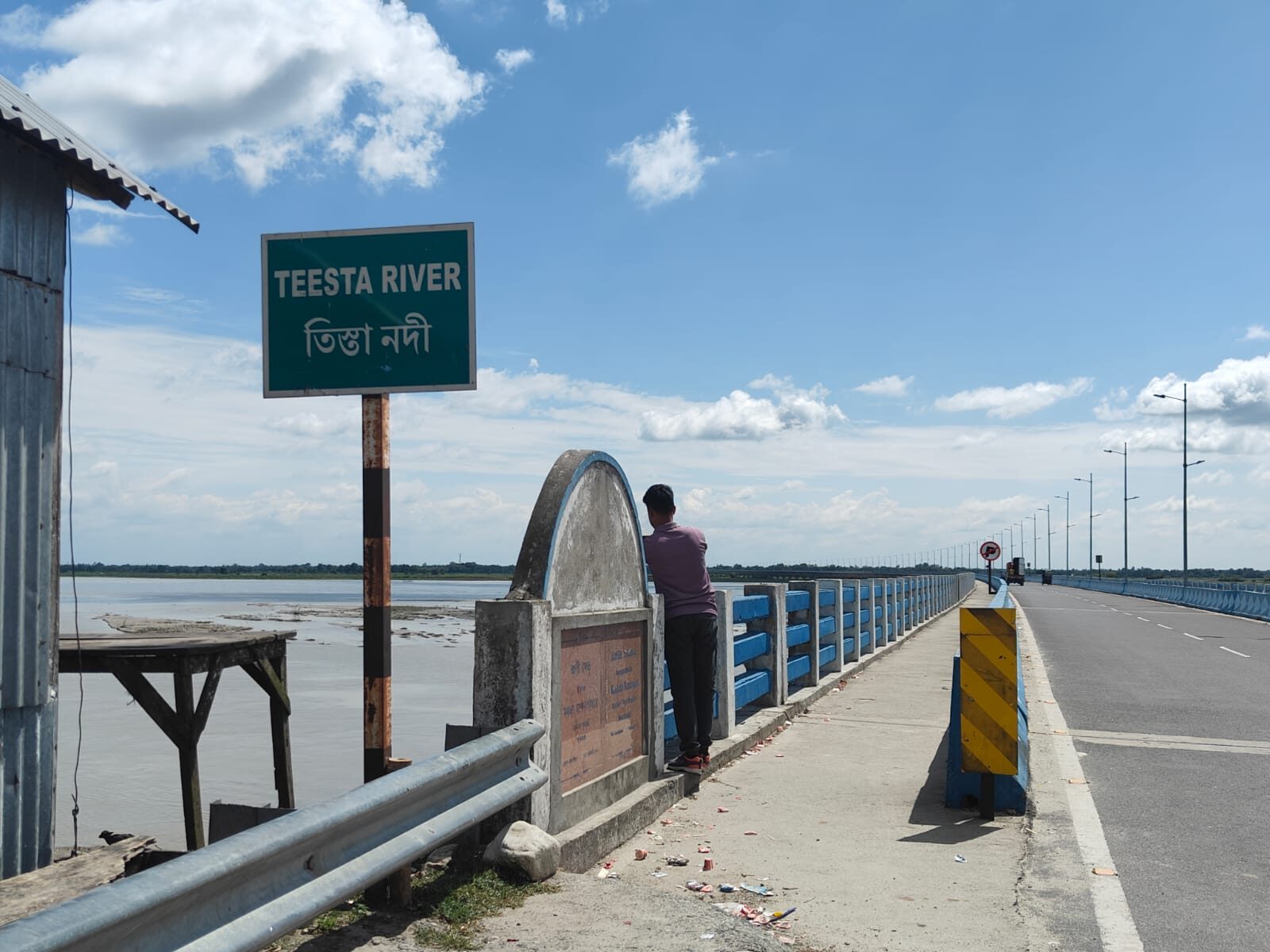
The Teesta River near Paschim Bhotbari, Cooch Behar district, West Bengal. Pic Credit: Bidhayak Das
Bangladesh has been raising concerns over reduced Teesta flows during the lean season, citing agricultural and daily-use shortages, while also highlighting monsoon flooding and the need for better river management. India, especially West Bengal, has countered by pointing to its own dry-season constraints and farmer concerns. These differences, compounded by political sensitivities at the sub-national level, have prevented a final agreement despite decades of dialogue. Yet, framing Bangladesh’s current outreach to China solely through the prism of water-sharing risks oversimplifying a more deliberate strategic repositioning.
This recalibration became more visible after Yunus assumed office. During his visit to Beijing in March, following his meeting with Chinese President Xi Jinping, the joint statement welcomed Chinese participation in the Teesta River Comprehensive Management and Restoration Project (TRCMRP). More tellingly, Yunus publicly referenced India’s Northeast as a landlocked region and positioned Bangladesh as a potential economic gateway—remarks that were widely interpreted as signalling Dhaka’s openness to facilitating a larger Chinese economic footprint in the eastern subcontinent.
Such signalling underscores a broader question Bangladesh now faces: how to balance short-term economic relief against long-term strategic interests. India is not merely Bangladesh’s closest neighbour but a democratic partner that played a decisive role in its independence and has since remained deeply embedded in its security, trade, and cultural ecosystem. China, by contrast, is an authoritarian power whose overseas engagements are driven primarily by economic and strategic calculations that often prioritise Beijing’s interests over local outcomes.
The Teesta River near Mekhliganj in Cooch Behar district, before crossing into Bangladesh’s Nilphamari region. Video credit: Bidhayak Das
The proposed TRCMRP, estimated at around $1 billion, has attracted Chinese interest for several years. While Beijing submitted formal proposals and loan offers, similar large-scale BRI projects across South Asia—from Nepal and Pakistan to Sri Lanka—have demonstrated that promised infrastructure-led transformations often encounter delays, debt burdens, and contested public benefits. These experiences raise legitimate questions about how much of the Teesta vision will translate into durable gains for ordinary Bangladeshis.
For Bangladesh, the Teesta project now represents more than a river-management initiative; it has become a test case of strategic judgement. Moving closer to China may offer immediate financial avenues amid economic distress marked by declining Western aid, high inflation, unemployment, and stress in the garment sector. Yet distancing India—its most proximate partner with enduring stakes in Bangladesh’s stability—could prove counterproductive over the longer term.
For India, the Teesta remains a cornerstone of regional stability, affecting millions of livelihoods in West Bengal. For Bangladesh, however, the larger challenge lies in recalibrating its foreign policy to ensure that economic necessity does not translate into strategic vulnerability. Whether Chinese-backed proposals under the TRCMRP will materialise as envisioned—and whether they will deliver equitable and sustainable benefits—remains uncertain. What is clearer is that Bangladesh’s long-term interests may be best served by restoring balance in its regional partnerships rather than tilting decisively towards a single, interest-driven external power.