As Bangladesh’s elections approach, the political battleground is becoming curiouser and curiouser, with Jamaat-e-Islami set to make its mark—something that is also a growing cause for worry. Those who want a liberal Bangladesh, or who dreamt of one after its foundation, are increasingly wary that the hardline Jamaat has gained significant ground over the past few weeks. Many fear this could alter the face of Bangladesh in ways that may be difficult to reverse.
Bangladesh’s 13th national election will be held on February 12. Nearly 2,000 candidates—including representatives from more than 50 political parties and independent contenders—are vying for 300 parliamentary seats. The election will also be held alongside a referendum on the July reform charter.
The rise of Jamaat-e-Islami—both overt and covert, with the July uprising serving as one of its key springboards—is also a matter of concern for democratic neighbour India. While few are saying this openly, the possibility of Jamaat either emerging as a dominant force or forming the government post-election could significantly reshape the regional political landscape. The implications could extend beyond Bangladesh, potentially affecting countries such as Myanmar as well.
What has further deepened anxieties around Jamaat’s resurgence is the growing perception that the party is no longer diplomatically isolated. In particular, the United States—and possibly some of its Western allies—appear to have increased their engagement with Jamaat-e-Islami in recent months, signalling a shift that has unsettled many observers in Bangladesh and the wider region.
The Borderlens had earlier reported how the United States is now openly acting against the very democratic and secular values it claims to uphold by signalling support for Jamaat-e-Islami, Bangladesh’s largest Islamist political party, ahead of the national election. The report, based on an audio recording, suggests that Washington may be recalibrating its Bangladesh policy by engaging Jamaat as a legitimate political stakeholder at a critical political juncture.
This perceived outreach has triggered sharp criticism among liberal constituencies, minority groups, and sections of the political class who argue that Jamaat cannot be treated as just another electoral player. For them, Western engagement with Jamaat undermines long-standing commitments to democracy, pluralism, and minority rights—principles that Jamaat’s ideological positions and historical record fundamentally challenge.
Beyond the United States, diplomats and political representatives from other countries are also reported to have met Jamaat-e-Islami’s Ameer, Dr Shafiqur Rahman, in recent months. While details of these interactions remain largely opaque, their very occurrence has lent Jamaat a degree of international legitimacy it previously lacked. For a party historically burdened by its opposition to Bangladesh’s Liberation War and its hardline Islamist agenda, this shift is politically significant.
For many Bangladeshis—particularly minorities and those invested in the country’s secular foundations—this international signalling is deeply unsettling. It reinforces fears that Jamaat’s rise is not only being normalised domestically but is also being quietly accommodated by powerful external actors driven more by strategic calculations than democratic principles.
A recent survey conducted by several Bangladesh-based agencies—NarratiV/Projection BD, the International Institute of Law and Diplomacy (IILD), and Jagoron Foundation—projects that Jamaat-e-Islami could secure as much as 33.6 percent of the vote. This places it marginally behind the Bangladesh Nationalist Party (BNP), which stands at 34.7 percent, and ahead of the newly formed National Citizens Party (NCP), led by student leaders of the July movement, at 7.1 percent. The survey also shows a significant 17 percent of voters as “undecided,” while parties such as Islami Andolan Bangladesh account for 3–4.5 percent.
There was speculation following the return of Tarique Rahman that the political landscape would shift dramatically. While there were strong currents initially, Jamaat appears to have clawed its way back into serious contention and could even surge ahead. This raises a crucial question: does Jamaat have a support base comparable to that of the BNP, traditionally one of Bangladesh’s leading political parties after the Awami League? The Awami League, of course, has been banned by the Muhammad Yunus–led interim government under circumstances that many consider questionable.
In the present scenario, the BNP is widely viewed as the next-best alternative to Jamaat, despite its own controversial track record—particularly that of Tarique Rahman. Between 2001 and 2006, the BNP shared power in alliance with Jamaat, a period marked by widespread human rights abuses and communal violence against minorities, especially Hindus. The BNP is also infamous for harbouring anti-India elements, including proscribed insurgent outfits such as the ULFA, on Bangladeshi soil.
Minority community leaders in Bangladesh have repeatedly raised concerns about attacks on minorities, which peaked between 2001 and 2006.
In a previous statement, Advocate Rana Dasgupta, general secretary of the Bangladesh Hindu Buddhist Christian Oikya Parishad, responding to a letter from six US congressmen endorsing what he termed an “error-ridden projection” of the condition of minorities in Bangladesh, categorically referred to “the widespread repression of minorities between 2001 and 2006” under the BNP-Jamaat government. He also cited a spate of attacks during the war crimes trials and claimed that the decline in the Hindu population in Bangladesh has occurred over five decades.
Minority leaders have further argued that repression and attacks largely began after the assassination of the Father of the Nation, Bangabandhu Sheikh Mujibur Rahman, in 1975. Successive regimes led by General Zia and General Ershad, they contend, went into overdrive by introducing Pakistan-style communal rule and embracing communal forces.
Yet many feel that compared to the BNP, Jamaat “on its own is worse.” This view is shared by a large section of Bangladesh’s population, particularly those who cherish the country’s founding ideals and the struggle for liberation from Pakistan. Jamaat remains deeply tainted by its history of supporting Pakistan and actively participating in mass killings during the Muktijuddho (1971 Bangladesh liberation war), including atrocities against minorities. This legacy continues to haunt Jamaat-e-Islami, alongside its hardline stance advocating the imposition of Islamic rule and Sharia law.
In recent months, Jamaat has attempted an image makeover, reaching out to religious minorities. Its Amir, Shafiqur Rahman, has assured that if the party comes to power, it “will protect all minorities” and will not allow “any forces to create any divisions and good will between the Muslims and the minorities.” For the first time, Jamaat has also campaigned intensively for a lone Hindu candidate, Krishna nandi it has fielded from the Khulna-1 constituency.
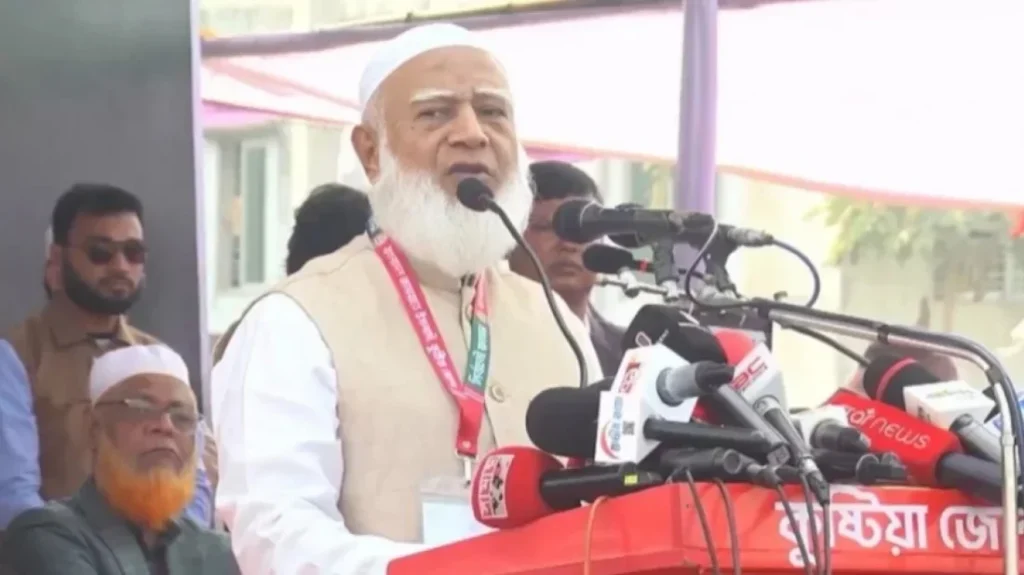
Addressing an election rally at Noakhali Zilla School ground on Friday, Jamaat-e-Islami Ameer Dr Shafiqur Rahman said his party loves every inch of Bangladesh and all its people, regardless of religion. “People of every religion in this country are ours,” he said, outlining Jamaat’s political vision and development pledges. Rejecting allegations against the party, he claimed Jamaat had never engaged in extortion and had instead been subjected to harassment through attacks and legal cases. “We did not harass anyone by filing false cases, nor did we engage in case-trading,” he said.
However, even as Jamaat pushes a narrative of secular inclusivity, contradictions have surfaced. A statement by Krishna Nandi, Jamaat’s candidate from Khulna-1, claiming that he had been sent “as a messenger of Allah,” has gone viral on social media. This has prompted questions about whether Jamaat’s professed concern for all religious groups could slide into coercive or exclusionary belief systems.
Jamaat has further exposed itself through conflicting positions taken by its leadership. In an interview with Al Jazeera, Shafiqur Rahman justified the party’s decision not to field a single woman candidate by calling it part of Bangladesh’s “cultural entity,” adding that Jamaat was “getting prepared for that.” In the same interview, he dismissed the possibility of a woman becoming Jamaat’s leader, stating that “it is not possible as Allah has made everyone in its own entity; what Allah made we cannot change.”
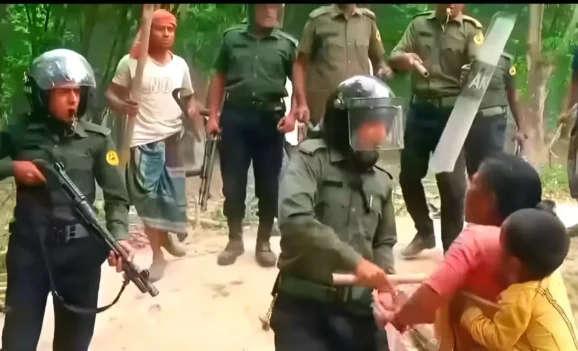
The Jamaat leadership has also issued explicit warnings amid rising political violence. Speaking at a rally on Friday—following a deadly clash between Jamaat and BNP activists in Sherpur’s Jhenaigati upazila that left a Jamaat worker dead—Shafiqur Rahman questioned whether a “level playing field” existed in the election. The Sherpur clash is one of several confrontations between the two parties over the past week and, according to local journalists, such violence is likely to escalate.
The BNP, which commands a large support base and has historically relied on violence as a tool in electoral politics, is unlikely to back down. Addressing journalists at a public meeting in Mirpur-10, Shafiqur Rahman said the incident reflected growing intolerance and mistrust surrounding the election process. He warned against attempts to manipulate results, asserting that Jamaat would not allow people’s voting rights to be taken away.
More notably, he issued stark warnings: “I will give my life if necessary, but I will not let the rights of the people be taken away.” He added that if results were “forcefully taken,” as in previous elections, young people would resist. Invoking the July uprising, he said, “The youth of the July revolution did not sleep,” implicitly reaffirming Jamaat’s close links to the movement that led to the ouster of former Prime Minister Sheikh Hasina and was followed by unprecedented violence.
For those familiar with Jamaat’s organisational style, this resurgence is hardly surprising. A senior journalist and a development worker described Jamaat as a “gupto” (secretive) party noting that it is often difficult to identify who is a Jamaat worker and who belongs to its student wing, Islami Chhatra Shibir. A well-known intellectual remarked, “After knowing someone for seven years, I now find that the person is working for Jamaat.”
While many educated and politically conscious Bangladeshis may still prefer the BNP in the absence of the Awami League, Jamaat’s secretive strategies—often involving coercion and force—could prove decisive. Even some Jamaat supporters concede that “the Jamaat has different strategies, and most of it is done very clandestinely.”
One such strategy involves burqa-clad women workers moving from village to village to survey voters. According to senior Mirpur based journalist “this allows Jamaat to identify who is likely to vote and who may abstain.” In rural Bangladesh, many women traditionally do not vote, with male family members often voting on their behalf. This election, however, heightened vigilance by political parties may prevent such practices.
This creates an opportunity for Jamaat’s women workers. As the same journalist noted, journalist by making photocopies of voter ID cards—which are still not fully digitised in Bangladesh—they can potentially enter polling stations and vote in place of others. Existing laws do not allow lifting the veil for identification, making such practices difficult to detect.
Taken together, these developments underscore why Jamaat’s rise is not merely an electoral phenomenon, but a deeper concern about the direction Bangladesh’s politics—and its democratic and secular foundations—may be heading in the near future.