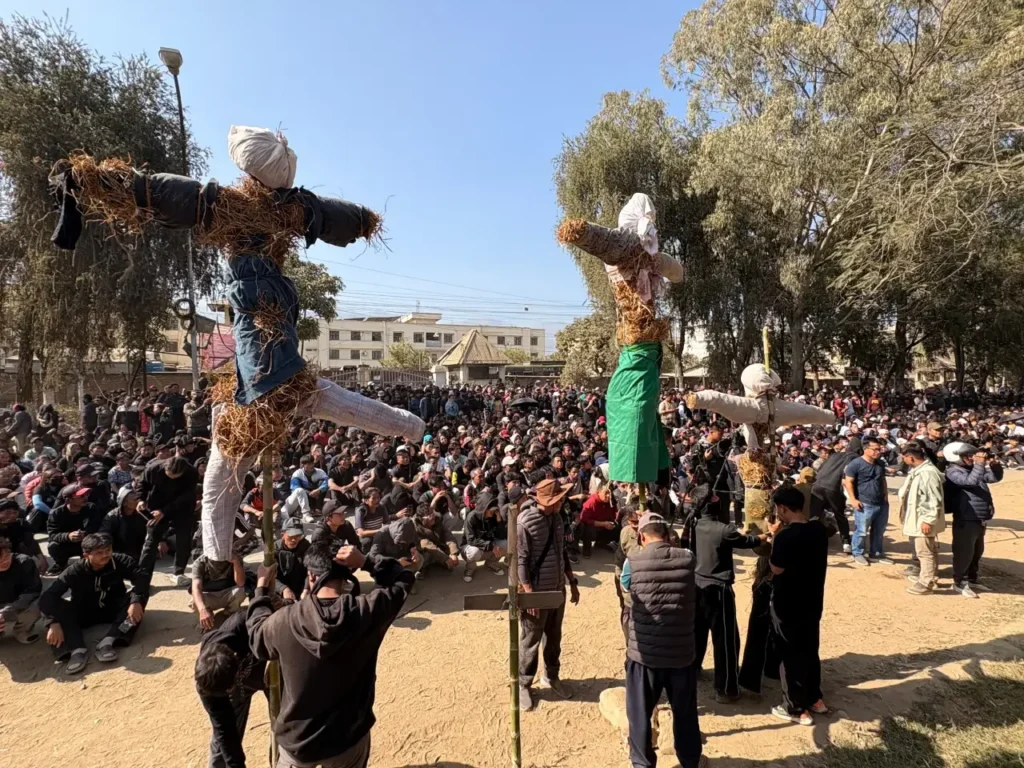
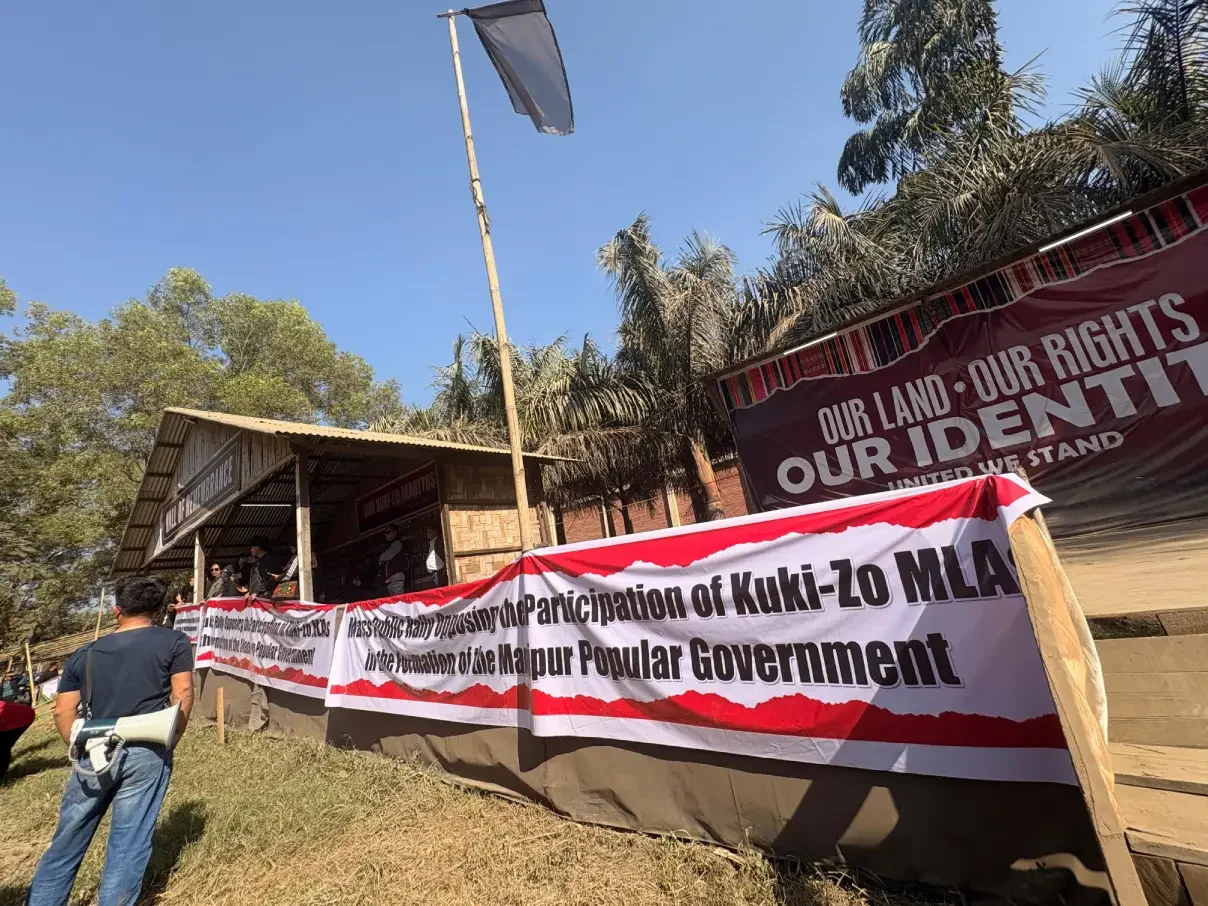
When it appeared that the dust had begun to settle and Manipur was slowly limping back towards a semblance of normalcy, the fault lines between the hills and the plains cracked open once again. The protests in Churachandpur and the subsequent violence on the evening of February 5 were triggered by the decision of a Kuki MLA to join the newly formed government as a deputy chief minister.
But the unrest was never only about that single act. It was the latest flashpoint in a much deeper and longer-running crisis in a state that continues to carry the embers of violence that has engulfed it for more than two years.
The unrest began in Churachandpur’s Tuibong Main Market area, where protesters clashed with security forces. While the violence erupted suddenly, tensions had been simmering beneath the surface for months.
The Bharatiya Janata Party’s (BJP) decision to appoint Yumnam Khemchand Singh, a senior party leader and Meitei MLA, as chief minister was widely seen as a political gamble—one that has so far failed to deliver the stability it was meant to ensure. The reasons for this failure go well beyond the Churachandpur incident and are rooted in a series of developments that unfolded in the run-up to the events in Churachandpur and Kangpokpi.
This Morning at Churachandpur.
The formation of the new government followed nearly a year of central rule. President’s Rule had been imposed in Manipur on February 13 last year amid escalating violence and a breakdown of political authority. While the legislative assembly—whose tenure runs until 2027—was not dissolved, it was placed under suspended animation, reflecting New Delhi’s assessment that the elected government was no longer capable of functioning. Against this backdrop, the new government took office after authorities in the national capital assessed that the situation had been largely contained through crackdowns and the confiscation of arms from armed groups that had fuelled much of the violence over the past two years.
Khemchand Singh was sworn in as chief minister on Wednesday along with four other legislators, taking the strength of the council of ministers to five. In what appeared to be an attempt at political outreach and ethnic balancing, two deputy chief ministers were appointed alongside him: Nemcha Kipgen, a BJP MLA from the Kuki-Zo–dominated Kangpokpi constituency, and Losii Dikho of the Naga People’s Front, who represents Mao. Their elevation reflects an effort to accommodate competing community interests in an intensely polarised state.
The cabinet was otherwise kept deliberately small. Senior BJP leader Govindas Konthoujam, a seven-time MLA and a key figure in the previous N. Biren Singh government, was sworn in and is expected to handle the crucial Home portfolio. Khuraijam Loken Singh, a first-time MLA from the Imphal valley and a leader of the National People’s Party—another important NDA ally—was the only other minister inducted.
Khemchand Singh, who had earlier served as a cabinet minister under Biren Singh, had emerged as an internal critic in the run-up to the collapse of the previous government, contributing to the pressure that eventually led to Biren Singh’s exit.
However, the inclusion of a Kuki deputy chief minister has failed to reassure large sections of the Kuki-Zo community. In fact, resistance to the new arrangement surfaced almost immediately. No sooner was Khemchand declared the BJP’s legislative party leader and named chief minister than protests erupted at different places both inside and outside Manipur.
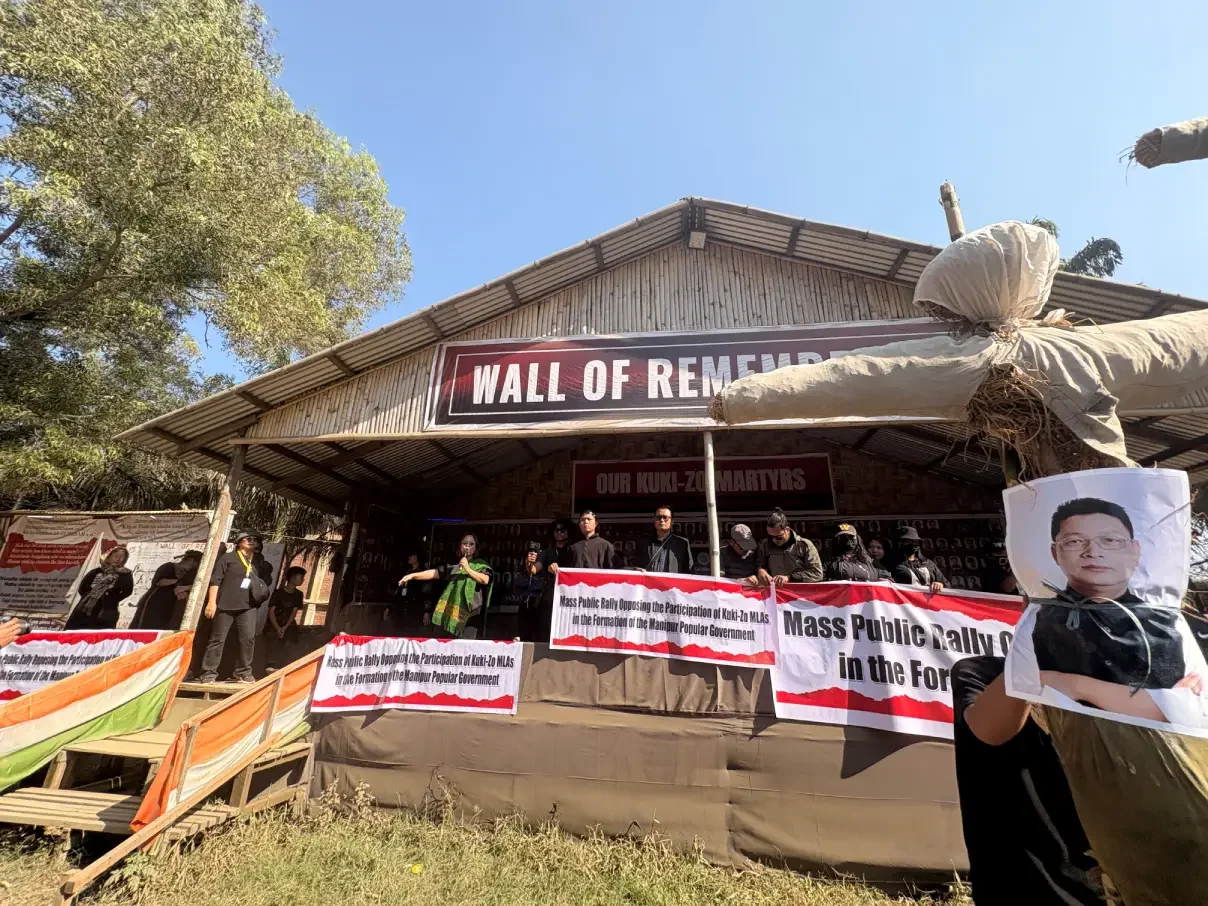
Churachandpur-based Kuki-Zo Council declared in a statement on Wednesday that “it is neither logical nor acceptable for the Kuki-Zo people to join a government formed with those from whom we have been violently separated”. In New Delhi the Kuki Students’ Organisation (KSO), Delhi & NCR president Ms Tingbem stormed the Manipur Bhawan in New Delhi premises, demanded Khemchand’s resignation, and labelled both him and Nemcha Kipgen as “traitors.”
Kuki-Zo organisations soon announced a social boycott of the deputy chief minister who joined the Khemchand-led BJP government. Many members of the community took to social media to express their anger, stating that “this deal is not acceptable” and that “the hills cannot be sold out.” Others made it clear that Kukis, as a community, would not support any popular government in Manipur “unless our just demands are met.”
The depth of opposition became even more apparent when Nemcha Kipgen could not travel to Imphal to take her oath owing to security concerns. Her oath was administered online. Within a day of the government taking office, violence erupted once again.
Interestingly, two other Kuki-Zo MLAs—Ngursanglur Sanate of the Hmar tribe and L. M. Khaute of the Vaiphei Zomi tribe—were physically present in Imphal. Both represent constituencies in Tipaimukh (largely covering Pherzawl district) and Churachandpur, respectively. Their presence in the valley further fuelled frustration among protesters, who saw the selective participation of Kuki representatives as deeply problematic.
Amid this backlash, the Zomi Students’ Federation–General Headquarters (ZSF-GHQ) attempted to offer a different interpretation of events. In a press communiqué issued recently, the organisation argued that the constitution of the Council of Ministers should “serve as a reminder of the need for collective decision making.” It maintained that so long as elected representatives continue as MLAs, all MLAs are, in effect, part of the government, and that the inclusion of some in the cabinet should not automatically be interpreted negatively.
The ZSF further suggested that the recent violence reflected internal political rivalries and stemmed from “the displeasure of some at not being inducted into the Cabinet.” It added that the Zomi community would extend “unconditional support” to its “tribe leaders” if they articulated a clear roadmap towards a political solution.
The Centre’s decision to back Khemchand Singh was shaped by the belief that he could serve as a bridge between the valley and the hills. In December 2025, he became the only Meitei MLA to undertake high-profile visits to Kuki-dominated areas after the outbreak of the conflict, travelling to Litan village in Ukhrul district and to a relief camp at the Litan Sareikhong Baptist Church.
Khemchand described these visits as confidence-building measures intended to bridge the widening mistrust between Meitei and Kuki communities. However, several Kuki organisations sharply criticised the outreach, describing it as unauthorised and politically motivated rather than reconciliatory.
In identical clarifications issued by the Litan Sareikhong Relief Centre and the Kuki Inpi Ukhrul (KIU), it was alleged that the MLA arrived unannounced at the relief camp around 9:30 a.m. on December 8, at a time when most adult inmates had left for work. According to the statements, he was accompanied by BJP workers and briefly interacted with women, children, and elderly residents before leaving, using the opportunity to take photographs.
Saikul protest
The KIU termed the visit uninvited and insensitive, arguing that symbolic gestures could not substitute for accountability or justice for internally displaced persons who have remained in camps since the violence of May 3, 2025. It also criticised Khemchand’s silence during the peak of the conflict, stating that “true goodwill cannot be proclaimed through sudden appearances.”
Kuki organisations further accused certain valley-based media outlets of merging unrelated video clips—one from the camp visit and another from a separate interview—to falsely suggest meaningful interaction with camp residents. The portrayal was described as unethical and misleading, with the KSO-Ukhrul, village authorities, and the Litan Sareikhong youth club distancing themselves from the visit and denying any prior knowledge or coordination.
Political observers tracking developments in Manipur believe that Khemchand was acting largely on directions “from the top,” as part of a broader plan to restore an elected government and put Manipur back on track. This perception is reflected in how he responded to the accusations, remaining committed to a rhetoric of reconciliation and peace.
Unfazed by the criticism, Khemchand continued to appeal to both communities to build mutual trust and work collectively to restore peace. At a reception held at the Chingamakha Ibudhou Luwangpokpa ground to honour him on being awarded the 5th dan in traditional taekwondo in South Korea, he made several candid observations about the consequences of the conflict.
He noted that Meiteis currently do not feel safe travelling through Kangpokpi, while Kukis feel insecure coming to Imphal. He also claimed that he was targeted for speaking about peace at the height of the violence, recalling how he was booed at a Nupi Lan function when he stated that not all Kukis were bad.
These observations and outreach efforts were part of a broader script to restore governance in Manipur. Khemchand stood out as a leader with a steady temperament and, among some stakeholders, a reputation as a relatively “liberal” Meitei. This, combined with his willingness to engage across ethnic lines, made him the BJP’s preferred choice for chief minister in February 2026 as it sought to manage the crisis.
Yet, as events have now made clear, these measures have failed to produce an inclusive or durable solution to Manipur’s deepening divide. Forming a government was undoubtedly important, but given the fragility of the overall environment, authorities must reassess their approach and address the cracks that have once again widened.
At the heart of the crisis lies the unresolved demand by Meiteis in the valley for Scheduled Tribe status—a demand that hill communities, particularly the Kuki-Zos, oppose vehemently and have instead demanded a separate Union Territory for Kuki-Zo-majority areas.
Any attempt to stabilise Manipur without grappling seriously with this issue, and without situating it within the state’s complex historical and political context, is unlikely to succeed. Putting together a ragtag political arrangement risks aggravating tensions further and providing space for vested interests, both old and new, to exploit the situation.
Manipur’s political landscape remains extraordinarily complex. Long-standing insurgencies, the proliferation of drugs and narcotics, and the cross-border movement of weapons and militants add multiple layers of challenge. The continuing instability in neighbouring Myanmar—despite the military junta’s recent elections—only heightens security concerns for New Delhi. In this context, restoring peace in Manipur will require more than symbolic outreach or tactical political balancing; it will demand a genuinely inclusive political settlement that addresses the roots of the conflict rather than merely managing its symptoms.