The coal mining racket in Meghalaya is under intense scrutiny as pressure mounts—rightfully—on the state government to explain how a banned and hazardous industry continued to operate in plain sight. Since the devastating blast at Thangsko in East Jaintia Hills on February 5, which has claimed 28 lives so far, demands for accountability have intensified from the judiciary, opposition parties, civil society organisations, and the public.
At the heart of the outrage lies a question that now dominates the political and legal discourse in the state: how did illegal coal mining persist despite repeated court orders, environmental warnings, and official bans?
Responding to the growing pressure, Chief Minister Conrad Sangma announced the formation of a Judicial Inquiry Commission. “The state government has decided to constitute a commission under the Commission of Inquiry Act to probe this tragic incident,” the chief minister said, indicating what he described as a multi-pronged approach to uncover the systemic failures that led to the explosion.
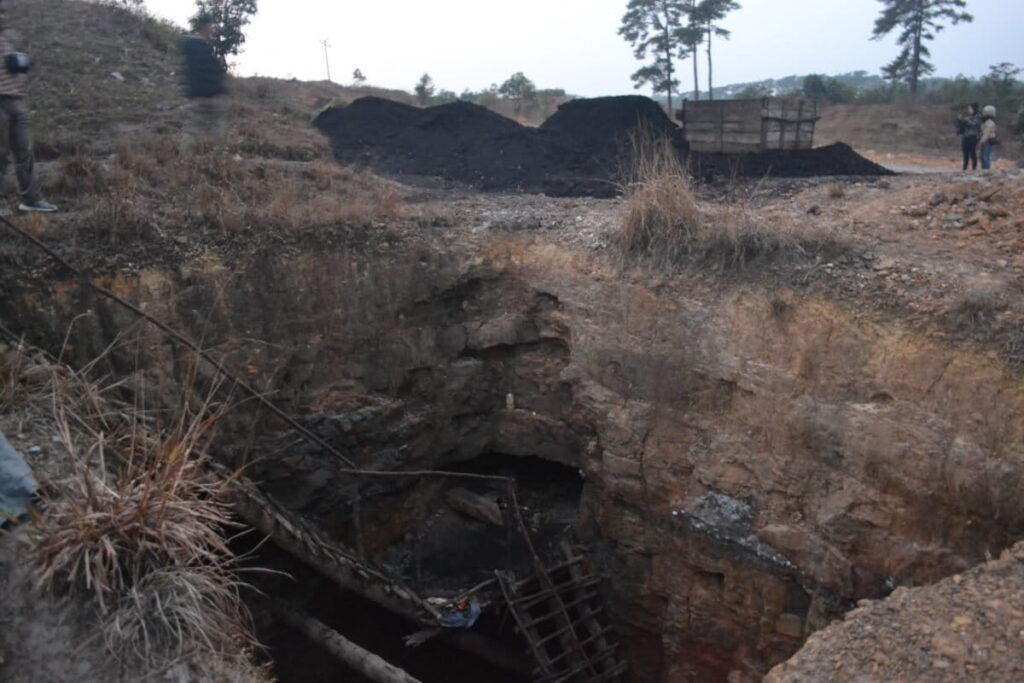
The Mynsngat–Thangsko tragedy has once again drawn attention to illegal rat-hole mining, a practice that has been repeatedly flagged by environmentalists, mining experts, and courts as extremely dangerous. The narrow, unregulated tunnels—often dug without safety measures—have been blamed for multiple fatalities in the past, even as the practice continues in defiance of bans imposed by the National Green Tribunal (NGT) and upheld by the judiciary.
With 28 labourers caught in the blast, rescue efforts quickly turned into a race against time amid unstable terrain and hazardous underground conditions. Teams from the National Disaster Response Force (NDRF), State Disaster Response Force (SDRF), Special Rescue Team (SRT), police, and the district administration were deployed in a large-scale operation. Despite days of effort, the rescue mission was eventually called off on the evening of February 9.
As rescue operations wound down, judicial intervention escalated. The Meghalaya High Court expressed “strong exception” to what it described as the persistent defiance of mining bans and ordered the immediate arrest of the mine owners responsible for the fatal explosion.
Taking suo motu cognisance of the disaster, the High Court summoned East Jaintia Hills Deputy Commissioner Manish Kumar and Superintendent of Police Vikas Kumar. The court sought explanations on how such a large-scale illegal mining operation had continued under their watch despite clear prohibitions.
After the court proceedings, SP Vikas Kumar told the media that the investigation had been made a top priority. He confirmed that multiple arrests had already been carried out. “We are doing our bit… I am sure we will bring it to the logical conclusion,” he said, while declining to share further details, citing that the matter is sub judice.
As the court-monitored investigation intensified, political and civil society reactions grew sharper. The tragedy has increasingly been framed as evidence of a “systemic governance failure” and what critics describe as the “criminal capture” of state resources.
The opposition Voice of the People’s Party (VPP) launched a scathing attack on the ruling Meghalaya Democratic Alliance (MDA), holding it directly responsible for the deadly dynamite explosion that initially claimed 27 lives before the toll rose to 28. The party argued that the incident was not an isolated accident but the consequence of a chronic lack of political will. Calling it “a systemic governance deficit,” the VPP said it would not remain silent on the issue.
According to the VPP, the continued operation of illegal mining networks—despite repeated warnings and past tragedies—demonstrates a governance failure that has eroded public trust and reduced human lives to expendable costs.
Similar concerns were raised by the Khun Hynniewtrep National Awakening Movement (KHNAM), which demanded accountability from the state government. In a statement, KHNAM working president Thomas Passah rejected claims that authorities were unaware of illegal mining. The party said it was inconceivable that the government could plead ignorance when coal-laden trucks routinely pass through police outposts and official check gates.
KHNAM also expressed deep skepticism about the newly constituted inquiry commission, describing it as a diversionary tactic. The party warned that the exercise could be aimed at pacifying public anger until the tragedy fades from public memory, only for the cycle to repeat itself.
Civil society groups have echoed these criticisms. Thma U Rangli-Juki (TUR) issued a strong condemnation of what it called the state’s long-standing role in enabling illegal mining in defiance of NGT orders and judicial directives.
The organisation called for an end to what it termed the “criminal capture” of state resources and highlighted three critical concerns: institutional failure, labour exploitation, and environmental and social collapse.
On institutional failure, TUR questioned why district administrations, the police, and departments such as Mining, Geology, and Taxation have not been held accountable for the blatant violation of court orders. On labour exploitation, the group criticised the state for failing to implement the Migrant Workers Act and other labour protections, leaving workers exposed to unsafe and degrading conditions.
On environmental and social collapse, TUR pointed to the devastation of water bodies and agricultural land. It noted that while a “corrupt mining elite” profits from illegal extraction, low-income families are left without access to clean water and sustainable livelihoods.
Collectively, these groups have demanded accountability that goes beyond what they describe as “rhetoric and token compensation.” They have called for strict enforcement of the rule of law, immediate implementation of judicial directives, and prosecution of those who enable illegal mining. They have also urged citizens to speak out against a system they say has “blood on its hands.”
Amid the backlash, the East Jaintia Hills Deputy Commissioner issued a press communiqué stating that enforcement drives against illegal mining have been intensified. According to the administration, teams comprising executive magistrates, police, and officials from the Directorate of Mineral Resources (DMR) were deployed across multiple locations.
During these operations, approximately 6 metric tonnes (MT) of coal were seized between Lumshyrmit and Cham Cham, around 10 MT from roadsides near Cham Cham and Mukhaialong, 2 MT from the stretch between Mutong and Mukhaialong village, and approximately 20 MT from Pynthorsale village.
The district administration also reported that makeshift camps linked to illegal mining activities were identified and destroyed. FIRs have been registered in connection with reported cases of illegal mining, and officials said further legal action is underway.
The human toll continued to rise even after the rescue operation ended. The search and rescue mission was officially called off at 5:00 pm on February 9 after no additional bodies were recovered. One injured labourer, Raju Tamang, 34, who had been admitted to NEIGRIHMS Hospital in Shillong, later succumbed to his injuries, taking the total death toll to 28.
Officials said compensation amounting to Rs 24,00,000 (Rupees twenty-four lakhs) has so far been paid to the families of eight victims of the mine explosion at Mynsngat, Thangsko. Authorities added that payments would continue as documentary evidence is submitted by the next of kin of the remaining deceased.
In the aftermath of the tragedy, the District Magistrate of East Jaintia Hills issued a prohibitory order under Section 163 of the Bharatiya Nagarik Suraksha Sanhita (BNSS) to ensure public safety and facilitate ongoing operations.
Even as investigations, arrests, and enforcement drives continue, the central question remains unresolved: how did illegal rat-hole coal mining flourish for years under bans, judicial oversight, and environmental warnings—and will this tragedy finally force Meghalaya to dismantle a system that many say has operated with deadly impunity?