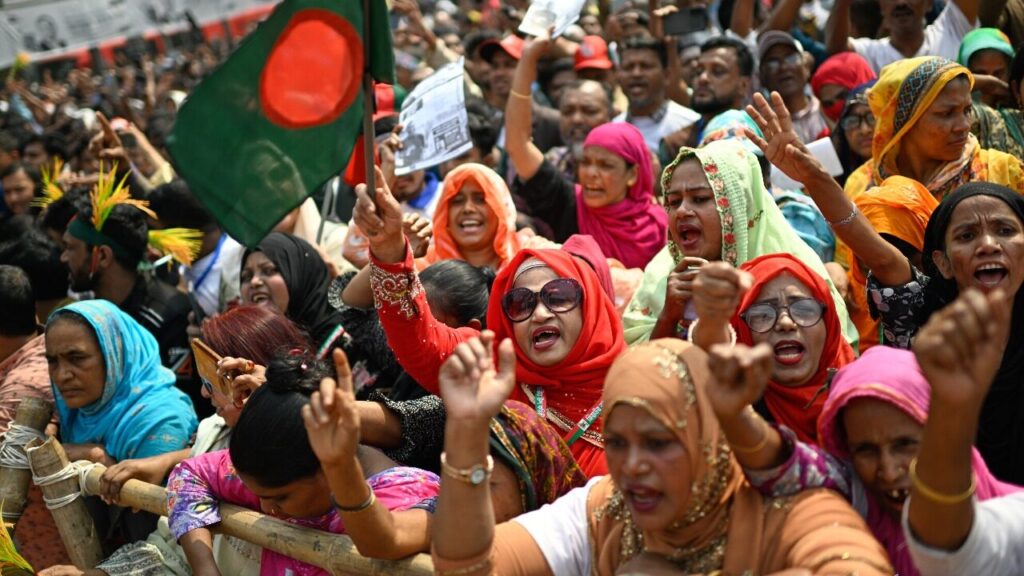
Bangladesh is preparing for one of the most consequential votes in its history as it heads into a rare dual polling exercise later this week—electing a new parliament while simultaneously holding a nationwide referendum on constitutional reforms—all in the absence of its longtime ruling party and under one of the heaviest security deployments the country has ever seen.
On Thursday, February 12, 127.7 million voters will cast ballots in the 13th parliamentary election and a referendum on the “July Charter,” a reform demand that emerged after the mass uprising which ended Sheikh Hasina’s rule on August 5, 2024. The polls are being conducted under an interim government led by Professor Muhammad Yunus, which assumed office following the political transition.
The vote is widely seen as a critical test of Bangladesh’s ability to restore electoral legitimacy after months of political upheaval, while also laying the foundation for a reconfigured political order.
A rare dual ballot on Election Day
The election presents a logistical challenge unprecedented in Bangladesh’s electoral history. Voters will receive two ballots—one to elect a member of parliament and another to vote “yes” or “no” on four constitutional reform questions under the July Charter.
Polling hours have been extended by one hour, from 7:30 a.m. to 4:30 p.m., to manage the dual process, the Election Commission (EC) said. Voting will take place in 299 constituencies after polls in Sherpur-3 were postponed following the death of a candidate.
“This is a massive operational challenge,” said election analyst Abdul Alim. “If turnout is high, election officials will be handling close to 200 million ballot papers. That puts enormous pressure on polling staff and counting procedures.”
Election officials, however, insist that preparations are complete. “We are fully ready to hold the national election on February 12,” Election Commissioner Md. Anwarul Islam Sarkar told reporters.
A political landscape without the Awami League
The political contest has been fundamentally reshaped by the absence of the Awami League (AL), which was barred from participating by the interim administration. The party had dominated Bangladeshi politics for more than a decade.
In its absence, the main competition is between the Bangladesh Nationalist Party (BNP) and Bangladesh Jamaat-e-Islami—former allies now locked in direct rivalry. BNP is contesting 291 seats under its traditional “Sheaf of Paddy” symbol, while Jamaat has fielded 229 candidates using the “Scale.”
Other parties in the race include the Jatiya Party, Islami Andolan Bangladesh, and the newly formed National Citizens’ Party (NCP), alongside hundreds of independents, making contests highly competitive in many constituencies.
The official campaign period ended early Tuesday morning. While candidates engaged in widespread door-to-door canvassing, the Election Commission recorded more than 500 electoral violations since the schedule was announced, including clashes between supporters, attacks on candidates, and at least 17 politically linked deaths.
Despite these incidents, some observers point to signs of competitive campaigning. “Candidates actually went to the voters,” said former election official Jasmine Tuli. “That itself is a positive development compared to previous elections.”
Massive security deployment
Authorities have rolled out an unprecedented security operation, deploying more than 900,000 personnel nationwide from the army, navy, air force, police, Border Guard Bangladesh (BGB), Rapid Action Battalion (RAB), Ansar and Village Defence Party, and the Coast Guard.
The army began election duties “in aid to civil power” on February 8. According to the Interior Ministry, polling centres have been categorised into three risk levels, with more than 8,700 centres labelled “most important” and receiving heightened protection.
Security measures include body-worn cameras for polling officials, CCTV surveillance at centres, over 400 monitoring drones, dog squads, and a real-time digital reporting system known as the Election Protection App.
“The entire country is under a security cover,” Election Commissioner Abdul Rahmanel Masud said. “There is no opportunity for wrongdoing.”
The operation also includes more than 27,000 newly recruited security personnel, appointed under the interim government. Analysts say their conduct will be closely scrutinised.
“Any sign of partisan behaviour would seriously damage public trust,” said criminology expert Dr. Towhidul Haque.
Disinformation and unrecovered weapons
Despite official assurances, concerns remain over disinformation and residual security risks. The Election Commission has identified AI-generated fake content and misinformation on social media as one of its biggest challenges.
According to EC data, its monitoring platform has flagged more than 86,000 suspected AI-generated posts since the election schedule was announced, most of them on Facebook. Many contained politically charged or violent content.
“Our biggest challenge is disinformation,” said EC Senior Secretary Akhtar Ahmed.
Another concern is the recovery of firearms looted during the unrest of 2024. While officials say most weapons have been retrieved, some remain unaccounted for. Election authorities insist the situation is under control.
International attention
The election has drawn intense international scrutiny. More than 540 foreign observers and journalists are in Bangladesh, making it one of the largest observer missions in the country’s history.
The European Union has deployed its biggest-ever election observation mission to Bangladesh, with 223 observers. Delegations from the Commonwealth, the Asian Network for Free Elections, the International Republican Institute, and election commissions from several countries—including Turkey, Malaysia, Indonesia, and Nigeria—are also present.
More than 150 foreign journalists from outlets including Al Jazeera, BBC, Reuters, and the Associated Press are covering the vote.
In meetings with election officials, international observers have emphasised the importance of a level playing field and transparent counting. However, many independent analysts argue that such conditions are absent in the current election due to the banning of the Awami League, Bangladesh’s largest and one of its oldest political parties. The move has drawn comparisons with the recently held elections in Myanmar, where the exclusion of the National League for Democracy (NLD) led to widespread boycotts by Western-backed international observer organisations.
Turnout and the Referendum question
Voter turnout remains a key unknown. Analysts predict participation could fall well below the 87 percent recorded in the landmark 2008 election, partly due to the Awami League’s absence and lingering public uncertainty.
Election Commissioner Anwarul Islam Sarkar said turnout could be “around 55 percent or higher.”
Beyond parliamentary results, the referendum on the July Charter is being closely watched. The reforms aim to reshape governance structures in the aftermath of the 2024 uprising, and their approval would give the interim government a popular mandate to implement long-term institutional changes.
A defining moment
For many voters, the overwhelming security presence is both reassuring and unsettling.
“We want peace and a government that comes from our vote,” said Abdul Wahed, a shopkeeper in northern Rangpur. “If the security lets us vote without fear, that is what matters.”
As Bangladesh enters a pre-election silence, ballot papers have been distributed, officials are in place, and counting centres are preparing for what could be a lengthy process due to the dual ballots.
The outcome of Thursday’s vote will shape not only the next parliament but also the future trajectory of a country attempting to rebuild democratic legitimacy after its most dramatic political rupture in decades.