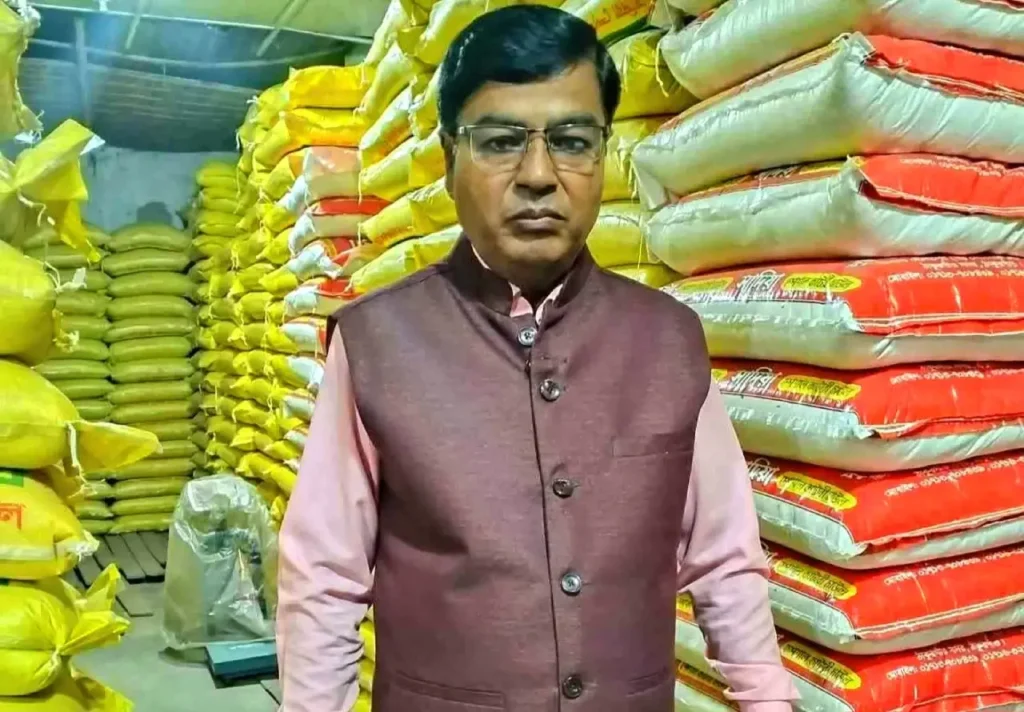
Little did he know that he would become one more name in a growing roll call of victims. On February 9, 62-year-old Sushen Chandra Sarkar, a rice trader, was hacked to death inside his shop at the Bogar Bazar intersection in Mymensingh district. The assailants struck with a sharp weapon, left his body inside, and pulled down the shutters before fleeing.
This report is not fake. It did not originate from an Indian social media handle. It was carried by Bangladeshi media itself—one of the few that chose to document what many others may have overlooked. Yet as gruesome and continuous murders of minorities surface, Bangladesh’s interim administration under Muhammad Yunus has repeatedly framed the issue as a “flood of misinformation,” often pointing the finger at India.
The killing of Sarkar is not an isolated crime. It is one among many incidents reported over the past few months, particularly after rumours circulated—largely from within Bangladesh and diaspora-linked networks in the UK, US, and Canada—that the killers of Osman Hadi, a youth extremist leader, had fled to India. Reports surrounding Hadi’s killing were widely used to generate “anti-India” sentiment. Much of that online mobilisation originated from accounts operated within Bangladesh and overseas networks sympathetic to the interim dispensation.
So when Yunus alleges that India is behind a campaign of misinformation surrounding the elections, the question that arises is simple: where is the evidence? Especially when reports of killings of minorities, particularly Hindus, are emanating from local Bangladeshi newsrooms and community organisations.
While Yunus has acknowledged that misinformation has come “from both foreign media and local sources,” his tendency has been to disproportionately attribute it to India. That claim appears increasingly tenuous when confronted with ground reports published within Bangladesh itself.
The Bangladeshi media report on Sarkar’s murder described it unequivocally as another attack on Hindus occurring without pause. It stated: “The brutal killing of a Hindu businessman in northern Bangladesh on Monday night has intensified domestic and international concern over the safety of religious minorities, coming just days before the country heads into national parliamentary elections amid heightened political uncertainty.”
The same report noted that anxiety had already deepened in Mymensingh district after another Hindu man, Dipu Chandra Das, was lynched by a mob and his body set on fire—reinforcing fears of a deteriorating security climate for minorities.
A senior Hindu community leader in the district, requesting anonymity out of fear of reprisals, described a climate of pervasive dread.
“People are afraid to speak openly, afraid to go to the police, afraid to demand justice,” the leader said. “Every killing sends a message that Hindu lives are not safe under the Yunus regime, which supports fanatics and hardliners.”
These are not imaginative accounts. Nor do they fall within the report of “more than 700,000 posts” generated by “more than 170,000 accounts on X” that allegedly made claims of a “Hindu genocide” between August 2024 and January 2026, as cited by Raqib Naik of the US-based Center for the Study of Organised Hate. Naik has asserted that his organisation tracked “coordinated Indian disinformation online,” claiming that more than 90 percent of such content originated from India, with the rest linked to Hindu nationalist networks in the UK, US, and Canada.
There is no denying that misinformation circulates on social media and that some Indian users have amplified unverified claims. But to assert that 90 percent of all such content originated from India risks becoming another sweeping narrative unsupported by transparent methodology.
Digital forensic experts caution that in an era of AI-driven manipulation, bot networks, coordinated amplification strategies, and advanced anonymity tools, the geographic origin of online content is not always what it appears to be. Through the use of VPNs, proxy servers, masked IP routing, automated posting systems, and synthetic accounts, actors can project digital footprints from virtually any jurisdiction. In such an ecosystem, attributing content to a single country without publicly verifiable technical evidence can be deeply misleading.
Moreover, AI-generated misinformation has originated from multiple geographies. Several Indian fact-checking organisations have themselves debunked fabricated or manipulated content. Mainstream Indian media, by and large, has avoided amplifying unverified social media narratives and instead relied on reports from established sources.
Among those documenting developments on the ground is the New Delhi-based Rights & Risks Analysis Group (RRAG), which has conducted research and compiled data on reported incidents. RRAG has documented what it describes as a surge in targeted attacks against Bangladesh’s Hindu minority, attributing them to Islamist forces operating under the cover of election-related unrest.
RRAG director Suhas Chakma has stated that deliberate temple burnings, vandalism of homes, and physical assaults on minorities continue. According to documented data, Bangladesh recorded over 520 communal attacks in 2025 alone, with more than 60 non-Muslims killed and at least 28 cases of rape and other violence against women reported. Numerous incidents involved attacks on religious sites and desecration of Hindu deities.
Thousands of incidents, according to various reports, have involved attacks by extremist elements against non-Muslims across Bangladesh, triggering protests by Hindus in India. Demonstrations erupted outside Indian missions, followed by counter-demonstrations outside Bangladeshi diplomatic premises.
Diplomatic tensions between Dhaka and New Delhi escalated, with both sides restricting tourist visas and summoning each other’s high commissioners to lodge protests.
India’s Ministry of External Affairs has stated that over 2,900 incidents of attacks on religious minorities were reported in Bangladesh under the Yunus-led interim government, describing the hostility against Hindus, Christians, and Buddhists as a matter of grave concern. At the same time, India has reiterated its support for “free, fair, inclusive and credible elections” in Bangladesh.
Independent sources recorded that nearly 200 people were killed in mob violence over the past year. The Bangladesh Hindu, Buddhist, and Christian Unity Council reported a sharp spike in attacks targeting minorities amid political instability following the ouster of Sheikh Hasina’s government.
On December 18, international media reported with shock the lynching of 29-year-old Dipu Chandra Das in Mymensingh over an alleged blasphemy charge. That incident was followed by the lynching of Amrit Mondal, 30, in Rajbari on December 24.
On December 29, Bajendra Biswas, 42, a garment factory worker, was shot dead in Mymensingh by a colleague. On January 3, businessman Khokon Chandra Das, 50, was hacked and set on fire by a mob in Shariatpur and later died in hospital. On January 11, Samir Kumar Das, 28, an auto-rickshaw driver, was stabbed to death in Chittagong. Mysterious deaths of Akash Sarkar, a Jagannath University student, along with Mithun Sarkar, Proloy Chaki, and Sarat Chakraborty Mani added to the toll.
RRAG’s Chakma has argued that official denials of religious motives only embolden fundamentalists. Victims, he says, often describe the burning of their homes as “accidents” or “foul play” out of fear of reprisal, even when they narrowly escape being burned alive or rendered destitute.
Even Bangladesh’s government press wing admitted that at least 274 violent incidents occurred following the killing of Hadi, convener of Inqilab Mancha, in Dhaka during the second half of December.
Against this backdrop, it becomes critical for the Yunus government to acknowledge that during its tenure, killings and atrocities against minorities—including Hindus, as well as Chakmas, and Buddhists in the Chittagong Hill Tracts—have escalated sharply.
Police confirmed that Sarkar, a resident of Dakshinkanda village and owner of “Bhai Bhai Enterprise,” had no known disputes. The Bangladeshi media report quoted a local shopkeeper at Bogar Bazar as saying, “Everyone here knew Sarkar as a quiet, hardworking man. After this killing, Hindu traders are terrified to keep their shops open at night.”
The report also quotes Sarkar’s son, Sujan Sarkar, as saying that the family had no known enemies. “This was not just a murder, it was an execution,” another trader remarked.
As Bangladesh prepares to vote in national parliamentary elections, observers warn that persistent violence, intimidation, forced displacement, temple desecration, and land seizures have raised grave concerns about minority safety and electoral credibility.
“Elections cannot be called credible when entire communities are voting under fear,” said a senior lawyer in Dhaka. Another minority rights defender noted, “In many cases, a single accusation is enough to mobilise a mob. The damage is done long before the truth is established—if it ever is.”
The U.S. Commission on International Religious Freedom and other monitoring bodies have flagged a steady rise in harassment and violence against Hindu communities throughout 2025, cautioning that Bangladesh risks undermining its constitutional guarantees of religious freedom.
Bangladesh’s minorities—around 10 percent of the population, most of them Hindu—find themselves at the centre of a storm where documented violence is increasingly dismissed as “misinformation.” But the blood on the shop floor in Bogar Bazar, the ashes of burned homes, and the testimony of those too afraid to speak openly cannot be wished away as digital fabrication.
As ballots are cast, the question is not merely about electoral outcomes. It is about whether a nation can confront the violence within its borders honestly—or continue to blame shadows across the frontier.
Source : The Chittagong Hill Tracts
With additional inputs from Sanjoy Kumar Barua and Nava Thakuria