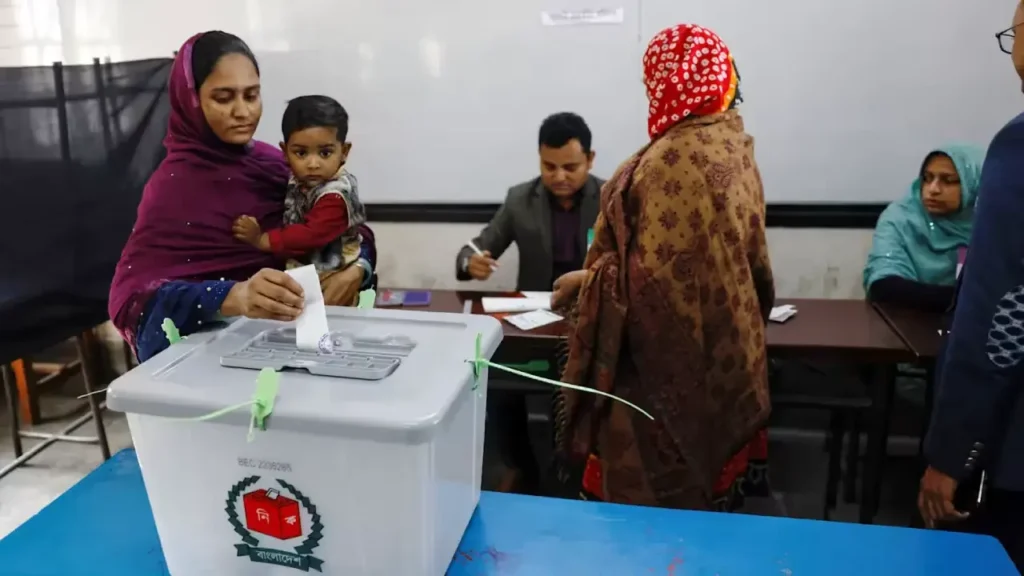
As Bangladesh approaches the February 12 election for its 13th Jatiya Sangsad, women have emerged as one of the most contested constituencies in the race. Of the country’s 127.7 million registered voters, women make up nearly half the electorate and form the backbone of key sectors such as the ready-made garment (RMG) industry. No longer treated as a peripheral or dependent voting bloc, female voters now sit at the centre of competing manifesto promises by the Bangladesh Nationalist Party (BNP), Jamaat-e-Islami and the National Citizen Party (NCP).
Yet beneath the growing list of gender-focused pledges lies a web of ideological contradictions, alliance politics and credibility gaps. This raises a fundamental question ahead of polling day: which political force, if any, can offer women not just protection and welfare, but lasting rights and genuine agency in Bangladesh’s post-authoritarian transition?
Jamaat-e-Islami and the trust question
Jamaat-e-Islami’s manifesto—its first since 2008—signals a notable rhetorical shift. Ranking “a safe, dignified and participatory role for women” as its fourth priority, the party promises to combat violence against women, ensure workplace safety and uphold women’s social dignity.
However, these assurances have been clouded by controversial policy positions and Jamaat’s historical record. Its proposal to reduce women’s working hours during maternity, presented as a consent-based welfare measure, has drawn sharp criticism. Senior BNP leaders, including Ruhul Kabir Rizvi, have accused Jamaat of duplicity, pointing to earlier statements advocating reduced workdays for women and subsequent denials to international media.
Political analysts argue that the gap between Jamaat’s softer manifesto language and its ideological roots has created a significant trust deficit. Transparency International Bangladesh has warned that religion-based parties often struggle to reconcile doctrinal positions with contemporary frameworks of gender equality. Allegations—though contested—of intimidation targeting female activists have further amplified concerns that a Jamaat-influenced government could encourage moral policing and limit women’s public participation.
BNP and the limits of welfare politics
The BNP’s 51-point manifesto makes the most expansive economic pitch to women voters. Its flagship “Family Card” proposal—issued in the name of the female head of household and providing a monthly allowance of BDT 2,500—aims to position women as central economic stakeholders. Other pledges include free education for women up to the postgraduate level, six months of paid maternity leave, daycare facilities at workplaces and a promise that 80 percent of newly recruited health workers will be women.
These commitments are likely to resonate with low- and middle-income families, particularly in rural and semi-urban areas. Yet critics argue that the party’s approach remains largely welfarist rather than transformative. The proposal to reserve only 10 percent of seats for women in a future upper house of parliament has been described by gender-rights advocates as lacking ambition.
BNP’s position is further complicated by alliance politics. While the party has publicly criticised Jamaat’s stance on women’s rights, it continues to maintain an electoral understanding with the Islamist party. This contradiction has exposed BNP to accusations of political pragmatism and raised doubts about how strongly it would defend women’s rights within a coalition government.
NCP and the alliance dilemma
The National Citizen Party, born out of the July 2024 mass uprising, offers the most progressive platform on women’s issues—at least on paper. Its commitments include direct elections to 100 reserved parliamentary seats for women, six months of paid maternity leave alongside one month of paternity leave, optional menstrual leave and daycare facilities in government workplaces.
For urban professionals, students and younger voters, the NCP’s platform signals a generational break from entrenched patriarchal norms.
However, the party’s credibility is undercut by two major challenges. As a new political force, it lacks a track record in implementation. More significantly, its electoral alliance with Jamaat-e-Islami sits uneasily with its feminist rhetoric.
For many voters, this alliance represents a core contradiction: a youth-led, rights-oriented party aligned with a partner whose commitment to gender equality remains widely questioned. Analysts suggest that in a coalition scenario, the NCP may struggle to translate progressive promises into policy leverage.
Women as a decisive bloc
The increasingly public clash between BNP and Jamaat over women’s rights—despite their political proximity—highlights how electorally significant female voters have become. Parties now recognise that women are not a passive constituency but a discerning bloc capable of shaping electoral outcomes.
Still, across all manifestos, a common weakness is evident: the absence of detailed implementation roadmaps.
Promises of safety, employment and empowerment often lack clarity on enforcement mechanisms, budgetary commitments and institutional safeguards—leaving room for scepticism.
Beyond the manifestos
Bangladesh’s women are far from a monolith. The priorities of an RMG worker differ from those of a rural homemaker, an urban professional or a university student activist. As election day approaches, their choices are likely to be shaped less by isolated manifesto pledges and more by broader assessments of credibility, alliance politics and past conduct.
Ultimately, this election will test whether Bangladesh’s political parties can move beyond rhetorical inclusivity to offer women genuine agency and protection—or whether gender-focused promises will once again give way to political expediency once the ballots are counted. For a country navigating its post-authoritarian future, the outcome may shape not only the next parliament, but the evolving social contract between the state and half of its citizens.