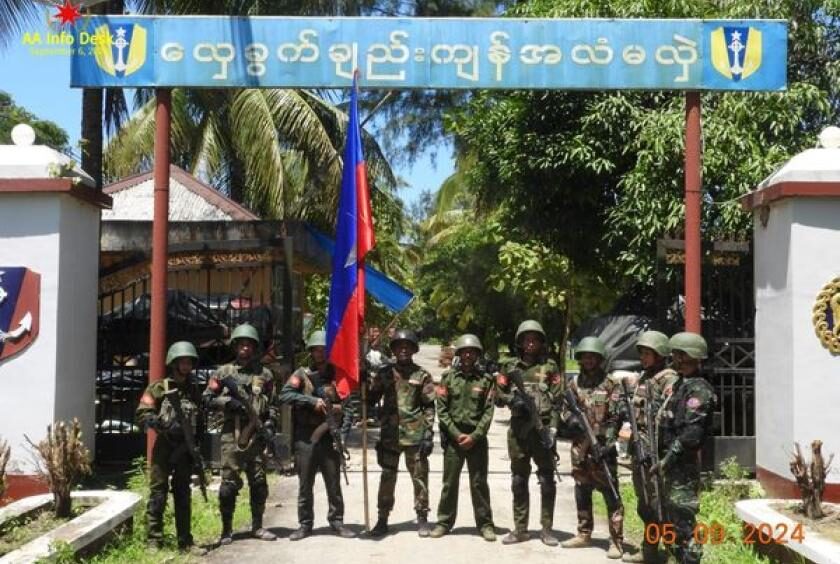
London-based advocacy group Burma Campaign UK has called on the British government to impose sanctions on the Arakan Army (AA), accusing it of committing serious human rights violations since Myanmar’s military coup on February 1, 2021.
According to a briefing report by Democratic Voice of Burma (DVB), the group alleged in a statement issued on Wednesday that the AA has carried out grave abuses against both junta forces and civilians, including members of the Rohingya community. The accusations include summary executions, beheadings, torture, and sexual violence.
Mark Farmaner, director of Burma Campaign UK, said allowing the AA to act with impunity would only encourage further violations, stressing that accountability is essential to prevent continued abuses.
Other international human rights organisations, including Human Rights Watch, Amnesty International, and Fortify Rights, have also documented what they describe as a pattern of violations by the AA in the post-coup period.
According to the DVB report the AA has expanded its territorial control in western Myanmar, seizing 14 of 17 townships in Rakhine State as well as Paletwa Township in southern Chin State. The group has previously denied all allegations of wrongdoing.
The DVB report states that Burma Campaign UK has urged the use of international justice and accountability mechanisms against the AA. It also noted that, as the United Nations Security Council’s “penholder” on Myanmar, the United Kingdom has the authority to call for a Council meeting to address the situation in Rakhine.
In a separate development, Twan Mrat Naing, chairman of the United League of Arakan and head of the Arakan Army, sent a congratulatory letter to Bangladesh’s foreign minister. The message followed a similar note from Myanmar’s newly appointed foreign minister, Than Swe.
According to local media reports in Bangladesh, a senior foreign ministry official described the messages from Myanmar authorities and the Arakan leadership as an “extraordinary event.” The official said the outreach came after sustained engagement and reflected confidence in the new Bangladeshi government’s role in seeking a peaceful resolution to the Rohingya crisis.
The Rohingya issue remains one of the region’s most pressing challenges. Bangladesh continues to host a large Rohingya refugee population, while instability in Myanmar’s Rakhine State complicates prospects for repatriation.
The Arakan Army now controls much of Rakhine State, including Maungdaw and Buthidaung — areas that were predominantly Rohingya-inhabited villages near the Naf River along the Bangladesh border. Reports suggest the AA has been exploring possible “settlement” arrangements, though observers say any such framework would likely reflect its own political priorities.
The Bangladesh media report claims that in recent months, Rohingya representatives have reiterated their demand for a safe and dignified return to their ancestral homes in Rakhine State. Similar calls were made during a multi-stakeholder dialogue in Cox’s Bazar last August and at a high-level conference during the 80th session of the United Nations General Assembly on September 30, 2025.
At those forums, the international community acknowledged the importance of including Rohingya voices in shaping their future and reaffirmed their right to return to Myanmar under conditions of safety and recognition, the report adds.