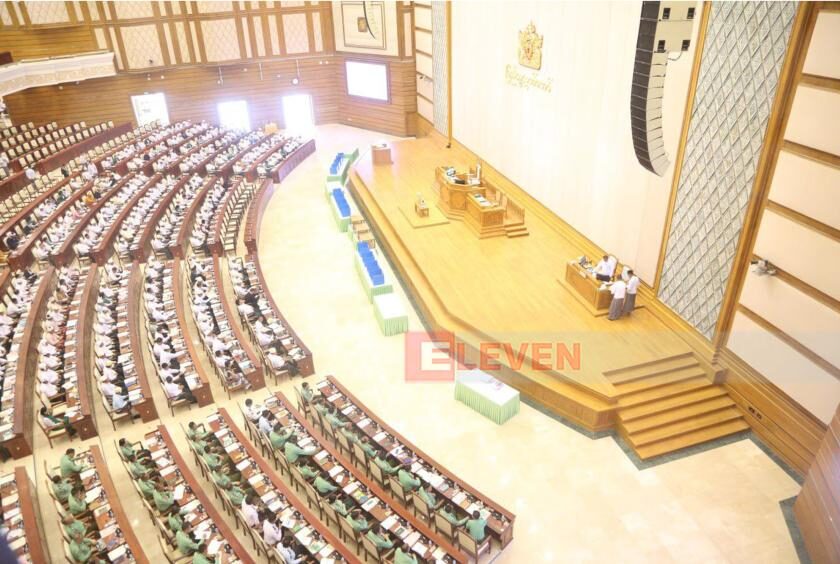
As Myanmar’s parliament convened in Naypyitaw today for the first time in six years since the February 1, 2021 military coup, major political changes appear imminent. Senior General Min Aung Hlaing, the powerful leader of the Tatmadaw, is expected to step down as commander-in-chief of the armed forces and assume the role of President of the country, marking a significant transition in Myanmar’s political landscape.
The parliamentary session follows general elections that were held for elected seats in the Amyotha Hluttaw (National Assembly) and the Pyithu Hluttaw (People’s Assembly) of the Pyidaungsu Hluttaw (Assembly of the Union). The elections were conducted in three phases beginning on December 28, 2025 and concluding on January 25, 2026. Held under strict supervision of the military junta, the polls were ultimately won by the junta’s political proxy, the Union Solidarity and Development Party (USDP).
The victory of the military-backed party has now provided the political platform required for Min Aung Hlaing to formally transition into the country’s “civilian” leadership. The 69-year-old commander, who rose to the position of commander-in-chief in 2011, had earlier hinted at stepping down during a speech delivered recently in the capital Naypyitaw. While the speech did not explicitly state his intentions, insiders in Naypyitaw told local media that it strongly indicated that the senior general was preparing for a new phase as Myanmar’s president. The move is widely seen as an attempt by the military leadership to repackage its authority within a controlled parliamentary framework.
State-run media outlet The Global New Light of Myanmar reported that on March 14 Min Aung Hlaing addressed a gathering of senior officers from all three branches of the defence services—the Army, Navy and Air Force. During the address he emphasised that the military would continue performing its “duties of protecting the country and the constitution” regardless of who forms the government. The statement appeared to underline the continuing central role of the armed forces even as political leadership formally shifts.
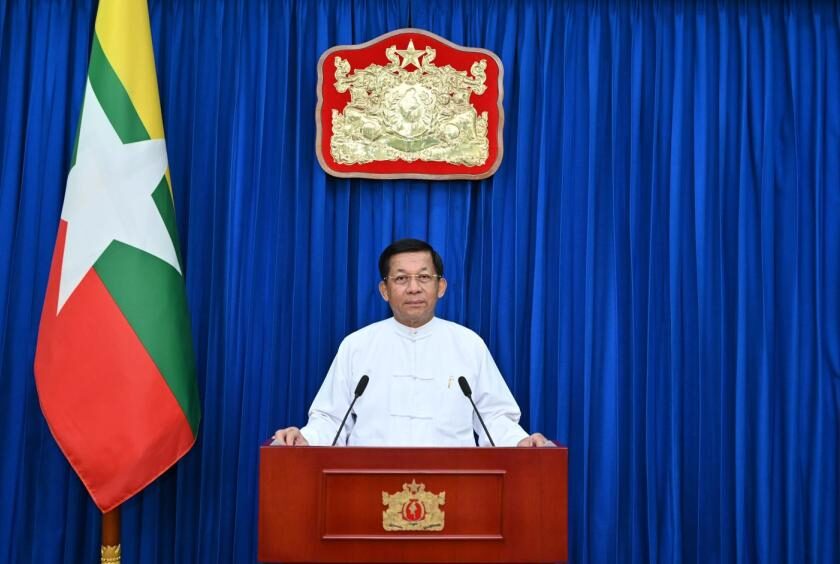
Min Aung Hlaing’s tenure as commander-in-chief has been deeply controversial internationally. He led the February 2021 coup that overthrew the elected government and has also been widely condemned for the military operations carried out against the Rohingya population in Rakhine State between 2016 and 2018, actions that many international observers and rights groups have described as genocide. His anticipated transition to the presidency therefore comes with considerable global scrutiny.
Attention is also turning to the leadership of the military once Min Aung Hlaing steps aside. According to local media sources in Yangon, the most likely successor as commander-in-chief is General Ye Win Oo, the current Chief of the Military Security Affairs Corps.
Considered a close confidant of Min Aung Hlaing, Ye Win Oo has reportedly played a key role since the 2021 coup in strategising the military’s campaign against pro-democracy resistance groups. He has also served as secretary of the ruling State Security and Peace Commission—formerly known as the State Administration Council—and as chief executive officer of the National Defense and Security Council. While relatively little is publicly known about him, his rise would signal continuity within the military leadership.
Under the established structure of Myanmar’s armed forces, the deputy commander-in-chief of Defence Services—effectively the second-ranking officer in the military hierarchy—usually assumes the post of Army chief. However, the current deputy commander-in-chief, Soe Win, is set to retire from his position. He is expected to take up a role in the new “Union Consultative Council,” a move that would further reshape the senior leadership structure of the military establishment.
Even as the political transition unfolds, Min Aung Hlaing has reportedly been attempting to revive dialogue with various ethnic armed groups across the country. Sources say that before assuming the presidency he has reached out to these groups, urging them to participate in peace talks with the military leadership. The senior general has repeatedly expressed interest in reactivating the peace process, a long-standing challenge in Myanmar’s complex ethnic conflict landscape.
In fact, the military leadership has already engaged in several symbolic gestures aimed at reviving negotiations. On October 15, 2025, the regime marked the tenth anniversary of the Nationwide Ceasefire Agreement with a major event attended by senior members of the military establishment, including Min Aung Hlaing himself. The gathering was presented as a signal that the junta remains committed—at least officially—to pursuing peace with ethnic organisations.
Min Aung Hlaing has claimed that since 2021 the military government has held 89 rounds of talks with ethnic armed groups that are signatories to the Nationwide Ceasefire Agreement, along with 25 meetings with groups that are not signatories. He also stated that “state authority” would be transferred to the USDP-led administration in April following the convening of parliament on March 16, a timeline that suggests the formal political transition may take place within weeks.
At the same time, the military leadership has reportedly attempted to persuade forces aligned with the National Unity Government (NUG)—the parallel administration formed by pro-democracy groups after the coup—to surrender. The NUG, however, is believed not to have responded to any such overtures from the junta so far.
Instead, there are indications that the opposition camp is pursuing its own strategy. According to sources cited by local media, the NUG has been holding discussions with several ethnic armed organisations regarding the formation of a broader political and military coordination structure.
The Democratic Voice of Burma (DVB) reported that representatives from the NUG have met with the Kachin Independence Organisation (KIO), the Karen National Union (KNU), the Karenni National Progressive Party (KNPP), and the Chin National Front (CNF) to explore the establishment of a “Federal Steering Council.” The “Federal Steering Council” is meant provide political leadership and direction to the forces opposing the military controlled rule and governance in Myanmar.
These discussions are said to have taken place last week on an unspecified date and follow earlier talks held in February. If confirmed, such a development would signal efforts by pro-democracy forces and ethnic groups to strengthen coordination against the military establishment.
As Myanmar’s parliament resumes after six years of military rule, the country appears to be entering a new but uncertain phase. While Min Aung Hlaing’s anticipated shift from military chief to president may present the appearance of a political transition, the underlying balance of power between the armed forces, civilian institutions and resistance movements remains deeply contested.