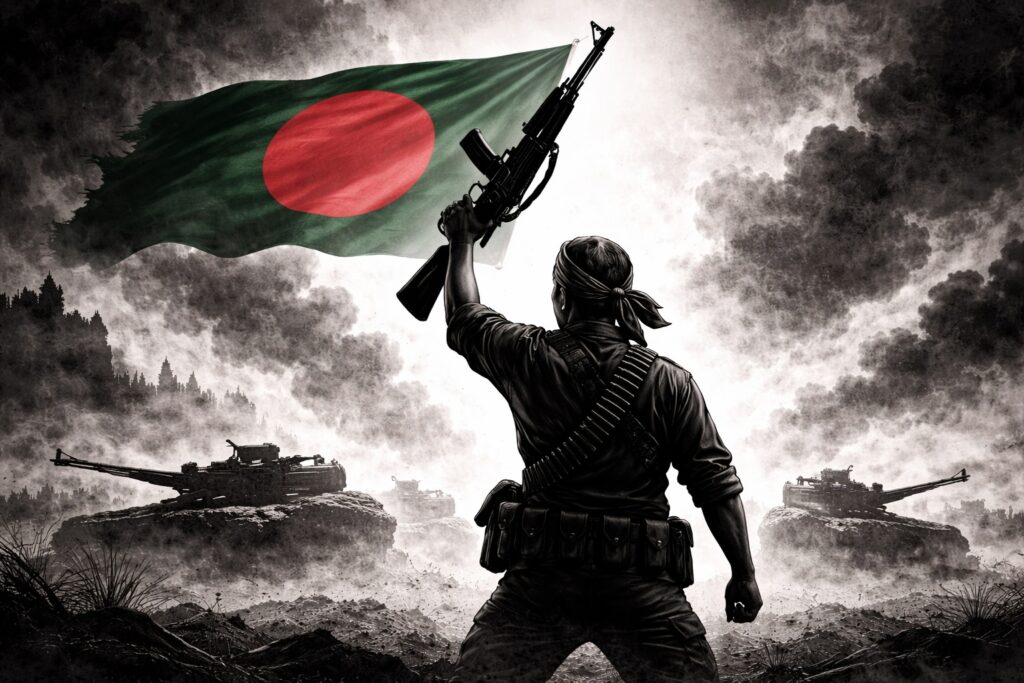
March 25 is not just a date in Bangladesh’s history—it is the night that refuses to fade, a wound that continues to breathe.Observed as Genocide Day, it marks one of the darkest nights of 1971, when the Pakistani occupation forces launched a brutal crackdown under “Operation Searchlight,” turning cities into graveyards and silence into terror. On this day, Bangladesh remembers not only the scale of violence but the human cost—the teachers, intellectuals, students, and ordinary civilians who were indiscriminately gunned down in places like Dhaka University, Pilkhana, and Rajarbāgh Police Lines.
In a statement issued today, Prime Minister Tarique Rahman paid his deepest respect to the martyrs, calling March 25 “one of the most disgraceful and brutal days” in the history of a freedom-loving Bangladesh. He emphasised that the killings were not spontaneous, but part of a pre-planned genocide designed to crush a people’s aspiration for dignity and self-determination. The question of why this organised violence could not be resisted earlier, he noted, remains a matter of historical inquiry—particularly regarding the role of political leadership at the time.
Yet even in that darkness, resistance was born. On the very night of March 25, the 8th East Bengal Regiment in Chattogram declared “We Revolt,” marking the beginning of armed resistance. That moment would grow into a nine-month Liberation War—one that would ultimately give birth to Bangladesh, but at an unimaginable cost.
For the Prime Minister, remembering this genocide is not merely about the past; it is essential for future generations to understand the value of independence and to uphold the ideals of equality, human dignity, and social justice.
As Bangladesh prepares to mark its 55th Independence Day on March 26, 2026, these memories feel especially alive. The air is heavy with reflection—of sacrifice, loss, and the long road to freedom. But this year, remembrance is not confined within national borders. The echoes of 1971 are reverberating far beyond, reaching the corridors of power in Washington, D.C.
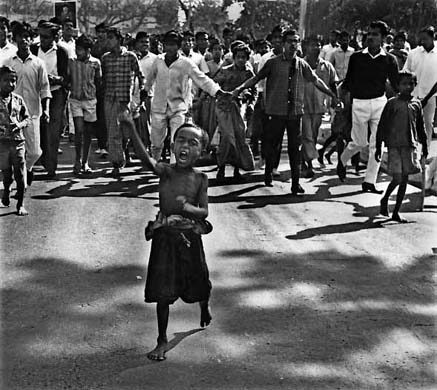
Recognition and the weight of history
On March 20, 2026, U.S. Congressman Greg Landsman introduced a resolution in the U.S. House of Representatives seeking formal recognition of the 1971 atrocities as genocide, war crimes, and crimes against humanity. For Bangladeshis, this is more than a diplomatic gesture—it is a long-awaited acknowledgment of a truth that has lived in memory but often remained unrecognised globally.
The timing is deeply symbolic. Coming just days before Independence Day and alongside Genocide Day, it intersects with a moment of profound national reflection. But it also arrives at a politically sensitive time. Bangladesh’s political landscape has shifted following recent elections, where Bangladesh Jamaat-e-Islami—explicitly named in the resolution as a collaborator in 1971—has emerged as the largest opposition force. This convergence of past and present gives the resolution a layered significance, both historical and political.
The resolution itself is rooted in decades of documentation, testimonies, and archival records. It reconstructs 1971 through three defining dimensions. First is Operation Searchlight—the night of March 25, when Dhaka became a city of massacre, with university halls burned, neighborhoods shelled, and civilians killed based on prepared lists. Second is the systematic elimination of intellectuals—journalists, doctors, academics, and political activists—culminating in the targeted killings of December 1971, an attempt to cripple the nation before its birth.
The third dimension is perhaps the most haunting: the widespread and organised use of sexual violence. Tens of thousands of women were abducted and subjected to repeated rape as a weapon of war. These women, later honoured as “Birangona,” carried scars that history has yet to fully heal.
Alongside this, the resolution highlights the targeted violence against Bengali Hindus—many of whom were singled out for extermination, forced conversion, or displacement, with entire villages wiped out and families forced into refugeehood overnight.
At the same time, the resolution underscores a critical legal and moral distinction: that no entire religious or ethnic community can be held responsible for the crimes of individuals. This principle is essential, especially in a region where history often bleeds into present-day tensions.
Echoes of conscience and the politics of memory
At the heart of this renewed recognition lies a voice that once spoke out—and was ignored. Archer Blood, the U.S. Consul General in Dhaka during 1971, witnessed the unfolding massacre firsthand. On March 28, he sent a telegram to Washington describing what he called a “selective genocide,” detailing how Bengali civilians, particularly Hindus, were being systematically targeted.
Days later, Blood and 20 of his colleagues sent what would become known as the Blood Telegram—a rare act of diplomatic dissent against the U.S. government’s silence. In it, they expressed moral outrage, stating that while the term genocide was applicable, the United States had failed even to take a moral stand.
Today, that message stands as one of the most powerful internal protests in American diplomatic history—and the Landsman resolution brings it back into the light, forcing a confrontation not only with the past atrocities but also with past complicity.
At the same time, the politics of memory within Bangladesh itself has undergone a visible shift. The caretaker administration led by Muhammad Yunus had drawn criticism from sections of society for attempting to recalibrate narratives of the Liberation War.
In contrast, Prime Minister Tarique Rahman—son of former President of Bangladesh Ziaur Rahman, who served as a Major in the 8th East Bengal Regiment and fought in 1971—has firmly described March 25 as a pre-planned genocide and taken a clear stance against Pakistani atrocities. His position signals a restoration of the Liberation War’s historical clarity, aligning state discourse once again with the lived experiences and sacrifices of 1971.
March 25, 1971 is observed as Genocide Day. On the occasion of Genocide Day, 1 pay my deepest respect to all the martyrs.
In the history of freedom-loving Bangladesh, 25 March 1971 remains one of the most disgraceful and brutal days. On that dark night, the Pakistani occupation… pic.twitter.com/SiLUrbVSgP
— Tarique Rahman (@trahmanbnp) March 24, 2026
But the story does not end in memory alone. In Bangladesh today, the electoral rise of Jamaat-e-Islami has raised concerns among observers and diaspora communities, given its historical opposition to independence and allegations of collaboration during the war. By naming the party, the resolution steps into a delicate space where historical accountability meets contemporary democratic realities.
At the same time, advocacy groups and diaspora organisations have played a crucial role in bringing this issue to the global stage. Their efforts have emphasised the experiences of minorities, particularly Hindus, adding a new dimension to the narrative of the Liberation War.
While the war has long been framed as a struggle for Bengali nationalism, this perspective highlights the layered nature of violence—where identity, religion, and politics intersected in devastating ways.
The path to recognition has been long. Cold War geopolitics once silenced these truths, as global powers prioritised strategic alliances over human rights. Today, the resolution attempts to correct that historical omission. Its implications extend beyond the United States, touching regional dynamics, including India’s historical role in Bangladesh’s liberation and its own narratives of the conflict.
As the resolution moves through the U.S. legislative process, its final outcome remains uncertain. Yet its symbolic power is undeniable. It reopens a conversation long suppressed, amplifies voices once ignored, and offers a form of acknowledgment that has been denied for decades.
For Bangladesh, this recognition is both a tribute and a challenge. It honours the martyrs, as Prime Minister Tarique Rahman urged, and calls upon the nation to build a future rooted in justice, dignity, and equality. But it also demands introspection—because truth, when it arrives late, rarely comes without complexity.
Fifty-five years ago, Archer Blood warned that what was happening in Bangladesh was not merely an internal matter. Today, that warning echoes louder than ever. And as Bangladesh raises its flag, the world may finally be beginning to understand the price at which that freedom was won.
With inputs from Bidhayak Das