The misty shores of Umiam Lake, long a symbol of Meghalaya’s ethereal natural beauty, have recently become the stage for a high-stakes confrontation that epitomises the global struggle between economic ambition and environmental preservation.
Located just a short drive from Shillong, this iconic landscape is now caught in a complex tug-of-war centred on the proposed Taj Umiam Resort & Spa. The dispute pits the Meghalaya Tourism Department’s vision of high-value, sustainable growth against the uncompromising resolve of the Green-Tech Foundation, an environmental advocacy group determined to protect the lake’s fragile ecosystem from corporate encroachment.
The controversy ignited when the Green-Tech Foundation filed a formal petition challenging the state’s decision to lease 66 acres of land to Umiam Hotels Pvt. Ltd., a Special Purpose Vehicle partnered with the Indian Hotels Company Limited of the Tata Group.
While the scale of the land deal is significant, the inclusion of Lumpondeng Island has emerged as the primary source of public anxiety. As an ecologically sensitive landmass within the lake, many consider the island the crown jewel of the local environment.
This concern runs deeper than mere symbolism. Many argue that handing over such pristine territory to a major corporation represents an existential threat to Meghalaya’s natural heritage—a sentiment that has resonated deeply with the public and fuelled a viral online movement against the project.
The Green-Tech Foundation’s stance is rooted in a fundamental distrust of large-scale development within protected or sensitive zones. They maintain that any form of luxury infrastructure on Lumpondeng Island, regardless of promised safeguards, risks permanently damaging the environment.
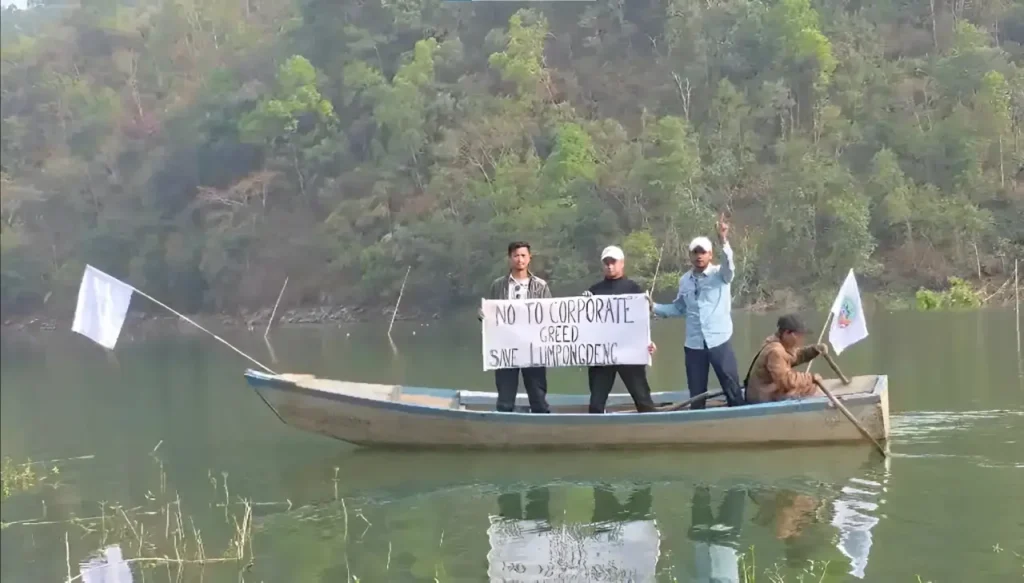
This position was articulated in stark terms by HBansiewdor Nonglang, Chairman of the Green-Tech Foundation, during a recent site inspection of Umiam Lake. Emphasising both ecological and moral concerns, he said that the organisation had surveyed the entire area and found it to be “a very beautiful place” that should not be subjected to commercial exploitation.
“We have no right to auction it off or interfere with this natural beauty,” he said, adding that the project must be “completely scrapped” and the proposed handover of Lumpondeng Island immediately withdrawn.
video credit : Contributed
Nonglang further underscored the group’s uncompromising stance, asserting that no justification from the government would be acceptable. “There is no need for any explanation or clarification on this—we will not accept it,” he said, warning that the Foundation would resist any attempt to proceed with the project.
Their scepticism was further heightened during a recent meeting, where activists claimed the Tourism Minister appeared unaware that Lumpondeng Island was included in the 66-acre lease.
For the Foundation and its supporters, this perceived lack of transparency suggests a rushed process that prioritises corporate interests over ecological integrity. They argue that the lake is an integral part of the Khasi community’s cultural and ecological fabric.
Equally significant is the potential disruption to local biodiversity—supporting various species of birds, plants, and aquatic life—which, they contend, is a price too high to pay for economic gain.
The opposition has also gained visible public backing. According to Nonglang, the Foundation’s petition against the project has already garnered around 3,000 signatures. “After we took up this issue with the public, we have stood united,” he noted, framing the movement as a collective effort to prevent what activists describe as the defacement of a pristine natural site.
Reinforcing the group’s escalation strategy, he added that representations have been sent to multiple authorities, including the Environment Minister (who also serves as Chief Minister), the Tourism Minister, the District Council, and the Ministry of Environment of the Government of India. Their demand, he stressed, is unequivocal: revoke the 66-acre land allotment to private developers. Failing this, the Foundation has warned of an intensified protest movement.
In response to mounting dissent and what it characterises as social media misinformation, the Meghalaya Tourism Department has taken a firm stand in defence of the project. In a clarifying statement issued on 31 March 2026, government officials insisted that the Taj Umiam Resort & Spa is a strategic move towards “high-value, low-impact” tourism, arguing that luxury and ecology can coexist through rigorous planning and management.
Officials have explicitly pledged that no permanent construction will be allowed on Lumpondeng Island, thereby preserving its canopy and natural terrain. To bolster their argument, the department points to the Taj Madikeri in Coorg as a successful model where luxury infrastructure has been integrated into a rainforest without tree felling or environmental degradation.
The government further emphasises that the project will adhere to the highest global sustainability standards, citing the Indian Hotels Company Limited’s long-standing partnership with the EarthCheck Certified Programme. Officials maintain that the development will comply strictly with the Forest (Conservation) Amendment Act 2023 and the Waterbodies Preservation and Conservation Guidelines 2023.
By following these legal frameworks, along with oversight from the Meghalaya State Pollution Control Board, the Tourism Department argues that the project can generate revenue and employment while also improving the monitoring and protection of the lake’s micro-ecosystem.
As the debate intensifies, the fate of Umiam Lake remains uncertain. The area continues to function as a hub for recreation, with visitors enjoying panoramic vistas from the Umiam Viewpoint.
Yet, the shadow of the ongoing dispute looms large over these tranquil waters. This clash of visions serves as a critical case study for the future of Northeast India.
It raises a difficult question: can the promise of high-end growth truly honour the mandate of environmental stewardship, or are some landscapes simply too precious to be priced for development?