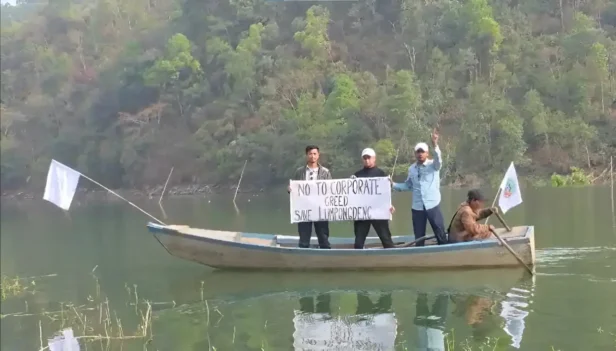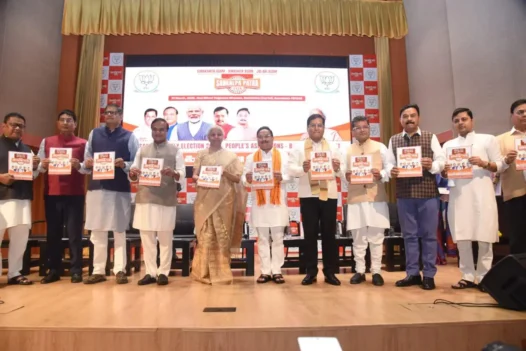
It no longer seems to matter who wins the election in Assam. In all likelihood, the BJP-led NDA will return to power yet again. But what has unmistakably changed in the past few days is something else entirely—the visible descent of political discourse into mudslinging, personal attacks and headline-grabbing allegations that everyone can now see and hear.
Primarily, two parallel developments have driven this shift. On one hand are the Congress’s explosive claims of concealed properties, international business links and multiple passports involving Chief Minister Himanta Biswa Sarma and his wife Riniki Bhuyan Sarma. On the other is the sudden and striking rise of 27-year-old Assam Jatiya Parishad (AJP) candidate Kunki Chowdhury, whose campaign in the newly carved Guwahati Central constituency has captured public imagination.
#WATCH | Guwahati, Assam: On allegations over Assam CM Himanta Biswa Sarma’s wife Riniki Bhuyan Sharma, Congress leader Pawan Khera says, “… Are they denying that they have no property in Dubai? Are they denying that they have no company in America? Are they denying that they… pic.twitter.com/leC03MrF6x
— ANI (@ANI) April 6, 2026
Together, these two threads have disrupted what until recently appeared to be a predictable election, adding both uncertainty and intensity to the final stretch.
There is also a growing sense that these developments have unsettled the Chief Minister. In recent days, Sarma has appeared unusually combative, a shift from his otherwise energetic public persona—often marked by dancing, singing and engaging freely with crowds. Instead, he has issued warnings of legal and police action against opposition leaders. At his April 6 press conference, many observers felt the lack of sleep was evident, with the seriousness of the allegations perhaps beginning to show.
At the same time, the popularity of Kunki Chowdhury has surged—ironically fuelled in part by the very attacks directed at her and her family, which seem to have amplified rather than diminished her appeal.
The allegations and the counter
It is against this shifting backdrop that the Congress chose to strike—late in the campaign, but with sharp and pointed allegations that quickly altered the tone of the contest.
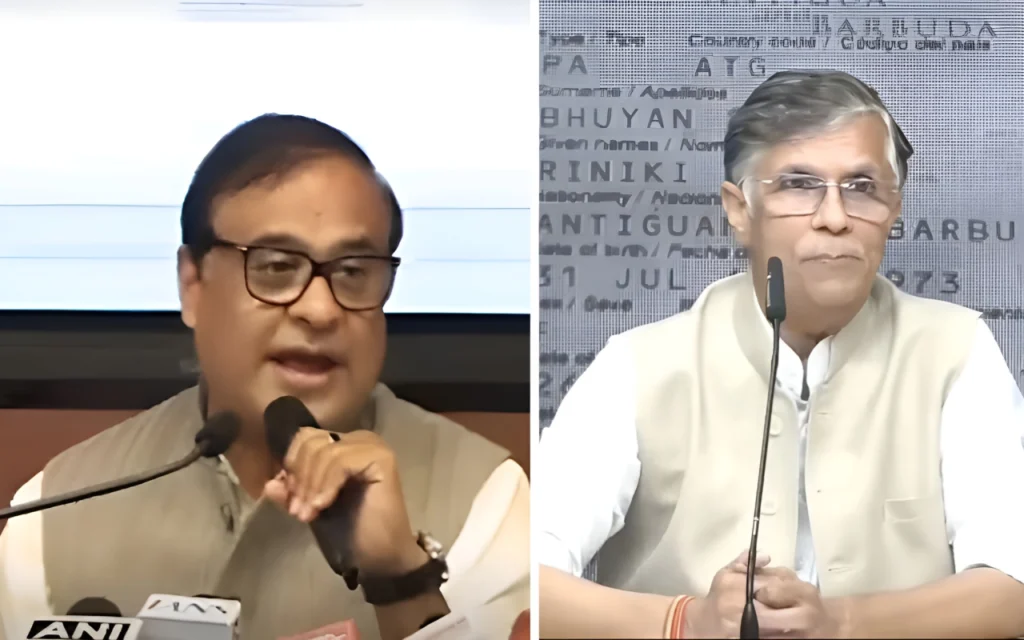
Leading the charge, party spokesperson Pawan Khera alleged at a June 5 press conference in Guwahati that Riniki Bhuyan Sarma owns three passports and that the Chief Minister, his wife and their son are linked to a business empire worth Rs 52,000 crore in the United States.
Even as Sarma dismissed the allegations and warned of legal and police action, Khera remained unfazed. He raised a series of pointed questions:
“Are they denying that they have no property in Dubai? Are they denying that they have no company in America? Are they denying that they have no shell companies anywhere in the world?… We will give much more evidence every day. A lot is coming.”
He also asked, “Why has he concealed the Dubai properties owned by his wife from his election affidavit?”
Khera further claimed that a company in Wyoming lists Sarma, his wife and their son as members, with a reported budget of USD 3,467 crore and plans to open hotels in the United States. According to him, Rs 52,000 crore from the company is to be distributed among the three family members.
These are serious allegations, but as of now remain unverified—raising a key question: will voters view them as credible disclosures or as a last-minute political strategy?
Sarma has strongly denied the charges, arguing that “anyone can register a company by paying USD 199,” and that such entities can be easily created online without implying wrongdoing.
However, instead of addressing each allegation directly, he has chosen to shift the narrative. Even as the Chief Minister sought to deflect and reframe the debate, the opposition continued to press its line of questioning, keeping the focus firmly on disclosure, accountability and intent.
Former Chhattisgarh Chief Minister Bhupesh Baghel added to the pressure, asking:
“The question is whether you have property in Dubai or whether the property in the US states is yours or not. You have to answer these questions. Why is Amit Shah silent about it? PM Modi says that he will neither eat nor let others eat. Why is he silent? The question is this.”
In response, and in a move that shifted the narrative away from the specifics of the allegations, Sarma revived the “Pakistan link,” claiming that the materials presented by the Congress were supplied by a Pakistani social media group. He added that in the past 10 days, “Pakistan channel” had conducted at least 11 talk shows on Assam elections, all concluding that Congress should win.
He warned that displaying “fraudulent documents” in public could attract Sections 420 and 468 of the IPC (and corresponding provisions under the BNS), and that using such documents to influence elections could invite penalties up to life imprisonment.
It is also worth noting that Sarma had earlier promised to reveal an alleged “Pakistani agent” linked to Congress leader Gaurav Gogoi. Timelines were set, but no evidence has been made public so far.
Gogoi has dismissed the claims as a “wild theory,” continuing to campaign as the opposition’s chief ministerial face. He sharpened his attack further:
“He can tell thousands of lies. He has been lying for so long. The Congress Party is going to expose all these lies regarding his family’s property and his family’s businesses abroad… The question is clear: Does your family have a Gold Card in Dubai? Does your family own property in Dubai? Third, did you declare this in your election affidavit?…”
While the political exchanges grew sharper, Gogoi attempted to reposition the conversation, presenting himself as a counterpoint to the increasingly combative tone of the campaign. During an interview with The Borderlens in his home in Jorhat, he said political opponents need not resort to coarse language. For him, Assam represents “a sense of fearlessness, a sense of progressiveness and civility.”
We have clear evidence that a Pakistan backed Social media group has contributed to #CONGFakeAICampaign.
Last year we had done an expose as to how Pakistani Facebook accounts were being deployed in Assam Elections. pic.twitter.com/SOSl2bFkf7
— Himanta Biswa Sarma (@himantabiswa) April 6, 2026
Interestingly, while his demeanour remained calm and the turnout outside his residence appeared low-key, a journey through Upper Assam suggested something else—a quiet undercurrent, a sense that the political mood may be shifting beneath the surface.
As polling day approaches, these allegations have clearly altered the campaign narrative, even if it remains uncertain whether they will alter the final outcome.
The Gen Z surge
Even as these allegations dominated headlines and shaped the political discourse, a parallel story was quietly gathering strength on the ground—one that would soon become just as central to the election narrative.
The rise of Kunki Chowdhury, in many ways, represents the other side of this election—less about accusation, and more about a changing political mood.
Her campaign has been relentless, but measured. She has kept her criticism grounded and restrained, focusing on civic issues such as flooding, waste management and urban infrastructure. Her tone—calm, inclusive and accessible—has struck a chord, particularly with younger voters.
At the same time, it is the attacks against her that have significantly amplified her reach.
Chief Minister Sarma accused her mother, Sujata Gurung Chowdhury, of posting videos consuming beef. He framed it as an affront to Assam’s cultural ethos, invoking Kamakhya Temple, Majuli and Batadrava Than, and warning of legal action under the Assam Cattle Prevention Act.
His words were emphatic: “The moment I hear someone eating beef, my entire body trembles with rage.”
However, the reaction appears to have backfired. Instead of weakening her campaign, the remarks have triggered widespread criticism. Many have described them as “below the belt,” arguing that personal food choices should not be politicised. For some voters, the issue has shifted from cultural identity to constitutional rights.
As the campaign progressed, it became evident that something had shifted. What initially seemed like routine exchanges gradually turned into a sharper and more unpredictable contest, with the opposition appearing to gain momentum while the BJP’s tone was increasingly described by critics as marked by “arrogance and unwanted aggression.”
Chowdhury, meanwhile, stayed her course.
These changes in the campaign mood appear closely tied to the impact created by her candidacy. Campaigning relentlessly, she has maintained a composed and respectful tone, and her demeanour, maturity and inclusive approach seem to be resonating widely. The Gen Z candidate, now a household name, is taking on BJP’s Vijay Gupta—a seasoned figure who had initially entered the contest as a clear favourite.
Among the most notable endorsements has come from economist and commentator Parakala Prabhakar, who is also the husband of Union Finance Minister and senior BJP leader Nirmala Sitharaman. Highlighting the broader significance of the elections, he said that “these elections are not only crucial for Guwahati or Assam, but have long implications for the entire country.”
Prabhakar went further, emphasising the need to safeguard constitutional values. He said, “secularism, tolerance, democracy, social justice and equality are under threat. To protect these ideals, we must defeat intolerance and religious fanaticism.” He also urged voters to “vote for Kunki,” describing it as a “vote for development, constitutional values and justice for Zubeen Garg.”
What makes his endorsement particularly significant is not just who he is, but what he chose to emphasise. His remarks on protecting secularism and democracy come at a time when Chowdhury has faced a series of personal attacks from her opponents—attacks that many have described as “despicable,” reflecting a broader discomfort with the tone of the campaign.
Support for Chowdhury has also come from former Assam DGP and Sahitya Akademi award-winning poet Harekrishna Deka, who has spoken in favour of her candidature in Guwahati Central. Notably, Deka has been among a group of eminent individuals from Assam who recently moved the Supreme Court against Chief Minister Himanta Biswa Sarma over a series of alleged hate speeches targeting the Miya Muslim minority community in the state.
The group of petitioners also includes noted public intellectual Hiren Gohain, a retired professor who has consistently spoken on issues of constitutional values and public discourse.
Just when the campaign appeared to be settling into familiar lines of attack and counterattack, another development surfaced—one that once again shifted attention and raised fresh concerns.
It was in this charged atmosphere that Chowdhury alleged the circulation of AI-generated deepfake videos. On April 4, 2026, she said manipulated clips—some taken from her own Instagram content—were altered and shared to misrepresent her statements. She filed an FIR at Panbazar Police Station under the IT Act and defamation laws, calling it a malicious attempt to damage her campaign.
The episode raises larger questions. If such tools are being used, what does it say about the nature of electoral politics today?
Chowdhury and the AJP have dismissed the allegations against her as politically driven. She has argued that instead of harming her, the attacks have amplified her visibility—turning criticism into unintended publicity.
According to media reports what began as online buzz has now translated into visible support on the ground. In Guwahati Central, there is a growing emotional connect with voters, and if this translates into votes on April 9, Vijay Gupta could face a much tougher contest than initially expected.
News reports maintain that At 27, Chowdhury represents a generational shift. Her international exposure, combined with a grassroots approach, has given her both credibility and relatability. She entered the race relatively late but has quickly built momentum, with support from groups like the All India Gorkha League and strong traction among Gen Z voters.
Her candidacy also disrupts the BJP’s established narrative in Assam. A young, globally exposed candidate focused on local issues offers a different political story—one centred on renewal and accountability.
The intensity of the attacks against her suggests she is no longer being treated as a fringe player.
As the campaign enters its final phase, these two parallel stories now define Assam’s political moment. On one side are allegations—of passports, properties in Dubai, and overseas businesses—that remain unanswered but continue to dominate headlines. On the other is the rise of a young candidate whose campaign has been shaped as much by her message as by the attacks against her.
Taken together, these developments suggest that this election is no longer being shaped by a single narrative, but by competing forces pulling public attention in different directions. Between accusation and counter-accusation, between aggression and restraint, lies the voter—and the final word will belong to them.