Over the past 24 hours, the election campaign in Assam has taken a turn that many observers feel leaves much to be desired. Increasingly, it has been dominated by personal attacks and social media vitriol—an emerging trend that has not traditionally defined the political culture of the state. The shift raises an important question: is Assam witnessing a temporary aberration, or the beginning of a deeper transformation in its electoral discourse?
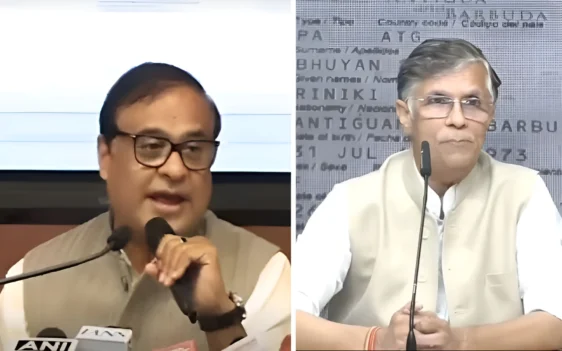
At the centre of the storm is Chief Minister Himanta Biswa Sarma, whose sharp attacks on Congress leader Pawan Khera—and the language employed—have drawn mixed reactions. Sarma’s remarks came in response to allegations made by Khera in Guwahati on Sunday, where the latter accused the Chief Minister and his wife, Riniki Bhuyan Sharma, of concealing ownership of multiple passports across three countries, as well as properties in Dubai and a company in the United States, in their election affidavit.
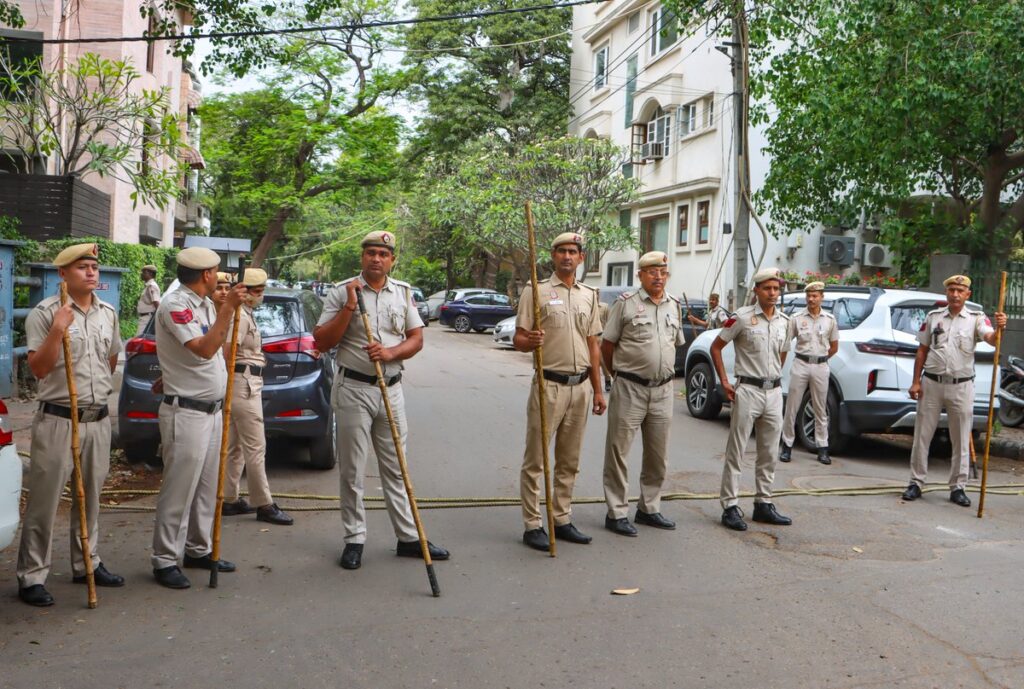
Since those allegations surfaced, the campaign narrative appears to have shifted significantly. Conversations around welfare schemes and policy promises have taken a backseat, replaced by a cycle of allegations and counter-allegations, police complaints, and legal escalations. The situation intensified further with a raid by the Assam Police at Khera’s New Delhi residence on Tuesday morning, following an FIR lodged by Riniki Bhuyan Sharma at the Crime Branch in Guwahati on Sunday.
On Monday, during a press conference, Sarma spent considerable time dismissing the allegations against him and his wife. However, his tone through the day suggested visible agitation. At multiple campaign events, he targeted Khera, at one point remarking he would make “pera” (peda) out of him and warning of serious consequences once he returns to power. His statements, laced with anger, have led many to ask: do such reactions amplify the allegations rather than contain them?
पवन खेड़ा को मैं पवन पेड़ा बना दूँगा…
पवन खेड़ा को पेलूंगा
पवन खेड़ा गां— है@himantabiswa pic.twitter.com/gZqHqgA3FE
— Mamta Tripathi (@MamtaTripathi80) April 7, 2026
Khera, for his part, maintained that the claims were based on documents he described as potentially used for “KYC” purposes in acquiring properties and passports. He reiterated his demand for clarity on why these were not disclosed in the election affidavit. Responding to reports that legal action was being considered within 48 hours, Khera retorted, “File it immediately—why wait?”
He further pressed the issue, asking whether the Chief Minister and his spouse were denying ownership of property in Dubai, business interests in the United States, or any involvement in shell companies globally. “We will provide more evidence every day,” he added, hinting that the controversy is far from over.
On the allegations over the Assam CM Himanta Biswa Sarma’s wife Riniki Bhuyan Sharma, Congress leader & spokesperson Pawan Khera says –
“Are they denying that they have no property in Dubai?
Are they denying that they have no company in America?
Are they denying that they… pic.twitter.com/Uz329Zo27L
— Sourav Kundu (@souravramyani) April 6, 2026
Among residents in Guwahati, informal conversations reveal a degree of puzzlement. Some feel the Chief Minister could have chosen to ignore the allegations altogether, particularly if they are, as he claims, baseless. Others believe his response reflects a desire to firmly counter the narrative and retain political control. But does such a strategy risk deepening the controversy instead of closing it?
The deployment of an Assam Police team to New Delhi has not entirely come as a surprise, given the escalating tensions. Yet, it has triggered another set of questions—particularly because the elections are underway, and executive authority over state machinery is expected to rest with the Election Commission. Did the Commission, or the Chief Electoral Officer (CEO), sanction this move? As of now, there has been no official clarification, with the CEO, Assam, unavailable for comment despite attempts to reach him.
In contrast, Sarma addressed media queries by stating he had “heard” about the police team’s movement and suggested that Khera may have “run away to Hyderabad.” He added that the Assam Police is capable of tracking individuals “even from paatal.” Escalating the rhetoric further, he speculated that Rahul Gandhi may have provided Khera with the documents, indicating that the matter could widen.
In a more striking remark, he stated, “this is Assam, and we have fought against Islamic invasion 17 times”—a comment that has also drawn attention for its historical and political undertones.
#WATCH | Jorhat | On Congress leader Pawan Khera, Assam CM Himanta Biswa Sarma says, “Before levelling an allegation, he should have asked the foreign minister. Kharge ji has aged, yet he speaks like a madman. Assam Police can find and bring people from ‘pataal’ as well. I… pic.twitter.com/EgIOsIFcuv
— ANI (@ANI) April 7, 2026
Congress leaders, however, have strongly criticised these developments. Senior leader Jairam Ramesh termed the police action as excessive, arguing that sending a large contingent to arrest Khera for raising “basic questions in the public interest” reflects a government that is “disturbed, desperate, and rattled.” He described the move as less about due process and more about silencing opposition voices.
Protests by Congress workers outside Khera’s residence in Nizamuddin have further intensified the political temperature. At the same time, attention has also turned to the broader pattern of allegations and counter-allegations. Commentator Tehseen Poonawalla publicly expressed hope that the Assam Police would remain focused on ensuring free and fair elections.
Meanwhile, Akhil Gogoi of the Raijor Dal stated that he was not surprised by the Chief Minister’s response. Addressing an election rally, he argued that Sarma tends to “hide behind the police and courts,” asserting that Khera’s questions should have been answered directly rather than through legal action.
#WATCH | Guwahati | President of Raijor Dal, Akhil Gogoi says, “People of Assam are waiting for April 9 to vote for the opposition to bring change. The people want to change the Hitler-like BJP govt in Assam.”
On Congress leader Pawan Khera, he says, “The language used by the… pic.twitter.com/2ErQiHIPu8
— ANI (@ANI) April 7, 2026
Adding another dimension, Gaurav Gogoi questioned the police’s priorities, asking why similar urgency was not shown when Congress candidates such as Sunil Chettri, Mira Bortakhur, and Bidisha Neog were allegedly attacked. He also escalated his critique, alleging that individuals linked to various “syndicates”—including cattle, water, coal, supari, and sand—are influencing governance in Assam.
VIDEO | Assam: State party chief Gaurav Gogoi (@GauravGogoiAsm), at a roadshow in Jorhat, on the presence of police at Pawan Khera’s Delhi residence, says, “Where was the Assam Police when Congress candidates Sunil Chhetri, Mira Borthakur, and Bidisha Neog were attacked?”… pic.twitter.com/PUWF09SmV7
— Press Trust of India (@PTI_News) April 7, 2026
According to him, these networks have merged into the ruling establishment, leading to stalled development in regions like Dhemaji and the alleged misuse of public funds to acquire assets, including properties in Dubai.
Drawing a contrast with former Chief Minister Tarun Gogoi, Gaurav Gogoi noted that despite 15 years in power, the latter did not accumulate estates, resorts, or media houses in his family’s name. He further alleged that under the current government, contracts are often awarded to relatives and close associates of ministers and legislators.
Notably, Gaurav Gogoi’s campaign strategy appears to have taken a different tone. While making pointed allegations, he has largely avoided engaging in personal attacks or inflammatory rhetoric. Instead, he has consistently framed his message around corruption-free governance and dismantling what he describes as syndicate-driven politics. Promising reforms in the contract system, he stated that contracts under a Congress government would be awarded to local contractors rather than political insiders, and that industrial growth would prioritise local entrepreneurs over external players.
VIDEO | Delhi: A team of Assam Police reaches residence of Congress leader Pawan Khera. Debojit Nath, ACP, Assam Police, says, “A case has been registered at Crime Branch Police Station in Guwahati and we wanted Mr Pawan Khera in connection with the case. We came in search of… pic.twitter.com/Gf65XNuYQy
— Press Trust of India (@PTI_News) April 7, 2026
As the campaign drew to a close at 5 pm today, bringing the high-decibel canvassing to a halt ahead of voting on April 9, it leaves behind a trail of sharp exchanges, police action, and lingering questions.
With the noise of the campaign now giving way to a brief silence, the focus shifts to the voters. Will the issues of governance and development ultimately shape their choice, or will the recent phase of allegations and counter-allegations leave a deeper imprint on the electoral outcome?