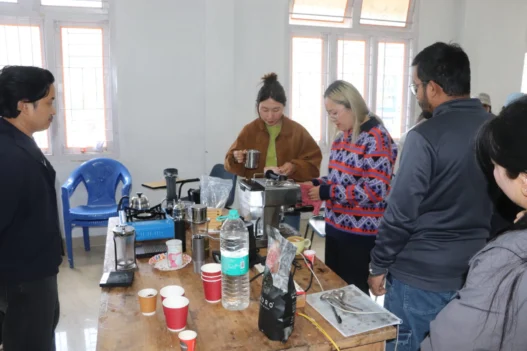
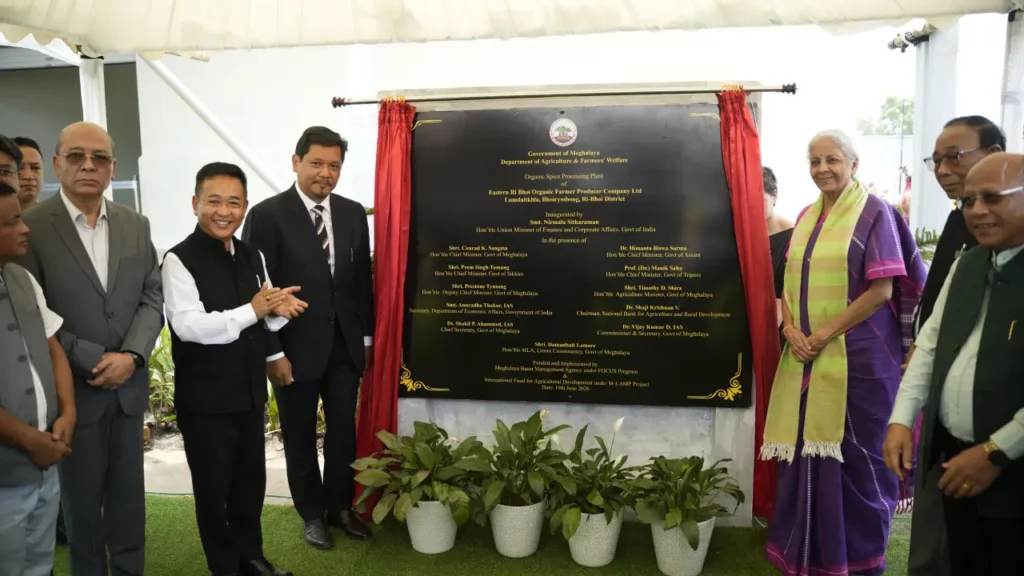
A major boost to Meghalaya’s organic farming sector came on Thursday with the launch of the Organic Spice Industrial Unit (PRIME-HUB) at Bhoirymbong, a ₹30-crore facility that is expected to strengthen farmer incomes, expand market access and position the state as a leading centre for value-added organic spice production in the Northeast.
The facility, the largest organic spice processing plant in the region, has been designed to process more than 10,000 metric tonnes of organic spices annually. It is expected to directly benefit 5,500 farmers across 112 villages by enabling them to move beyond cultivation into processing, packaging and marketing, thereby capturing greater value from their produce.
The project was inaugurated by Union Finance Minister Nirmala Sitharaman during her two-day visit to Meghalaya. Developed through a partnership between the Meghalaya Basin Management Agency, the Eastern Ri-Bhoi Organic Farmer Producer Company (FPC) and the International Fund for Agricultural Development (IFAD) under the Meghalaya Livelihoods and Access to Markets Project, the facility is aimed at creating a sustainable ecosystem for farmer-led enterprises and rural livelihoods.
For a state where agriculture remains the backbone of the rural economy, the project is expected to play a significant role in creating local employment, strengthening supply chains and enhancing the competitiveness of Meghalaya’s organic produce in national and international markets. The facility also comes at a time when demand for certified organic products is growing rapidly across the world.
Addressing the gathering, Sitharaman said the project demonstrated how targeted investments, institutional partnerships and convergence financing can deliver meaningful grassroots development. She noted that Ri-Bhoi’s transformation and the quality standards established by the Eastern Ri-Bhoi Farmer Producer Company had created a model that could serve as a benchmark for similar initiatives across the country.
The Union Finance Minister said Meghalaya’s organic spice economy commands a premium because of the trust associated with its natural farming practices, community-based production systems and ecological knowledge. Referring to projections that the global certified organic ginger market could approach USD 7 billion by 2030, she said Meghalaya is uniquely positioned to benefit from rising international demand.
“In this emerging premium economy, Meghalaya enjoys a natural advantage that many regions of the world are still trying to create,” she said, adding that the growth of Meghalaya’s farmers would contribute significantly to the broader vision of a developed India.
The inauguration ceremony was also attended by Sikkim Chief Minister Prem Singh Tamang, reflecting the growing importance of regional cooperation in promoting sustainable agriculture and agro-industrial development across the Northeast.
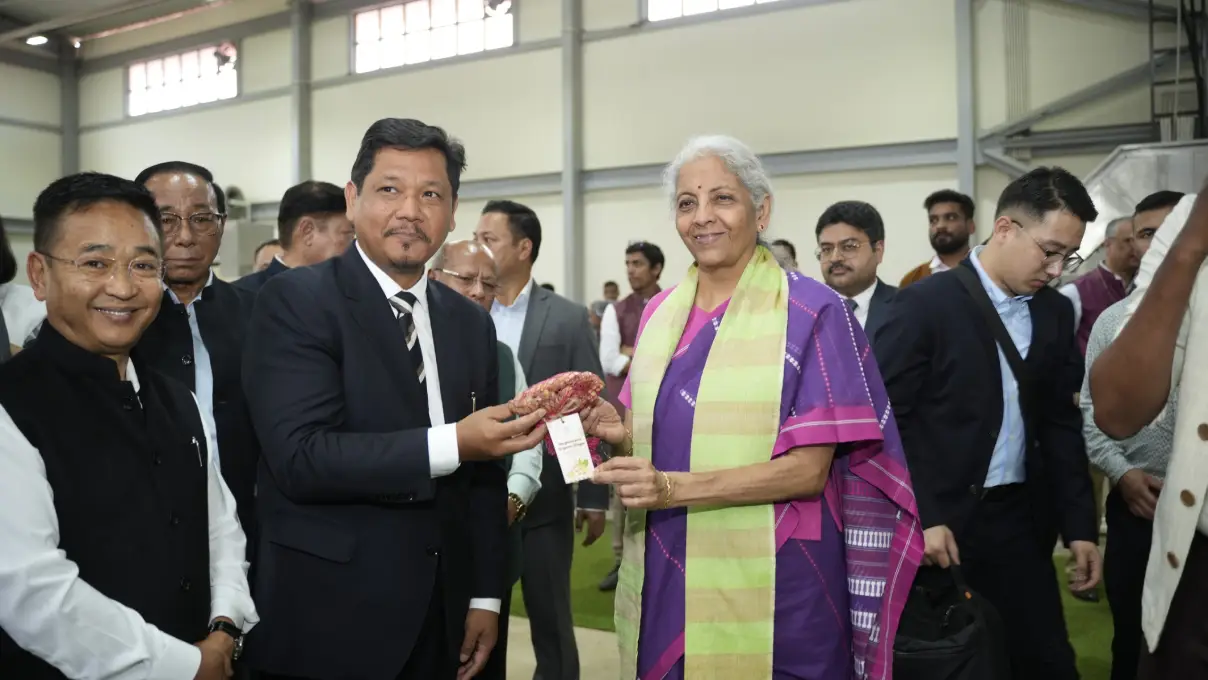
Meghalaya Chief Minister Conrad K. Sangma described the facility as a game-changing development for the state’s farming community. He said sustained efforts over the past several years to provide farmers with financial support, training, modern infrastructure and market access were now yielding tangible results, helping agricultural communities move up the value chain and improve their livelihoods.
The state currently has 11 such functional processing units. Together, these facilities support an estimated 55,000 people, with each unit benefiting roughly 5,000 individuals. The growing network reflects efforts to build a stronger agricultural ecosystem that allows farmers to participate more actively in value addition and enterprise development.
With more than 4.5 lakh farming households, Meghalaya’s agricultural sector remains one of the state’s largest sources of livelihood and employment. The new facility is expected to empower farming communities by enabling them to process and market finished products more effectively while creating opportunities for local employment and entrepreneurship.
Officials estimate that access to the new infrastructure could increase farmers’ incomes by as much as 50 percent while opening doors to wider domestic and international markets. The project’s community-centred public-private partnership model is also being viewed as a benchmark for cooperative-led and export-oriented agricultural growth.
During the event, memorandums of understanding were signed between private-sector partners and the Farmer Producer Company to support food-processing activities and market expansion. Representatives of the FPC also submitted a memorandum seeking support for an additional food-processing unit and the continuation of organic certification initiatives.
As farmers account for more than 70 percent of employment and livelihood engagement in Meghalaya, the PRIME-HUB facility is expected to play a key role in strengthening rural prosperity and ensuring that the benefits of the state’s growing organic agriculture sector reach communities across the region.