There appears to be a growing sense of urgency within Myanmar’s military establishment as it intensifies operations in sensitive border regions adjoining India. The latest offensives are unfolding in areas that have witnessed prolonged fighting between the military and resistance groups, and appear aimed at restoring full control over strategic territories that form part of the vital India-Myanmar trade corridor.
The most recent focus of the military campaign is Khampat town in Sagaing Region, where junta forces have been advancing following a series of battlefield gains in nearby areas.
The military recently carried out a decisive operation against the People’s Defence Force (PDF) in Yazagyo village, located close to the Indian border, and succeeded in retaking the settlement. Following the capture of Yazagyo, junta columns have continued moving northward towards Khampat, situated approximately 23 miles (37 km) away.
Khampat, located about 176 miles (283 km) northwest of Sagaing Region’s capital, Monywa, was seized by PDF forces operating under the command of the National Unity Government (NUG) in 2023. Since then, it has remained one of several strategically important resistance-held locations in the region.
The significance of the military’s recent gains extends well beyond Yazagyo itself. Control of the village provides the military with strategically advantageous positions from which it can project force towards neighbouring border towns, including Khampat.
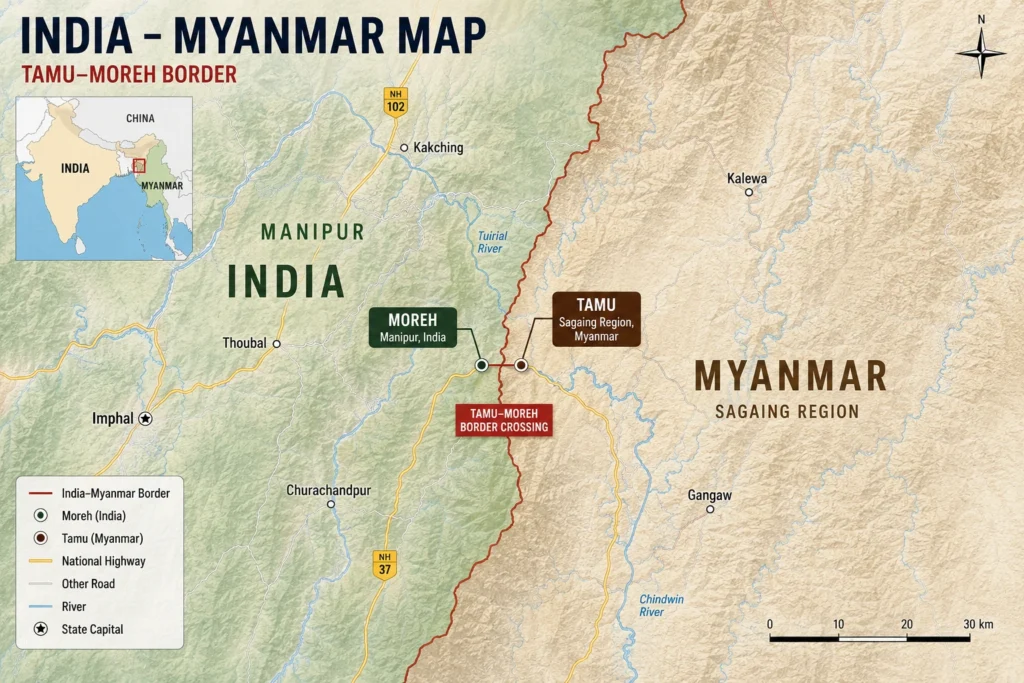
These areas lie only a few kilometres from the crucial Tamu-Moreh trade route linking Myanmar with India’s northeastern state of Manipur. For both Naypyitaw and New Delhi, this corridor carries importance that extends beyond commerce, touching upon border security, connectivity and regional influence.
Sources in Naypyitaw have confirmed that the military has prepared a broader strategy aimed at restoring control over the Kalay-Tamu corridor, which connects Myanmar’s interior to the Indian border town of Moreh in Manipur. The route occupies a central place in one of the most commercially and strategically significant corridors linking the two countries.
The renewed military push also comes against the backdrop of recent diplomatic engagement between Myanmar President Min Aung Hlaing and Indian Prime Minister Narendra Modi in New Delhi.
Border security featured prominently during discussions between the two leaders, a fact reflected in official statements issued by both sides following the meeting. The timing of the junta’s intensified operations has therefore drawn attention among observers tracking developments along the frontier.
India’s concerns have increasingly centred on cross-border insurgent activity, particularly the use of Myanmar territory by armed groups from Manipur. These include both valley-based insurgent groups (VBIGs) and Kuki armed organisations, which Indian security agencies believe have used the porous frontier to facilitate movement and launch attacks.
Alongside security concerns, Indian authorities remain wary of the flow of narcotics, arms and other contraband through poorly regulated sections of the border.
Recent reporting by The Borderlens has highlighted how instability across western Myanmar has increasingly become intertwined with New Delhi’s connectivity ambitions in the region. This is particularly evident in relation to two flagship infrastructure projects—the Kaladan Multi-Modal Transit Transport Project (KMTTP) and the India-Myanmar-Thailand Trilateral Highway (IMTT)—both of which depend on a stable security environment to function effectively.
Following the high-level meeting between Prime Minister Modi and President Min Aung Hlaing, India’s Foreign Secretary Vikram Misri confirmed that security concerns surrounding these strategic investments were discussed.
Upon his return to Myanmar, Min Aung Hlaing described his five-day visit to India as successful and indicated that his government would adopt a renewed approach towards securing the border with India.
Although he stopped short of detailing how the military would deal with armed groups operating along the frontier, he stated that “concerned parties” near the Myanmar-India border would need to cooperate with his government if they wished to see the country prosper.
Against this backdrop, the military’s capture of Yazagyo village and the strategically important Yazagyo Reservoir in Kalay Township on June 13 assumes greater significance.
Just two days later, on June 15, state media reported that efforts were being intensified to eliminate what it described as “insurgents” and reopen the Kalay-Tamu road route at the earliest possible opportunity.
The operation forms part of a wider military effort to restore control over the 81-mile (130-km) Kalay-Tamu road, a critical artery linking Sagaing Region with India’s border town of Moreh. Kalay itself lies approximately 144 miles (231 km) north of Monywa.
Military statements issued after the operation indicated that restoring full control over the road network remains a key strategic objective.
Control over territory along the India-Myanmar frontier remains particularly significant because of the fragmented authority that currently exists across large parts of Sagaing Region.
Moreh in Manipur sits directly opposite Tamu, a town that remains partially under the influence of resistance forces. The National Unity Government and allied resistance groups also administer several areas across Sagaing, including Khampat, Shwe Pyi Aye, Myothit and Pinlebu.
Viewed in this context, the military’s gains in Yazagyo and its ongoing push towards Khampat appear to form part of a broader campaign to re-establish authority over one of Myanmar’s most strategically important border corridors while simultaneously reassuring regional partners of its ability to secure key trade and connectivity routes.
The current offensive is also consistent with a broader pattern that has emerged across Sagaing Region this year.
Earlier military counteroffensives witnessed intense fighting with resistance forces and resulted in the recapture of Mawlu town on May 5 and Indaw town on April 30. Both towns occupy important positions within Sagaing and are viewed as key components in the military’s wider effort to consolidate territorial control.
Taken together, the recent operations suggest that the junta’s objectives extend beyond the recovery of individual towns. Rather, they point towards a concerted effort to reclaim strategic transport corridors, restore administrative authority in contested regions and strengthen control over the frontier areas that connect Myanmar to India.