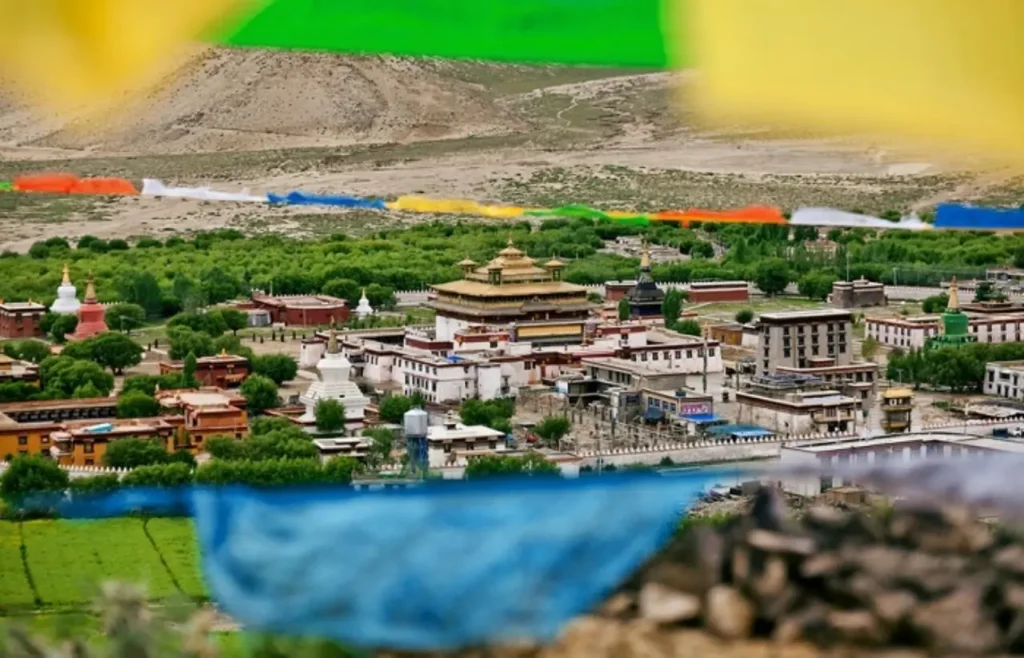
Long before any modern border cut across the Himalayas, India and Tibet were bound together by faith, scholarship, trade and shared sacred geography. At the centre of that bond sits Shannan Prefecture known in Tibetan as Lhoka (ལྷོ་ཁ, “southern district”) and in Chinese as Shannan (山南, “south of the mountains”) the prefecture level city in southeastern Tibet Autonomous Region widely regarded as the cradle of Tibetan civilization. It was here, on the banks of the Yarlung Tsangpo River, that Indian masters helped found Tibet’s first monastery it is through Lhoka’s southern valleys that a Dalai Lama once walked into Indian exile and it is along Lhoka’s edge that the modern, closely watched India China frontier now runs. Few single regions capture as much of the twelve century long relationship between India and Tibet as this one.
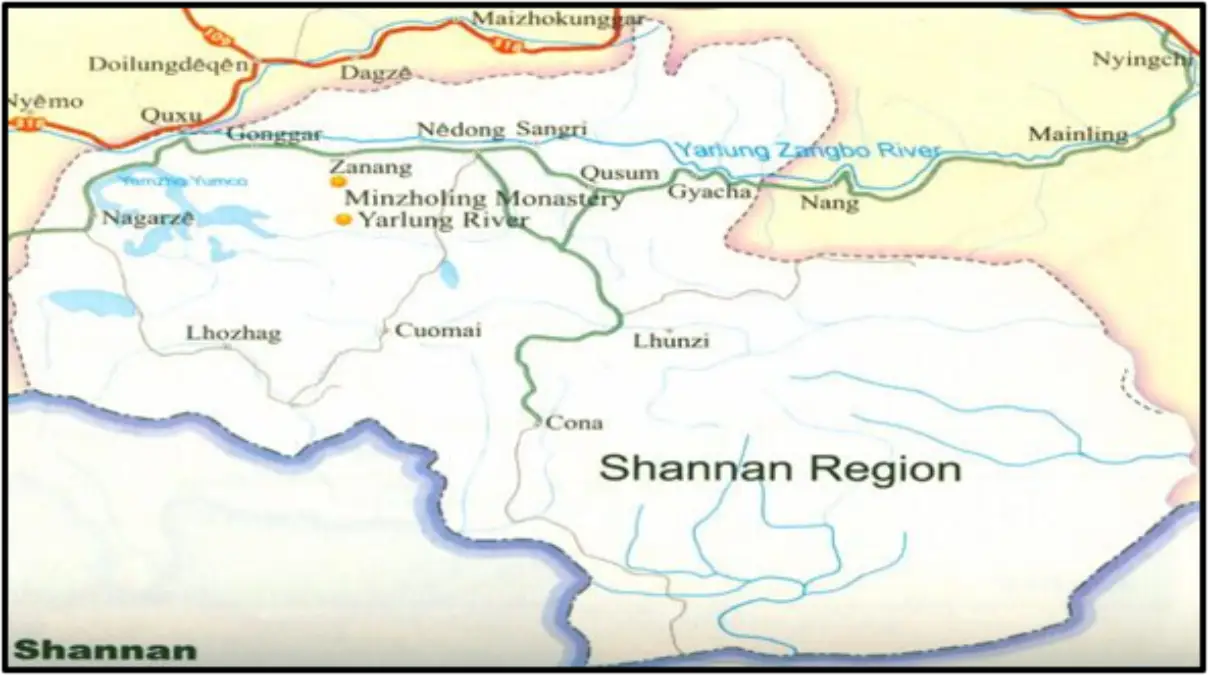
Shannan covers roughly 79,700 square kilometers and includes frontier counties such as Cona (Tsona) and Lhunze (Lhuntse), which sit directly along the international boundary. Just south, across Himalayan passes, lies India’s state of Arunachal Pradesh administered by India. This makes Shannan one of the most sensitive stretches of the roughly 3,500 kilometer Sino Indian frontier and also one of the most historically rich.
From the seventh century onward, Tibet’s rulers looked to India’s great monastic universities Nalanda, Vikramashila, Odantapuri, Somapura and Jagaddala as the wellspring of Buddhist learning. Tibetan monks travelled enormous distances to study in India, then carried home not just scripture but methods of philosophical debate, medicine, grammar and monastic administration. Among the most influential visitors moving the other way was the Bengali master Atisha Dipankara Shrijnana (982 1054 CE), who crossed into western Tibet in 1042 CE at the invitation of local rulers. Over more than a decade he revived monastic discipline and composed the Lamp for the Path to Enlightenment, inspiring the Kadam tradition that later fed into the Gelug school the lineage from which the Dalai Lamas themselves emerged.
Alongside individual teachers came an extraordinary translation movement; over several centuries, Indian scholars and Tibetan translators rendered thousands of Sanskrit manuscripts into Tibetan, producing the Kangyur and Tengyur together one of history’s largest translation enterprises. When Buddhist institutions later declined in India and countless Sanskrit originals were lost, many survived only because they had already been preserved in Tibetan translation. In this sense, Tibet became not just a recipient of Indian knowledge but one of its principal custodians.
This long exchange found its first lasting institutional home in Lhoka itself. In the eighth century, King Trisong Detsen invited two of India’s most distinguished Buddhist masters to help establish a monastery on the northern bank of the Yarlung Tsangpo, near present day Tsetang: Shantarakshita, abbot of Nalanda Mahavihara, who first introduced Buddhist philosophy to the Tibetan court and Padmasambhava (Guru Rinpoche), a tantric master traditionally linked to Oddiyana in the northwestern Indian subcontinent, invited after construction was repeatedly disrupted by setbacks attributed to local spirits.
Together they helped found Samye Monastery, completed around the 770s 780s CE Tibet’s first Buddhist monastery and the birthplace of its monastic culture. Architecturally it blended traditions: its central temple reflected Indian Buddhist cosmology, built with Tibetan techniques and Chinese decorative elements, while its philosophical curriculum stayed firmly rooted in the Indian Nalanda tradition.
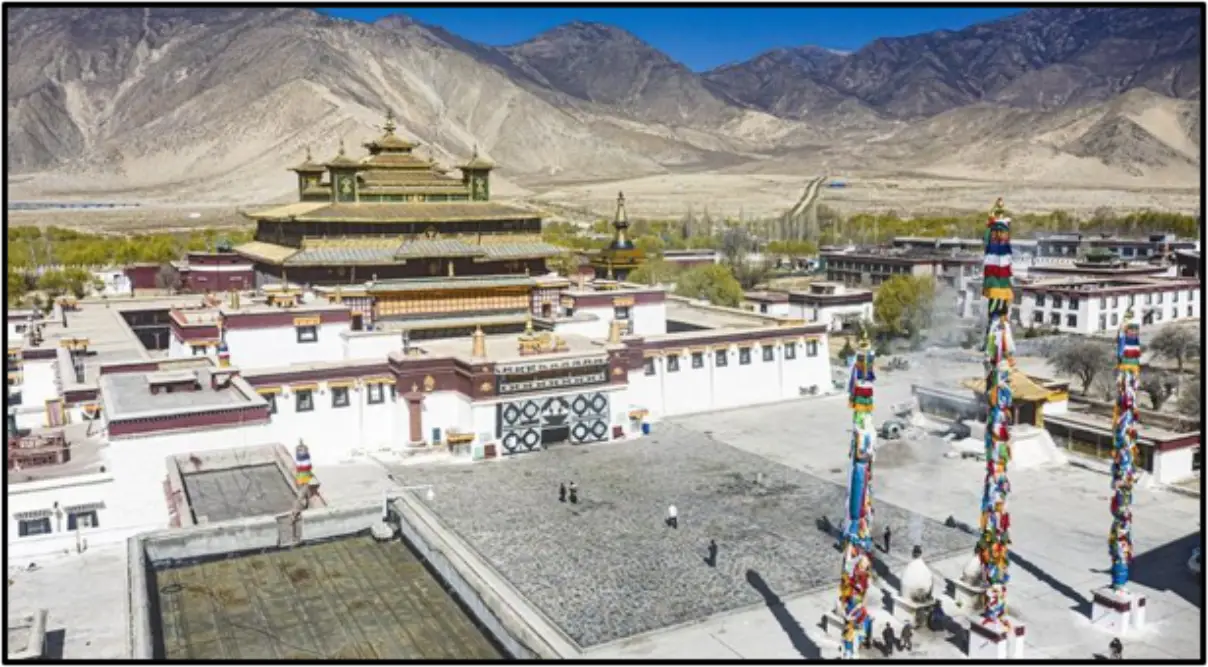
Samye also hosted one of Tibetan history’s pivotal moments, the Samye Debate of 792 CE, in which the Indian scholar Kamalashila, representing Nalanda’s gradual path to enlightenment, argued against the Chinese monk Moheyan’s doctrine of sudden enlightenment. According to Tibetan accounts, Kamalashila’s position prevailed and King Trisong Detsen formally aligned Tibetan Buddhism with the Indian scholastic tradition a decision that shaped Tibetan religious and intellectual life for centuries and ensured that generations of Tibetan monks would continue studying Indian philosophers such as Nagarjuna, Asanga, Vasubandhu, Dharmakirti and Atisha.
The India Tibet relationship was sustained by more than scholarship it rested on a shared sacred landscape. Foremost among these sites is Mount Kailash in western Tibet, revered by Hindus as the abode of Shiva and Parvati, by Buddhists as the earthly form of Mount Meru, by Jains as the site of the first Tirthankara’s liberation and by Bon practitioners as their spiritual axis. Nearby Lake Manasarovar has drawn Indian and Tibetan pilgrims alike for centuries on the arduous Kailash Manasarovar Yatra. In the other direction, Indian sites such as Bodh Gaya, Sarnath, Rajgir, Nalanda, Kushinagar and Lumbini formed a pilgrimage circuit that drew Tibetan monks and travellers south for over a millennium a devotional geography that treated the Himalayas not as a barrier but as a shared spiritual world.
Alongside pilgrims and monks came merchants. For over a thousand years, caravan routes through passes such as Jelep La and Nathu La (Sikkim), Lipulekh (Uttarakhand), Shipki La and Mana Pass (Himachal Pradesh) and Bum La near Tawang just south of Lhoka’s own Tsona and Lhuntse valleys carried cotton, spices, tea and sugar north and wool, salt, borax, musk and horses south. These caravans also carried news, religious texts and diplomatic messages and seasonal trade fairs turned remote settlements into vibrant meeting points between Indian and Tibetan communities.
Directly across the frontier from Lhoka’s Tsona County lie the Monpa communities of Tawang and West Kameng in Arunachal Pradesh, whose language, dress and Gelug tradition monasteries reflect centuries of exchange with southern Tibet. At the heart of this landscape stands Tawang Monastery, founded in 1681 under the patronage of the Fifth Dalai Lama India’s largest Buddhist monastery and the birthplace of the Sixth Dalai Lama, Tsangyang Gyatso. Monks moved constantly between Tawang and Lhasa for study, keeping alive a tradition that traced back to Nalanda. Neighbouring communities the Sherdukpen, the Bhutia of Sikkim, the Memba near the Siang River and the Khamba and Brokpa herders sustained similar seasonal, commercial and kinship ties across what only later became a hard international boundary.
Through the nineteenth and early twentieth centuries, British India maintained a Political Mission in Lhasa and trade agencies at Yatung, Gyantse and Gartok, following the 1903 04 Younghusband Expedition yet the older networks connecting India and Tibet remained largely intact. Tibetan traders, monks and officials routinely crossed into India without passports and Indian merchants and pilgrims moved into Tibet with similar freedom. Kalimpong in particular became a bustling hub of Indian, Tibetan, Bhutanese, Nepalese and European exchange and later a meeting place for the diplomats and scholars who would shape twentieth century Indo Tibetan relations.
The famous 1959 escape had a precedent. In 1910, as Qing forces under General Zhao Erfeng advanced on Lhasa to assert direct Chinese control, the Thirteenth Dalai Lama, Thubten Gyatso, fled south through the Chumbi Valley into British India, where he was received with courtesy in Darjeeling and Kalimpong British Tibet expert Sir Charles Bell assisted him during this period. He returned to Tibet in 1912 after the Qing collapse and pursued a program of modernising reforms but the episode had already established a precedent: that India was where Tibet’s spiritual leadership could find shelter in crisis, a memory that would matter again decades later.
Seeking a stable frontier framework, Britain convened the Simla Convention of 1913-1914, bringing together British India (represented by Sir Henry McMahon), Tibet (represented by Lonchen Shatra) and China. The conference produced the McMahon Line, a boundary following the crest of the eastern Himalayas that Britain and Tibet initialled but China declined to ratify, objecting to the proposed division of Tibet into “Outer” and “Inner” zones. India, as Britain’s successor state, has upheld the McMahon Line as its legal border. For decades after 1914, however, the line changed little on the ground: trade, pilgrimage and traditional crossings continued much as before.
India’s independence in 1947 initially changed little about the frontier’s character. But the 1949 founding of the People’s Republic of China, followed by the PLA’s 1950 victory at the Battle of Chamdo, ended Tibet’s de facto autonomy and transformed New Delhi’s calculations. The 1951 Seventeen Point Agreement formally incorporated Tibet into China while nominally promising autonomy. India, seeking peaceful coexistence, signed the 1954 Panchsheel Agreement, recognising Tibet as part of China and relinquishing Britain’s old privileges there a moment that also marked the symbolic close of the open frontier era, as the once free flowing caravan trade began to decline under new border controls.
By March 1959, unrest in eastern Tibet had spread to Lhasa itself. An invitation for the Dalai Lama to attend a performance at Chinese military headquarters with the unusual condition that he come without his armed escort triggered fears he would be detained. On 10 March, tens of thousands of Tibetans surrounded Norbulingka Palace to prevent his removal, beginning the 1959 Tibetan Uprising.
On the evening of 17 March, as shells reportedly landed near the palace, the 23 year old Dalai Lama slipped out in disguise with a small party of officials, monks and family members, beginning a journey south that would run directly through Lhoka. The party crossed the Yarlung Tsangpo by night and moved largely after dark to avoid detection, sheltered along the way by villagers and monasteries. On 26 March 1959, they reached Lhuntse Dzong in Shannan/Lhoka, where the Dalai Lama briefly re-established a temporary Tibetan government the last time it operated from Tibetan soil before exile and formally repudiated the Seventeen Point Agreement as coerced. From Lhuntse he sent an urgent appeal to Indian Prime Minister Jawaharlal Nehru, who agreed to grant asylum on humanitarian grounds.
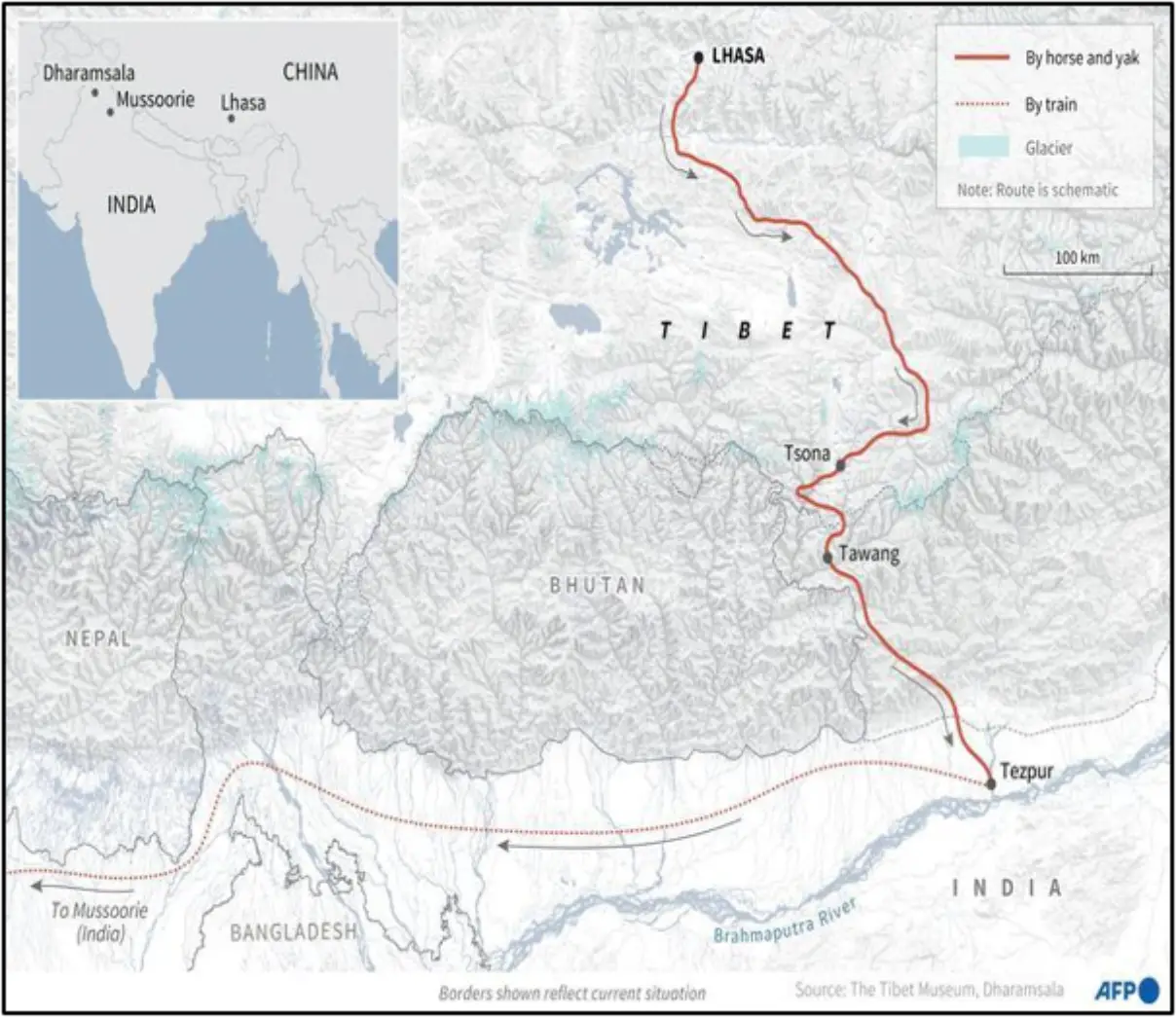
The party pressed on through the Karpo Pass and on 31 March 1959 crossed the McMahon Line into India near Chuthangmu, a small Assam Rifles post in what is now Arunachal Pradesh, where Indian officials led by P. N. Menon, former Consul General in Lhasa, were waiting to receive them. The exhausted travellers were escorted to Tawang, whose monastery had maintained ties with Lhasa for centuries, before continuing through Bomdila to Tezpur, Assam, where the Dalai Lama issued his first public statement since leaving Tibet. Thousands of other Tibetan refugees followed similar routes out of Lhoka and neighbouring regions into India over the following months.
Nehru’s grant of asylum is remembered as one of independent India’s defining humanitarian decisions. India went on to establish transit camps, schools and rehabilitation programs and Tibetan settlements gradually took shape in Himachal Pradesh, Karnataka, Uttarakhand, Arunachal Pradesh, Sikkim and elsewhere. After a brief stay in Mussoorie, the Dalai Lama was given a permanent residence in Dharamshala, Himachal Pradesh, which became the seat of the Tibetan government in exile in 1960 and is often called “Little Lhasa” today. Monasteries destroyed in Tibet Sera, Drepung, Ganden, Tashi Lhunpo and others were re-established on Indian soil and institutions such as the Library of Tibetan Works and Archives (founded 1970) preserved manuscripts and traditions for future scholarship.
Sino Indian relations, already strained, collapsed into the brief Sino Indian War of October November 1962, fought largely across this same Himalayan frontier, including areas adjoining Lhoka. Chinese forces occupied Tawang before withdrawing in January 1963. The war permanently hardened what had once been an open, lightly administered frontier into one of the most heavily militarised borders in Asia.
That duality deep cultural connection alongside unresolved territorial dispute still defines Shannan’s relationship with India today. China has developed “border defense villages” in Shannan’s frontier counties India has answered with its own Vibrant Villages Programme in Arunachal Pradesh, developing settlements such as Zemithang and Lumla along much the same routes the Dalai Lama once travelled. Beijing periodically issues Chinese names for locations in Arunachal Pradesh as part of its territorial claims, a practice India rejects. Yet the living heritage endures: Tawang Monastery remains one of the largest Tibetan Buddhist monasteries outside Tibet and pilgrimage traditions such as the Kailash Manasarovar Yatra continue to draw Indian pilgrims toward Tibet, even as political relations remain guarded. The Dalai Lama has long referred to himself as “the longest guest of the Government of India” a phrase that captures more than six decades of continued residence and cultural preservation on Indian soil.
The story of Shannan Prefecture and India is not simply a border story. It runs from Indian Nalanda masters helping found Tibet’s first monastery in the 8th century, through a millennium of shared pilgrimage and Himalayan trade, through two separate flights of Dalai Lamas in 1910 and again in 1959 along routes that passed directly through Lhoka’s valleys, to the fortified but still culturally resonant frontier of today. Political boundaries have shifted repeatedly across this landscape the deeper civilizational bond between India and Tibet, of which Shannan has so often been the doorway, has proven far more durable.