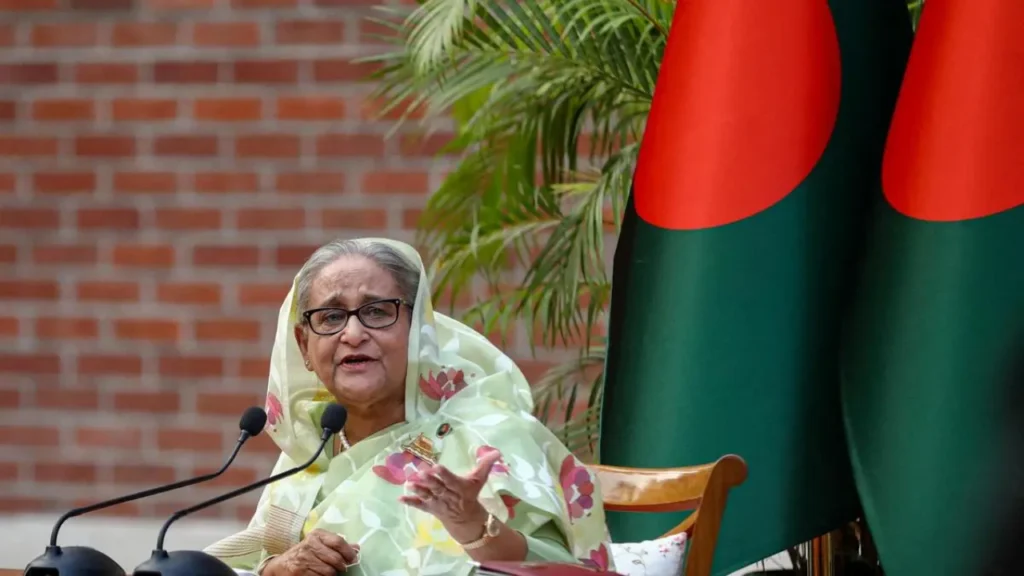
As proclaimed, ousted Bangladesh premier Sheikh Hasina is expected to return to Dhaka by December, but several challenges await the septuagenarian politician in the South Asian nation.
In several media interviews, the Awami League supremo has accused the current government in Dhaka of conducting mass raids, arrests and torture to terrorise ordinary citizens, alleging that extrajudicial killings and human rights violations have become the norm.
An Awami League statement even claimed that around 5,000 Bangladeshis are being arrested by government agencies every day. Recently, Hasina reportedly approached United Nations representatives, seeking urgent intervention to safeguard the political rights of Bangladeshi citizens.
A Muslim-majority nation of over 170 million people, Bangladesh frequently attracts international media attention for political unrest. Street demonstrations remain common in Dhaka and other cities.
Bordering India and Myanmar, Bangladesh has also drawn global attention for its use of capital punishment. The latest death sentence was handed down on 29 October 2026, when one of Hasina’s associates was sentenced to death for crimes against humanity committed during the July–August 2024 mass uprising.
Hasina, who was ousted following the same uprising two years ago and is currently taking unofficial shelter in India, faced a similar verdict in November 2025.
The International Crimes Tribunal (ICT), a domestic Bangladeshi tribunal despite its name, convicted Hasina and former home minister Asaduzzaman Khan Kamal over the crackdown on protesters.
According to a United Nations-backed investigation, as many as 1,400 people were killed and approximately 25,000 injured, including many young people, during the nationwide movement in 2024.
The Dhaka-based ICT recently sentenced Awami League joint general secretary Mahbubul Alam Hanif to death for crimes against humanity, including the killing of six protesters in the Kushtia area during the mass uprising.
The three-member tribunal, headed by Justice Nozrul Islam Chowdhury, also sentenced Sadar Uddin Khan, former Awami League district president; Azgar Ali, the party’s district general secretary; and Ataur Rahman Ata, another district-level Awami League leader, to life imprisonment.
All four convicts are currently absconding.
Hanif was accused of participating in government decisions to suppress the uprising by coordinating the use of lethal force. He was also accused of instructing the district police chief and party activists, through telephone conversations, to carry out the killings.
Earlier, death sentences were handed down to Awami League general secretary Obaidul Quader, along with Bahauddin Nasim, Mohammad Ali Arafat, Sheikh Fazle Shams Parash and Mainul Hossain Khan Nikhil.
Two Chhatra League leaders, Saddam Hossain and Sheikh Wali Asif Enan, were also convicted in the 15 September order for their alleged roles in orchestrating mass killings during the youth-led uprising.
The tribunal also ordered the seizure of 50 per cent of the personal properties belonging to Quader, Nasim, Arafat, Parash and Nikhil. The confiscated assets, cumulatively valued at Taka 500 million, are expected to be used to compensate families affected by the violence.
Significantly, all those sentenced to death were tried in absentia, as they remain fugitives. A section of the Bangladeshi population believes that some of them are secretly taking shelter in India.
Families of the victims welcomed the verdicts and urged the Tarique Rahman-led Bangladesh Nationalist Party (BNP) government in Dhaka to bring back the convicts to face their sentences.
The families continue to recall how the student-led anti-Hasina movement spread across the country and how, despite the government’s violent crackdown, the administration could not survive.
After ruling Bangladesh for 15 consecutive years, Hasina was overthrown and compelled to flee the country on 5 August 2024, seeking temporary shelter in New Delhi.
Following in the footsteps of the Professor Muhammad Yunus-led interim government, the current administration continues its efforts to bring Hasina back to Dhaka to face legal proceedings, despite New Delhi’s sustained reluctance.
Rahman, who became Bangladesh’s prime minister following the 13th parliamentary elections held on 12 February 2026, has repeatedly called for Hasina’s extradition under the 2013 extradition treaty between the two neighbouring countries.
Dhaka has pursued the matter through various diplomatic channels, insisting on Hasina’s repatriation. A few weeks ago, New Delhi stated that it was examining the request in accordance with relevant laws.
Meanwhile, Hasina, the daughter of Bangladesh’s founding leader, Bangabandhu Sheikh Mujibur Rahman, vowed to return to her country while addressing a live audio press briefing from New Delhi on 5 August.
She subsequently reiterated her intention to return voluntarily to Bangladesh in several public communications, attracting considerable international media attention.
The Rahman government, reportedly displeased with these developments, imposed restrictions on Bangladeshi media coverage highlighting Hasina’s statements.
A section of officials in the Dhaka administration maintained that Hasina would only return through formal repatriation, ruling out the possibility of her voluntary return.
They also asserted that once Hasina reaches Bangladesh, she would face execution, arguing that she had already lost the opportunity to appeal against the ICT verdict following the expiry of the 30-day deadline.
The authorities appear determined to secure Hasina’s return and ensure that she faces the legal consequences of the tribunal’s verdict.
The Hasina issue also appears to have complicated Rahman’s diplomatic engagement with India. His first official overseas visits were to Malaysia and China rather than New Delhi.
Rahman has yet to undertake an official visit to India, despite repeated invitations from New Delhi.
He also avoided attending the 18th BRICS outreach session in New Delhi on 12–13 September, despite Bangladesh being the current chair of the Bay of Bengal Initiative for Multi-Sectoral Technical and Economic Cooperation (BIMSTEC).
Hasina’s continued presence in India is widely perceived as a possible factor behind Rahman’s reluctance to visit New Delhi.