As Assam moves to reopen its plywood and sawmills under a regulated licensing system, a crucial question remains unanswered: will the new policy protect the state’s trees, or create fresh pressure on its already battered forests?
The Assam Wood Based Industries (Promotion and Development) Rules, 2022, approved by the state Cabinet on October 29, 2022, and formally notified in the Assam Gazette on January 12, 2023, provide the framework for reopening or setting up wood-based industries, including plywood and veneer mills.
The Rules classify wood-based industries into three categories — primary, secondary and composite. Plywood and veneer units fall under the primary category as they use round logs as raw material.
The policy lays down a licensing process, with applications accepted online through the state’s ease-of-doing-business portal or offline through the Principal Chief Conservator of Forests and Head of Forest Force in Guwahati. The prescribed licence fee for a veneer, plywood, hardboard, particle board or match manufacturing unit is Rs 2,000. The department is required to process a complete application within 60 days.
According to the government’s explanation, primary and composite wood-based industries must be located within industrial estates. The state has also proposed promoting fast-growing, high-yielding plantations outside forest areas to ensure a steady supply of raw material.
The government has described the policy as an attempt to revive Assam’s wood-based industry, attract investment and generate employment. The Cabinet had termed it a move to revive the “dead plywood industry”. The Environment and Forest Department, meanwhile, said the Rules would liberalise the functioning of wood-based units while making them environment-friendly.
The policy is also linked to the Assam Trees Outside Forest (Sustainable Management) Rules, 2022, which seek to encourage farmers to grow commercially valuable trees outside forest areas and ease permissions for felling them. The stated objective is to develop a source of industrial timber without putting further pressure on natural forests.
But the question is whether plantations outside forests can meet the industry’s demand for timber — and, more importantly, whether the licensing system will prevent fresh exploitation of natural forests.
The 2022 Rules were not merely a Cabinet announcement. They were formally notified through Assam Gazette Notification No. 20, eCF No. 237152, dated January 12, 2023. The Environment and Forest Department also lists them among its Acts and Rules.
The reopening policy, however, must operate within the limits set by the Supreme Court in the landmark T.N. Godavarman Thirumulpad vs Union of India case.
In its December 12, 1996 order, the Supreme Court held that plywood, veneer and sawmills were non-forest activities and could not operate inside forest areas without prior approval from the Central government under the Forest (Conservation) Act, 1980.
The order also imposed specific restrictions in Assam and the adjoining region. Sawmills, veneer mills and plywood units within 100 km of the Arunachal Pradesh border in the Tirap and Changlang context were directed to close. It further barred such units from operating within 8 km of the boundary of a demarcated forest area. Industrial estates for wood-based units were to be formally notified in consultation with the Union Environment Ministry.
In 2021, the Supreme Court allowed State Level Committees for Wood-Based Industries to decide applications for licences and permissions, including those involving new machinery, subject to its earlier directions and prescribed guidelines. Appeals against their decisions can be made to the Union Ministry of Environment, Forest and Climate Change.
Therefore, reopening a plywood mill is not automatically a violation of the Supreme Court’s order. But a unit must comply with the prescribed location restrictions, operate from a duly notified industrial estate wherever required, and obtain all necessary licences and approvals. Any unit operating in a prohibited zone or without the required clearances would risk violating the court’s directions.
The Supreme Court’s 1996 intervention dealt a severe blow to Assam’s plywood industry, which at the time accounted for a reported 60 per cent of India’s total plywood production. Upper Assam, once regarded as the country’s plywood hub, was particularly affected.
The order of December 12, 1996, sought to curb large-scale forest destruction across the Northeast. It stopped tree felling in natural forests without government-approved working plans, restricted the movement of timber from the seven Northeastern states, subject to specified exceptions for the Defence and Railways, and ordered the closure of sawmills, veneer mills and plywood units within the restricted belt along the Assam-Arunachal border.
Following the order, most plywood factories in Assam stopped production from December 24, 1996. More than 1,000 units were reportedly affected, including A.R. & T. Company in Margherita, once described as Asia’s largest plywood manufacturer. The shutdown also cost an estimated one lakh workers their jobs and dealt a heavy blow to the local economy.
The industry did not disappear from the country. Instead, its centres shifted to regions where manufacturers could source timber from plantations or imports. Poplar and eucalyptus-based units developed in Yamunanagar, Haryana; rubberwood-based industries grew in Perumbavoor, Kerala; and timber-import-dependent businesses emerged near Kandla port in Gujarat.
Environment activist and journalist Apurba Ballav Goswami of Golaghat said the absence of forest timber had fundamentally changed the geography of India’s plywood industry.
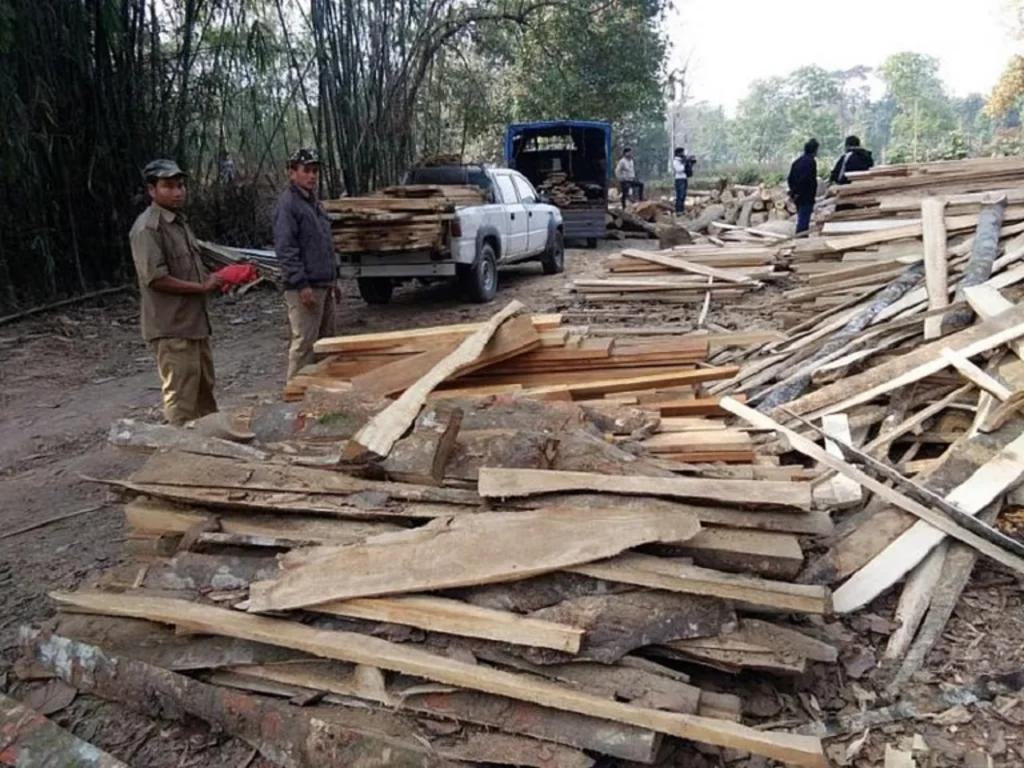
“At a time when global warming is affecting the climate, the Assam government is moving to reopen sawmills by issuing licences. At the same time, the government continues its crackdown on illegal sawmills. The Forest Department has been conducting raids in several places and seizing machinery and timber,” Goswami said.
He said agarwood and other timber-based units could be re-established only with government licences and within designated industrial estates.
“What impact the reopening of licensed sawmills will have on Assam’s forests will become clear in the days to come,” he added.
Despite the restrictions imposed in 1996, illegal tree felling and forest destruction have continued in different parts of Assam. Activists point to damage in the Dehing Patkai rainforest, often called the “Amazon of the East”, and the biodiversity-rich Patkai hills, where illegal coal mining has been a major concern.
The Dihing Patkai elephant reserve has also faced pressure from activities linked to oil exploration. In the Kaziranga-Karbi Anglong landscape, forest destruction associated with stone mining has raised concerns over habitat loss and elephants moving into human settlements.
Conservationists argue that the 1996 order had a positive impact on forest protection across the Northeast, but its restrictions have not stopped all forms of encroachment and degradation. They also say rivers, wetlands and other water bodies have not received the attention they deserve.
Activist Dilip Nath questioned the government’s move to reopen sawmills, arguing that Assam continued to face serious environmental challenges.
“Deforestation in Assam was massive compared with many other states. The state is now experiencing rising temperatures and increasing carbon emissions. At such a time, how can the government move to reopen sawmills? How can a Forest Minister announce such a decision without taking the Supreme Court’s directions into account?” Nath asked.
He also questioned the move in the context of funds received under the Compensatory Afforestation Fund Management and Planning Authority (CAMPA), which are meant to support compensatory afforestation and related activities.
“The government receives crores of rupees every year under CAMPA for plantation activities. How, then, can it permit sawmills to reopen?” he asked.
With Assam preparing to bring licensed wood-based industries back into operation, the real test will lie beyond the number of licences issued or factories revived. The government must demonstrate that the timber will come from sustainable plantations and lawful sources — not from the state’s remaining natural forests.
The question is no longer simply whether Assam can revive its plywood industry. It is whether the state can do so without sacrificing the trees it is supposed to protect.