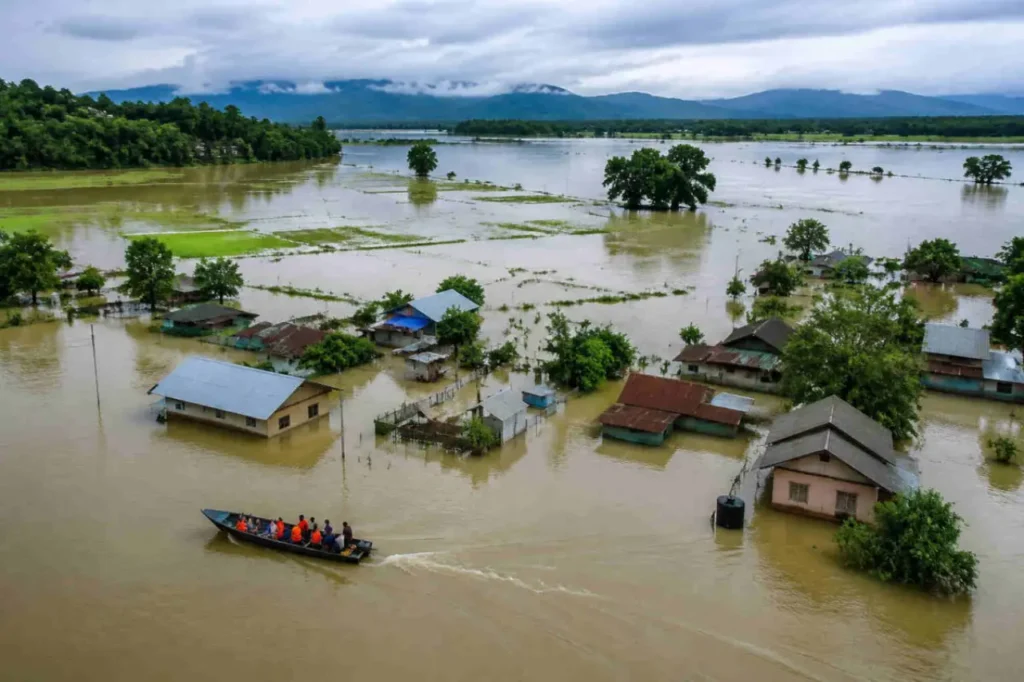
Eastern Assam witnessed one of its worst flood disasters in the last week of July 2026, leaving more than 70 people dead and affecting the lives and livelihoods of millions. While intense monsoon rainfall triggered the floods, experts and environmental observers argue that ecological degradation in neighbouring Nagaland significantly worsened the disaster downstream.
Large-scale hill cutting, deforestation, and legal as well as illegal coal, stone and sand mining have altered the hydrology of the Naga Hills over the years. Once covered with dense forests capable of absorbing rainfall, many hill slopes have been stripped of vegetation, reducing their ability to retain water. As a result, rainwater mixed with mud and debris flowed rapidly into the river systems of eastern Assam, intensifying flooding across the plains.
According to the Assam State Disaster Management Authority (ASDMA), Sivasagar was the worst-affected district, followed by Charaideo, Jorhat and Golaghat. Floodwaters also inundated Dibrugarh, Tinsukia, Hojai, Nagaon, Karbi Anglong, Biswanath, Dhemaji, Kamrup and Kamrup (Metropolitan).
More than seven lakh people across thousands of villages were affected. The floods damaged over 50,000 hectares of agricultural land, while lakhs of livestock and poultry were washed away. Hundreds of relief camps were established by district administrations to shelter displaced families.
Personnel from the State Disaster Response Force (SDRF), National Disaster Response Force (NDRF), the Army and the Air Force, assisted by local administration officials and volunteers, carried out round-the-clock rescue and relief operations. Assam Chief Minister Himanta Biswa Sarma deputed ministers Bimal Bora, Sushanta Borgohain, Pijush Hazarika, Keshab Mahanta and Ajanta Neog to oversee relief efforts in the affected districts.
Despite the large-scale response, thousands of families remained cut off for several days as floodwaters damaged embankments, roads and bridges. Many villages struggled to access drinking water, food supplies and healthcare services.
Nagaland and Assam experienced intense rainfall between 18 and 20 July. Water from the Naga districts of Mon, Mokokchung, Longleng and Wokha flowed downstream carrying heavy loads of silt and debris. Mon district alone recorded 137 mm of rainfall and reported nine deaths in landslides.
Several rivers originating in the Naga Hills swelled rapidly, inundating adjoining areas of Assam. The subsequent release of water from the NEEPCO-operated Doyang Hydroelectric Project further aggravated flooding in downstream regions.
Initial reports suggested that a cloudburst in Nagaland had triggered the floods. However, the India Meteorological Department (IMD) ruled out the possibility, explaining that a cloudburst requires at least 100 mm of rainfall within a single hour over a specific area. According to the IMD, rainfall during the period did not meet that criterion.
The Brahmaputra flowed above the danger level at several locations, while major tributaries including the Burhi Dihing, Disang, Dikhow, Dorika, Dhansiri and Bhogdoi contributed to the exceptionally high water levels.
President Droupadi Murmu expressed grief over the devastation and prayed for the safety of those affected as well as rescue personnel engaged in relief and rehabilitation. Prime Minister Narendra Modi spoke to Chief Minister Sarma and assured the Assam government of full support from the Centre.
Union Home Minister Amit Shah also reviewed the situation with the Chief Minister and informed him that an inter-ministerial central team would visit Assam to assess the extent of the damage. Assam Governor Lakshman Prasad Acharya and Union Minister Sarbananda Sonowal also expressed concern over the disaster and emphasised coordinated efforts between the Centre and the state government.
Amid the widespread devastation, hundreds of individuals and voluntary organisations joined government agencies in assisting affected communities. Volunteers from the Rashtriya Swayamsevak Sangh (RSS) and Sewa Bharati participated in rescue and relief operations across several of the worst-hit areas.
While the immediate priority remains rehabilitation and recovery, the disaster has also renewed concerns over unchecked environmental degradation in the Naga Hills and its growing consequences for downstream regions of Assam. Many observers argue that reducing future flood risks will require not only improved disaster preparedness but also stronger ecological safeguards in the fragile hill ecosystems that feed the state’s river network.