Strengthening regional connectivity is vital for bridging economic chasms, equitable distribution of resources, improving security, and meeting the larger goal of economic development. As a consequence, development of regional connectivity has emerged as a cornerstone for economic and strategic diplomacy. Focus on regional connectivity is being widely recognised for greater economic integration across markets, exploiting economies of scale and scope, as well as a platform to express soft power. Thus, physical infrastructure like roads, ports, and digital networks is widely being leveraged as an instrument for long-term economic growth, security, and regional stability. The ongoing Gelephu–Dalu corridor project embodies exactly these goals through enhanced regional connectivity.
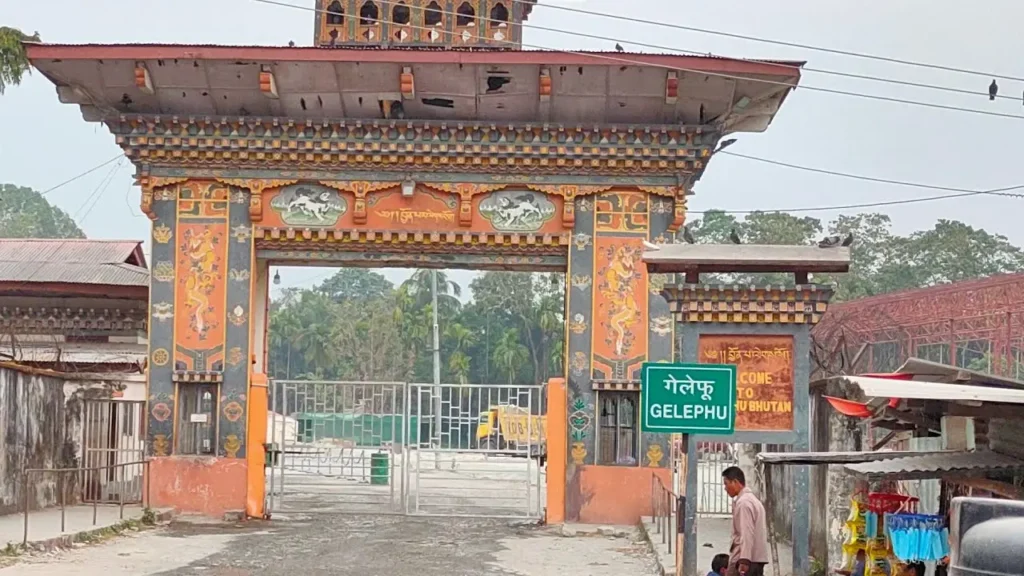
Conceptualised as a planned strategic sub-regional trade and transit route, Gelephu-Dalu is a multi-nation economic and transport route, connecting Bhutan, India, and Bangladesh. It is designed to link Bhutan’s Gelephu Mindfulness City through Indian territories of Assam and Meghalaya to markets and ports in Bangladesh. The infrastructural axis developed through the project links the landlocked South Asian nations to Southeast Asian markets and the Bay of Bengal.
Under the project, a 69 km cross-border Special Railway Project from Assam in India to Gelephu Mindfulness City in Southern Bhutan has been declared. Beginning in 2027, the railway project is fully financed by the Government of India. The overall project, comprising regional roadways, the Dhubri-Phulbari Bridge (connecting Assam and Meghalaya), and cross-border highway integrations, is also financially backed by the Official Development Assistance (ODA) of Japan.
The proposed corridor consisting of two routes connecting Assam and West Bengal to Gelephu and Samtse in Bhutan, respectively, is estimated to cost Rs 4,033 crore, which is a part of the Rs 10,000-crore development assistance commitment by India to Bhutan’s 13th Five-Year Plan (2024–2029).
The project is of strategic importance to all the stakeholders. To begin with, it addresses Bhutan’s structural constraint issue of being a landlocked nation. The project diversifies Bhutan’s heavily road-dependent logistics to a high-capacity, multi-modal connectivity framework including rail links. This is a step towards infrastructural integration as Bhutan gets connected to the vast Indian Railways’ broad-gauge network of 150,000 km, linking it directly to major industrial hubs such as Bongaigaon. The rail projects facilitate the physical foundation for the visionary Gelephu Mindfulness City (GMC), with the Kokrajhar–Gelephu link enabling high-capacity logistics for Bhutan’s goal of developing a global technology hub. The project stands to provide a large-scale transit capacity for the GMC. The 16-km rail connection to Samtse facilitates the efficient transport of crucial industrial minerals such as dolomite, ferro-silicon, quartzite and stone chips.
For India, integration of Bhutan with Assam and West Bengal helps in boosting local economies through better market accessibility and strengthened logistics networks in the northeast. The project is of special strategic and economic significance for India’s Northeastern region, being supported by a record Rs 11,486 crore budgetary allocation for regional rail expansion in 2026, integrating the Northeast with neighbouring economies through transnational borders. In this way, the Northeast turns into a gateway for commerce and connectivity in South Asia.
Strategically, the expansion of the railway network provides impetus to India’s Neighbour First policy, highlighting Bhutan’s vitality for India’s security. The network plays a crucial role in regional stability by providing space for executing humanitarian work during emergencies and defence operations.
The project also envisages regional integration through the BBIN (Bangladesh-Bhutan-India-Nepal) nexus and highlights India’s leadership in regional connectivity development.
For Bangladesh, the corridor implies enhanced trilateral commerce, with an expanded volume of goods between Bhutan, India, and Bangladesh. The corridor will also lower the logistics and transport costs for essential imports like Bhutanese stone chips, food grains, and coal for Bhutan. It also provides strategic linkages through improved cross-border transport networks, roads, and rail connectivity passing through Dalu (Meghalaya, India) toward the Bangladesh border.
At last, the India-Japan strategic partnership through the Gelephu-Dalu Corridor extends Japan’s interest in the region by advancing its Free and Open Indo-Pacific (FOIP) vision for stable trade paths. Besides, it balances regional powerplay of China via China’s Belt and Road Initiative, and open new trade links into South and Southeast Asia. By linking Northeast India with Bhutan and Bangladesh into a unified economic zone, it leads to the creation of a wider market, while developing synergies through India’s Neighbour First policy to foster smooth commercial transit, regional security and greater economic cooperation.